
Science with Passion

Application No.: VSP0014
Version 1 11/2017
Column choice based on Tanaka characterization – not all C18 columns are the same
Juliane Böttcher, Mareike Margraf, Kate Monks; applications@knauer.net
KNAUER Wissenschaftliche Geräte GmbH, Hegauer Weg 38,
14163 Berlin
Summary
Reversed Phase (RP) is with more than 90 % market share by far the most commonly used HPLC mode. The best known and most used surface modification is C18. Although the USP column code (L1) is the same for all C18 phases, there are a lot of differences which must be considered when choosing the right column. C18 always is a good choice for an initial try but one must bear in mind that not all C18 phases have the same separation characteristics. To differentiate between such phases Tanaka plots are extremely useful.
Introduction
The Tanaka test is an accepted standard method for the evaluation of performance and selectivity of a reversed phase HPLC column [1]. The Tanaka protocol is based on six variables (hydrophobic retention factor, hydrophobic selectivity, shape selectivity, hydrogen bonding capacity, total ion exchange capacity, acidic ion exchange capacity) reflecting different chromatographic properties. Here we focus on the hydrophobic retention, hydrophobic selectivity and shape selectivity of the following KNAUER C18 phases: Eurospher II C18 (ES II C18), Eurospher II C18 A (ES II C18 A), Eurospher II C18 H (ES II C18 H), Eurospher II C18 P (ES II C18 P), Eurospher I C18 (ES I C18), and Eurosil Bioselect C18 (EB C18). The hydrogen bonding capacity and ion exchange capacities are not considered here because they are nearly similar for the examined phases. The hydrophobic retention factor (HR) reflects the surface area and surface coverage (ligand density). Hydrophobic selectivity (HS) is a measure of the surface coverage of the phase as the selectivity between alkylbenzenes differentiated by one methylene group is dependent on the ligand density. Shape selectivity (SS) is a dimension which is influenced by the spacing of the ligands and probably also the shape/functionality of the silylating reagent [1].
Results
A hexagonal net diagram was used to display the measured Tanaka parameters as it enables good visual comparison of phases. For this type of diagra m measured values are multiplied by certain factors. The measured values without multipliers are shown in Tab A1 in the additional results section. Fig 1 to 3 show the Tanaka plots for the tested phases. The values for the ion exchange capacity and hydrogen bonding capacity are quite similar for all and were therefore not considered. The biggest difference between the tested phases could be seen when comparing the hydrophobic retention factor (HR) – the higher this value the less polar the modification. Sorting the phases with ascending hydrophobic retention leads to the following order: EB C18 > ES II C18 A > ES I C18 > ES II C18 > ES II C18 H > ES II C18 P. The value for shape selectivity of the Eurospher I phase is slightly deviating. This may be due to an incomplete endcapping.
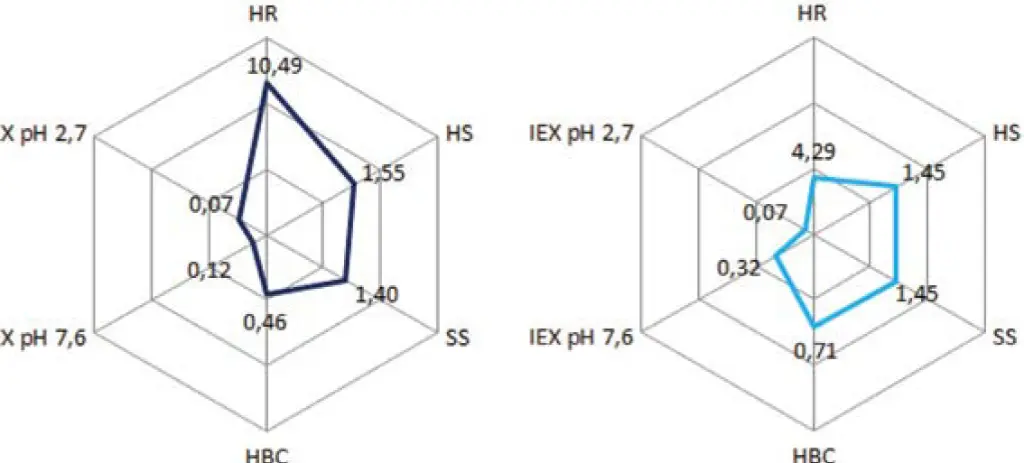
Fig. 1 Tanaka Plots of Eurospher II 100-5 C18 (left) and Eurospher 100-5 C18 A (right) T
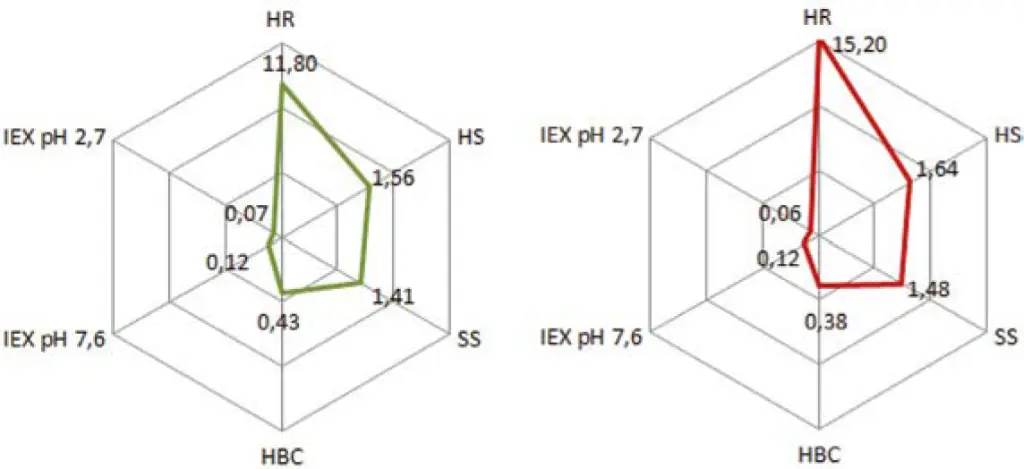
Fig. 2 Tanaka plots of Eurospher II 100-5 C18 H (left) and Eurospher II 100-5 C18 P (right)
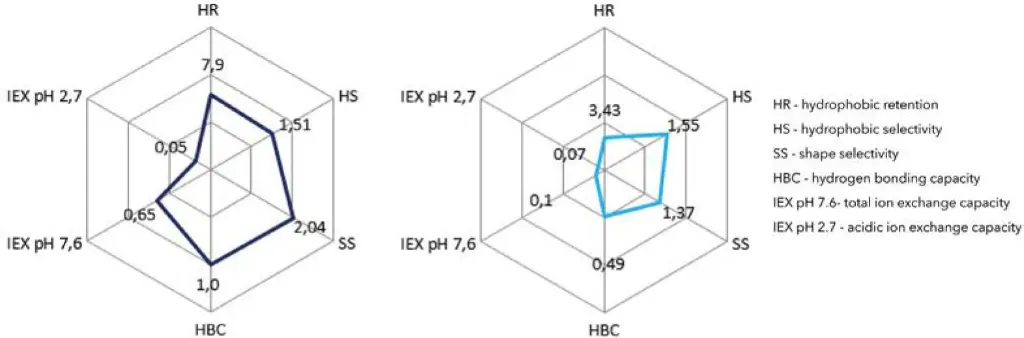
Fig. 3 anaka plots of Eurospher I 100-5 C18 (left) and Eurosil Bioselect 300-5 C18 (right)
Materials and Methods
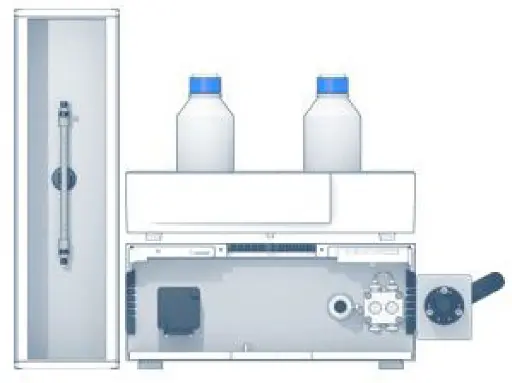
For the determination of the Tanaka parameters the KNAUER AZURA® Educational System was used. The method ran isocratically with a mobile phase composition of methanol:water 80:20 (v/v). The column thermostat AZURA® CT 2.1 was set to 30 °C and the UV detector was set to 254 nm. All used columns had a dimension of 150 x 4 mm ID and were filled with the following silica: Eurospher II 100-5 C18, Eurospher II 100-5 C18 A, Eurospher II 100-5 C18 H, Eurospher II 100 5 C18 P, Eurospher I 100-5 C18 and Eurosil Bioselect 300-5 C18. This method was used only for determination of HR, HS and SS. Detailed method parameters for HBC and IEX are attached in the additional materials and methods section (Tab A3 & A4).
Conclusion
The results obtained from the Tanaka test comparison can be used to assist in the choice of the most appropriate column for a given separation task. It is also important to know as much as possible about the chemical properties of the analyte. An analyte that is soluble only in a solvent with a high organic amount will have slightly or no retention on a C18 A phase. However, the C18 A phase can be operated with 100 % aqueous eluent without destroying the stationary phase. Inversely, a very polar analyte might have less retention on the C18 P or C18 H modification. However, due to their high carbon content they provide a high pH stability in an extended pH range. Furthermore, if the molecular weight of the analyte is above 2000 Da, a pore size of with 100 Å may be insufficient, making the so Eurosil Bioselect with a pore size of 300 Å the better choice. The KNAUER column portfolio offers classical and special C18 phases, making it easy to find the most appropriate column for a given application task.
Additional Results
Tab. A1 Measured Tanaka values without multipliers
Additional Materials and Methods
Tab. A2 Method parameters (HR, HS, SS)
Tab. A3 Method parameters (HBC)
Tab. A4 Method parameters (IEX)
Tab. A5 System configuration & data
References
[1] https://www.chromatographyonline.com/view/column-selection-reversed-phase-hplc
Application details