
Science with Passion

Application No.: VSP0013
Version 1 07/2017
Simplified scale up for sugars with the AZURA® RID 2.1L extended dynamic range option
Juliane Böttcher, Kate Monks; applications@knauer.net
KNAUER Wissenschaftliche Geräte GmbH, Hegauer Weg 38,
14163 Berlin
Summary
The extended dynamic range (EDR) option for the AZURA® RID 2.1L refractive index detector was investigated with a simple sample consisting of two common sugars. Calibration curves covering the range 700 µRIU to 2300 µRIU were generated with activated and deactivated EDR. A gain of about 65 % in dynamic range could be demonstrated over this range. Further benefits, such as simplified sample preparation, and improved fractionation possibilities are also discussed.
Introduction
The extended dynamic range (EDR) option of the AZURA RID 2.1L enables the linear dynamic range to be broadened in +100 % (-1000 μRIU offset) or -100 % (+1000 μRIU offset) [1]. This feature enhances the application of this detector for semi-preparative, preparative, and scale-up purposes. For instance, when carrying out overload studies, it is necessary to know how much sample and at which concentration can be injected on an analytical column. Often these measurements are out of the detector’s linear dynamic range. The EDR feature is very useful in this case because it enables the more exact calculation of the amount of sample that can be loaded on a column for purification without the need for additional sample preparation.
Results
To investigate the influence of the EDR option a simple method was chosen. A solution with a concentration of 40 mg/mL glucose and saccharose was injected with different volumes (10 µL, 20 µL, 30 µL, 40 µL, 50 µL, 100 µL, 200 µL) and measured with and without activated EDR. Fig 1 shows an overlay of an injection of 50 µL with and without extension. The blue trace is without extension, the red trace is detected using the +100 % option. When using the extension, a better resolution was gained as well as a higher and sharper signal was achieved. Now it was possible to measure up to 2.5 mRIU without difficulty. The advantage of the EDR option due to the linearity of calibration is visualized in Fig 2. It is shown that when using the extension, better values of linearity and correlation coefficient can be achieved over a wide range.
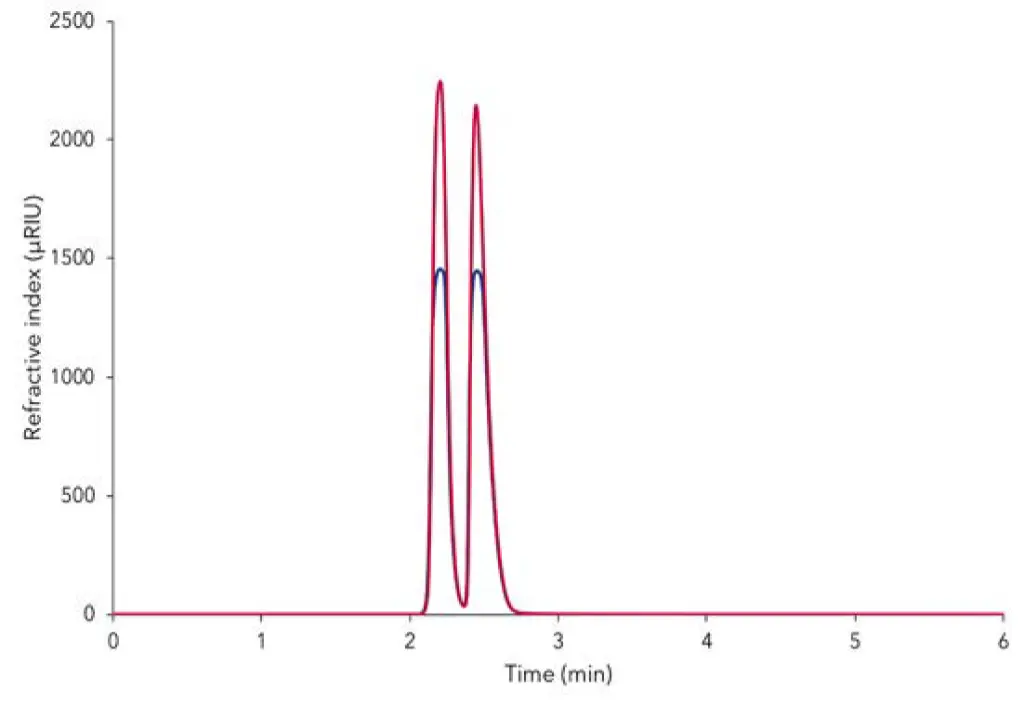
Fig.1 Overlay of an injection with 50 µL, blue=without extension, red=with extension (+100 %)
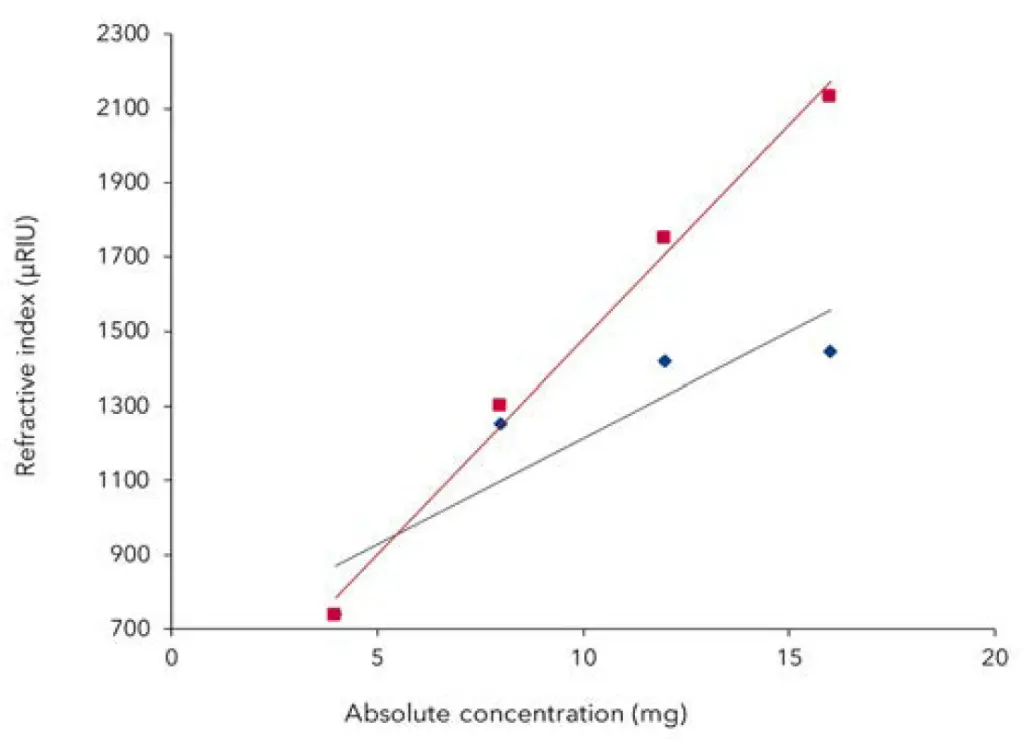
Fig.2 Linearity of glucose calibration with (red, R=0.9924) and without (blue, R=0.8087) EDR option
Materials and Method
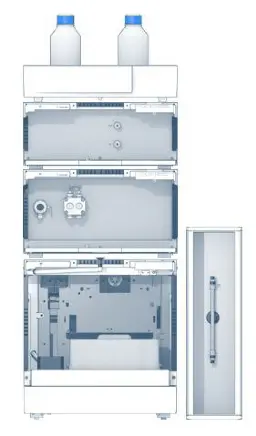
An AZURA® Analytical HPLC Plus system was used for this application. The system consisted of an isocratic AZURA P 6.1L pump, an AZURA AS 6.1L autosampler, an AZURA CT 2.1 column thermostat and an AZURA RID 2.1L refractive index detector. The used column was filled with Eurospher II 100 5 C18A silica. The isocratic method ran at a flow rate of 1.0 mL/min with a 100 % aqueous eluent for 6 minutes. The column thermostat was set to 25 °C and the data rate of the detector to 20 Hz. Different volumes (10 µL, 20 µL, 30 µL, 40 µL, 50 µL, 100 µL, 200 µL) of a solution containing 40 mg/mL of glucose and saccharose were injected.
Conclusion
The EDR feature was shown to prevent the need to dilute samples, which saves time and money and diminishes additional errors during sample preparation. Furthermore, due to an improved peak shape at high sample concentrations, software fractionation algorithms can work more efficiently. Therefore this feature facilitates a more efficient purification. Here, the EDR was used in positive mode (+100 %). For applications with inverted peaks, similar applicative benefits could be achieved by activating the negative mode EDR (-100 %). This was not carried out in this study.
Additional Materials and Methods
Tab. A1 Method parameters
Tab. A2 System configuration
Related KNAUER Applications
VFD0160 – Determination of sugars and natural sugar substitutes in different matrices
VFD0161 – Determination of sugars in honey using HILIC separation and RI detection
VFD0155 – Semi preparative xylitol purification with dedicated sugar purification system
VFD0150 – Alternative xylitol extraction via hplc purification from fermented biomass
References
[1] https://www.knauer.net/certificates
Application details