
Science with Passion

Application No.: VFD0172
Version 1 08/2019
A D E K - Easy separation of fat-soluble vitamins using GPC/SEC
Juliane Boettcher, Jan Wendrich, Kate Monks; applications@knauer.net
KNAUER Wissenschaftliche Geräte GmbH, Hegauer Weg 38, 14163 Berlin

Summary
Vitamins are essential micronutrients that are needed in small amounts for various roles throughout the human body. Vitamins are divided into two groups: water-soluble (B-complex vitamins and C vitamins) and fat-soluble vitamins (A, D, E, and K). The fat-soluble vitamins are stored in the body for long periods of time and generally pose a greater risk for toxicity when consumed in excess than water-soluble vitamins [1]. Here, an analytical HPLC method based on size exclusion chromatography is described.
Introduction
Fat-soluble vitamins are required for a wide variety of physiological functions. They are absorbed in the intestine in the presence of fat. Classical deficiencies of these vitamins can manifest clinically as night blindness (vitamin A), osteomalacia (vitamin D), increased oxidative cell stress (vitamin E), and haemorrhage (vitamin K) [2]. Since megadoses of vitamins A, D, E , or K can be toxic and may lead to health problems, it is necessary to provide quality control of dietary supplement products to guarantee the right indication of vitamin concentration. Therefore, a HPLC method for the analysis of fat-soluble vitamins was developed based on the separation principle of size exclusion.
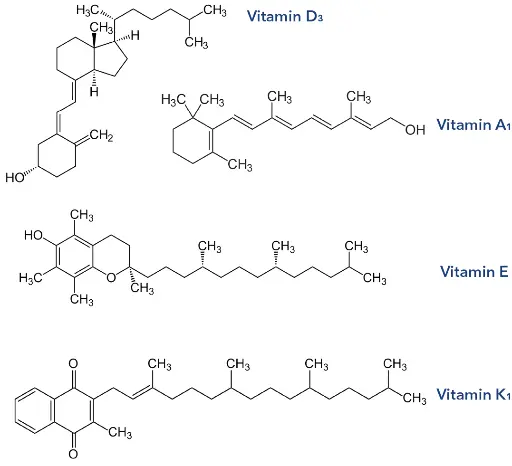
Structural formulas of typical fat-soluble vitamins
Results
A mixed standard of the fat-soluble vitamins was prepared and dissolved in tetrahydrofuran. For quantification, calibration curves for the four vitamins in ranges from 0.002 mg/mL to 0.1 mg/mL for vitamins A, D, K and from 0.0045 mg/mL to 0.18 mg/mL for vitamin E were determined. Fig. 1 shows the mixed vitamin standard at a concentration of 0.05 mg/mL (A, D, K) and 0.09 mg/mL (E). The calibration showed a good linearity and for all compounds R2 > 0.999 was achieved (Fig. 2). Tab. 1 summarizes the calculated LOD (S/N=3) and LOQ (S/N=10) values for the separation. Vitamin E showed the least sensitivity but nevertheless LOD and LOQ values reside in an approriate range e.g. the analysis of dietary supplement products, where high amounts of vitamins are expected.
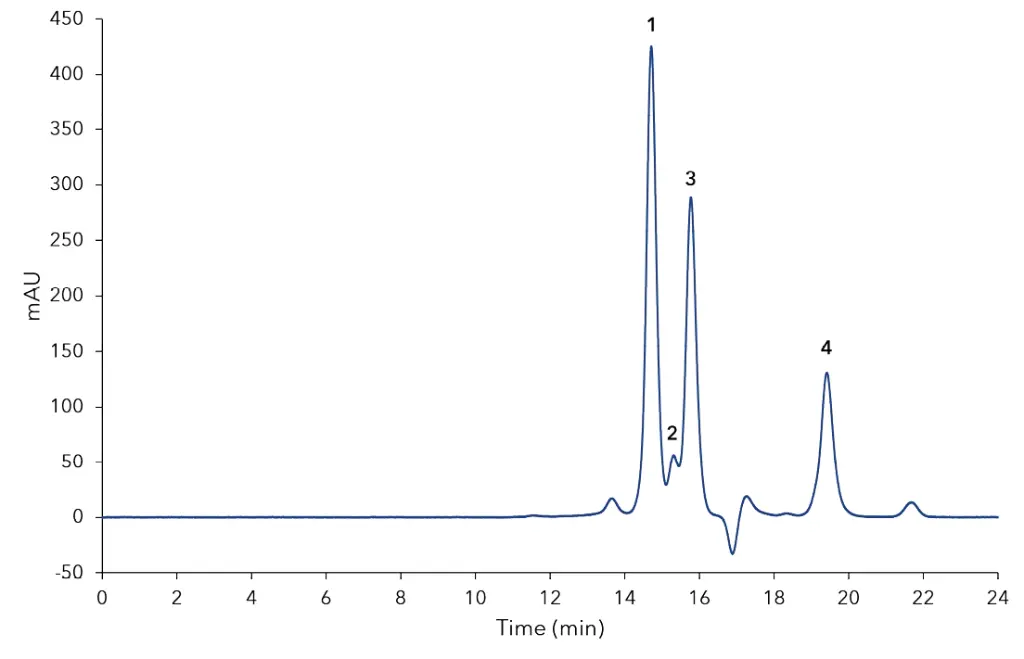
Fig. 1 Chromatogram of a mixed standard of fat-soluble vitamins at 0.05 mg/mL (A, D, K) and 0.09 mg/mL (E), 1) vitamin A palmitate, 2) vitamin E, 3) vitamin D3, 4) vitamin K
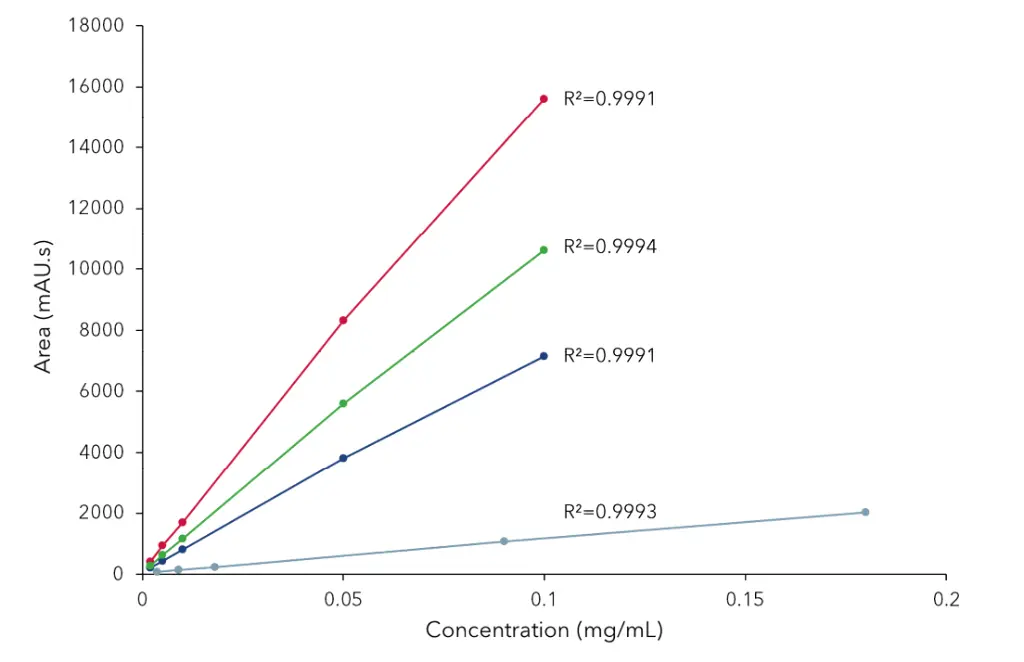
Fig. 2 Calibration curves for vitamin D3 (red), vitamin A (green), vitamin K (blue), and vitamin E (grey); corresponding linearity values are indicated
Tab. 1 Calculated LOD and LOQ values
Matrials and Methods
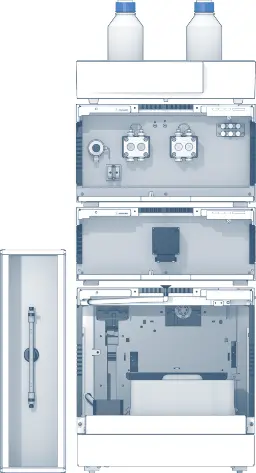
The used AZURA® analytical system was equipped with an AZURA P 6.1L pump suitable for normal phase applications. Furthermore a 2 channel GPC degasser was used. Aquisition was performed with an AZURA UVD 2.1L and an analytical flow cell. For injection, an AZURA autosampler AS 6.1L was used. The column thermostat CT 2.1 was part of the system. The isocratic method ran at a flow rate of 1 mL/min for 25 minutes. Stabilized tetrahydrofuran was used as eluent. The column temperature was set to 40 °C and vitamins were detected at 280 nm. A column tandem was used of two times AppliChrom ABOA StyDiViBe, with a pore size of 35 Å, covering a molecular weight range from 100 to 2500 Da in a dimension 300 x 8 mm ID.
Conclusion
The isocratic method based on size exclusion separation mechanism is an easy possibility for the determination of the four fat-soluble vitamins and a valuable addition to commonly used reversed phase gradient methods. Although, the peaks are not completely baseline separated it is possible to perform quantification. The method can be used for the quality control of dietary supplement products. To obtain a better resolution for vitamin E, the extension of the separation distance would be reasonable. This could be achieved by adding a third column with the same pore size.
Additional Materials and Methods
Tab. A1 Method parameters
Tab. A2 Pump parameters
Tab. A3 System configuration
Related KNAUER Applications
VFD0162 – Separation of ascorbic acid and vitamin B complexes - essentially required nutrients
References
[1] Fat-Soluble Vitamins: A, D, E, and K; Fact Sheet No. 9.315, Food and Nutrition Series/Health, http://extension.colostate.edu/topic-areas/nutrition-food-safety-health/fat-soluble-vitamins-a-d-e-and-k-9-315/
[2] Fat-Soluble Vitamins: Clinical Indications and Current Challenges for Chromatographic Measurement, Ali A. Albahrani and Ronda F. Greaves; https://www.ncbi.nlm.nih.gov/pmc/articles/PMC4810759/
Application details
|
Method |
HPLC |
|
Mode |
GPC/SEC |
|
Substances |
vitamin A palmitate, vitamin E, vitamin D3, vitamin K |
|
CAS number |
58543-16-1, 57817-89-7 |
|
Version |
Application No.: VFD0172 | Version 1 08/2019 | ©KNAUER Wissenschaftliche Geräte GmbH |