
Science with Passion

Application No.: VFD0162 Version 1 12/2017
Separation of ascorbic acid and vitamin B complexes – essentially required nutrients
Stefan Weiz, Juliane Böttcher, Kate Monks; applications@knauer.net
KNAUER Wissenschaftliche Geräte GmbH, Hegauer Weg 38, 14163 Berlin
Summary
Vitamins can be divided into fat-soluble and water-soluble vitamins. Water-soluble vitamins dissolve in water, which means these vitamins and nutrients dissolve quickly in the body. Examples for water soluble vitamins are vitamin C and the vitamin B complex: thiamin (B1), riboflavin (B2), niacin (B3), pantothenic acid (B5), vitamin B6, biotin (B7), folic acid (B9), cyanocobalamin (vitamin B12). In this work, eight water-soluble vitamins were separated and quantified in less than 10 min.
Introduction
Water-soluble vitamins are essential nutrients that an organism requires in limited amounts. All B-vitamins and C-vitamin are water-soluble vitamins. They are distributed in all watercontaining areas of the body, for example in blood or in cell interstices. Water-soluble vitamins are hardly stored in the body, only vitamin B12 can be stored in the liver. Therefore, a consistent intake is important, which can be achieved with one of the dietary supplement on the market. Vitamin B12 supplements are particularly important for individuals following a vegan diet. Qualitative and quantitative analysis of vitamins in dietary supplements is a challenging task since vitamins are relatively unstable and vitamins are a mix of neutral, acidic and basic compounds. In the consecutively described results the separation of the vitamin B-complexes such as ascorbic acid, nicotinic acid, thiamine, pyridoxine, nicotinamide, cyanocobalamin (synthetic form of vitamin B12) and riboflavin is described. The method includes a wavelength switching step at 5.5 min to get the highest sensitivity for cyanocobalamin.
Results
The absorption spectrum of cyanocobalamin shows a specific band at 360 nm, but at 220 nm the molar attenuation coefficient is higher (Fig 1). For the measurement of ascorbic acid and thiamine it is important, that the pH of the sample is set to a value of 3.0. It is recommended to use a 20 mmol potassium dihydrogenphosphate buffer adjusted to pH 3.0. In comparison, the eluent has a pH of 4.25. For ascorbic acid the limit of quantification (LOQ, S/N=10) is 66 µg/L, for nicotinic acid 107 µg/L, for thiamine 1406 µg/L, for pyridoxine 2183 µg/L, for nicotinamide 162 µg/L, cyanocobalamin 145 µg/L and for riboflavin 462 µg/L. Fig 2 shows the chromatogram of a mixed vitamin B standard. The folic acid was not stable under the applied test conditions.
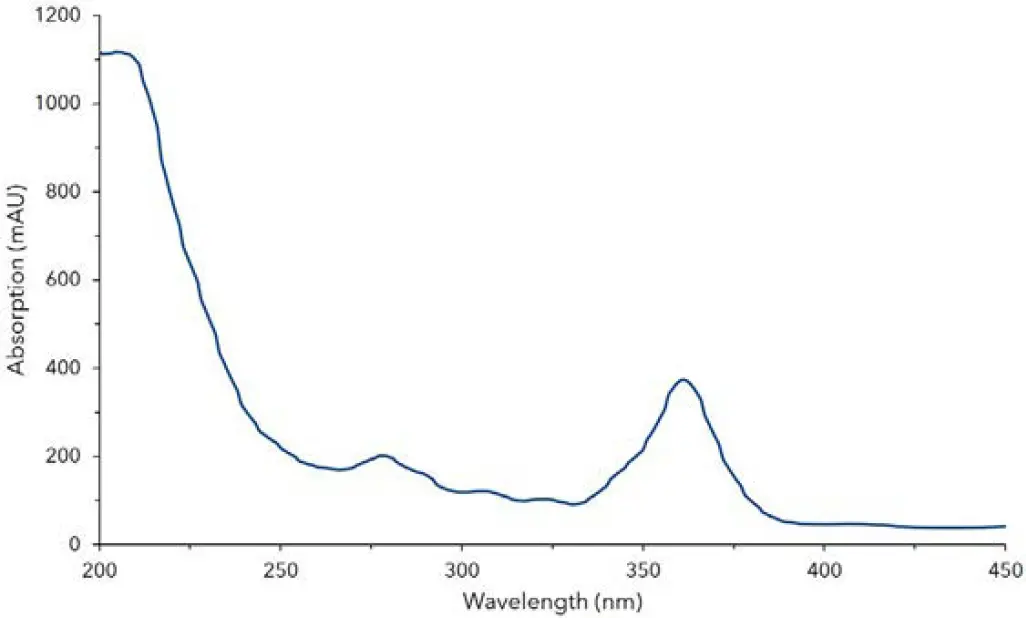
Fig. 1 Absorption spectrum of cyanocobalamin
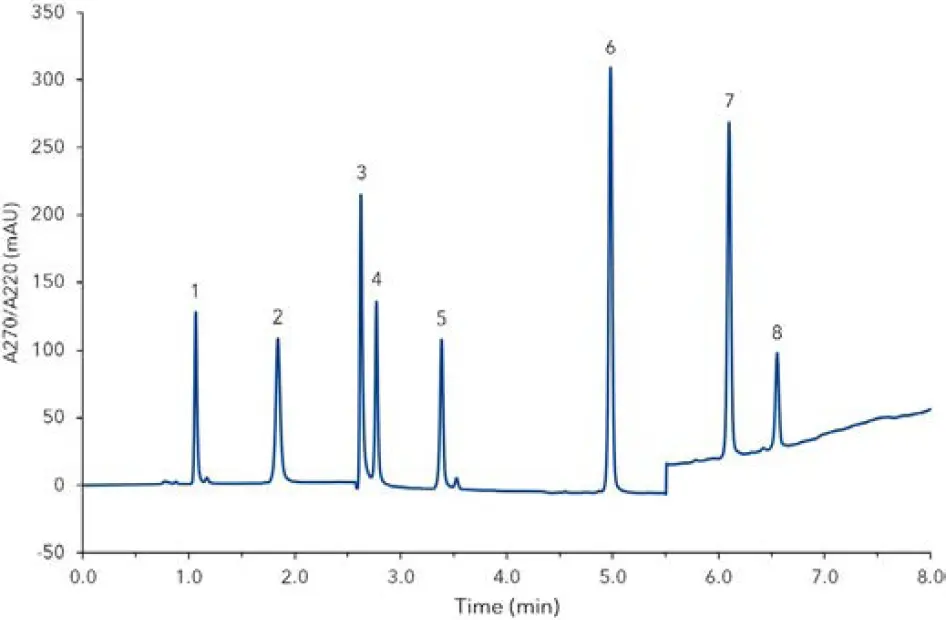
Fig. 2 Chromatogram of standard mix, 1) ascorbic acid, 2) nicotinic acid, 3) thiamine, 4) pyridoxine, 5) nicotinamide, 6) folic acid, 7) cyanocobalamin, 8) riboflavin
Materials and Methods
An AZURA® UHPLC system was used for this application. The system consisted of an AZURA P 6.1L LPG pump, an AZURA AS 6.1L autosampler, an AZURA DAD 6.1L with a High Sensitivity LightGuide flow cell and an AZURA CT 2.1 column thermostat. Analysis was performed using the OpenLAB EZChrom Edition chromatography software. The samples were diluted in 20 mmol potassium dihydrogenphosphate buffer pH 3.0 and filtered over 0.45 µm pore size syringe filter. 10 µL of each sample was injected onto a 150 x 3 mm ID column, filled with Eurospher II 1003 C18 A silica. The samples were separated at 30 °C at a flow rate of 1 mL/min with a linear gradient of 20 mmol potassium dihydrogenphosphate pH 4.25 adjusted with phosphoric acid (A) and acetonitrile (B) (0 – 30 % B in 8.5 min). At the beginning the detection wavelength was set to 270 nm and then switched to 220 nm at 5.5 min.
Conclusion
All components could be clearly be qualified and quantified. The wavelength switching increased the sensitivity of the method for the determination of cyanocobalamin (vitamin B12). This fast and sensitive method could be used for quality control of supplementary products.
Additional Materials and Methods
Tab. A1 Method parameters
Tab. A2 System configuration
Related KNAUER Applications
VFD0172 – A D E K - Separation of fat-soluble vitamins using GPC/SE
VFD0152 – Determination of Aflatoxin M1 in milk
VFD0158 – Zearalenone and its major metabolites – a simple isocratic method
VFD0159 – Alternaria alternata – determination of main metabolites
VFD0160 – Determination of sugars and natural sugar substitutes in different matrices
VFD0161 – Determination of sugars in honey using HILIC separation and RI detection
Application details