
Science with Passion

Application No.: VFD0161 Version 1 12/2017
Determination of sugars in honey using HILIC separation and RI detection
Hagen Schlicke, Kate Monks; applications@knauer.net
KNAUER Wissenschaftliche Geräte GmbH, Hegauer Weg 38, 14163 Berlin
Summary
Honey is one of the most popular natural foods and the consumption has grown in the last few decades. Hydrophilic-interaction chromatography was used for the separation of mono- and disaccharides to distinguish between honey and honey substitute products. The dedicated AZURA® Sugar Analytical System with autosampler upgrade is perfectly suitable for this application.
Introduction
There are well over 50 different kinds of honey on the market, which differ in consistency, color, and taste. In Germany, the honey ordinance differentiates honey according to the origin, type of extraction, the form of supply or the intended use. Natural bee honey consists of approx. 39 % fructose and approx. 34 % glucose. [1] For example, blossom honey (Blütenhonig) must contain at least 60 % fructose and glucose [2]. In addition, small amounts of sucrose or maltose can be detected [1]. Internationally, products containingmore than 5 % sucrose or maltose must no longer be labeled as „pure“ honey [3]. The Association of Official Analytical Chemist (AOAC) designed a method for the analysis of sucrose, fructose, and glucose in honey (AOAC 977.20). Based on this method, we used an Eurospher II NH2 column for hydrophilic-interaction chromatography (HILIC). Two different commercially available honeys and two substitutes were analyzed to illustrate the differences between these products.
Results
The carbohydrates fructose, glucose, sucrose, and maltose were separated in 12 min with an isocratic method (Fig 1). All sugars could be quantified in a range of mg per 100 g standard sample. Thereby the lowest concentration measured in the standard mix used for the calibration was 0.39 mg/mL (Fig A1). All four sugars followed a linear calibration fit and had R2 coefficients >0.999 (n=6, data not shown). The composition of the sugars in the examined samples differed greatly between the honey and the substitute products (Fig 2). The agave nectar had a much higher content of fructose whereas honey substitute had only 1.24 g fructose per 100 g sample. The content of maltose was greatly increased in the honey substitute compared to the honey and the agave nectar samples. The two honey samples each contained more fructose than glucose. The total sugar content of bee honey and blossom honey was around 77 % and 74 %, respectively. No detectable amounts of sucrose were found in bee honey and agave nectar which additionally contained no maltose (Tab. 1).
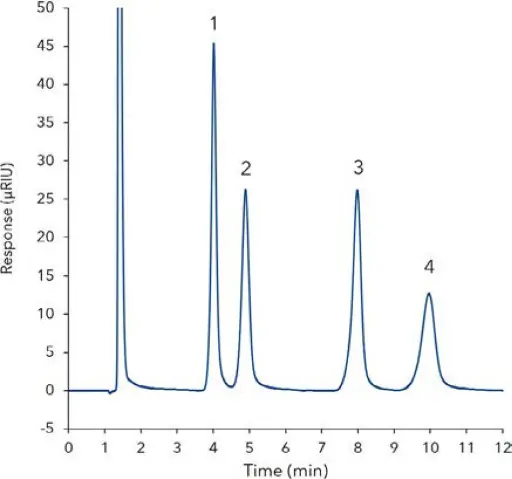
Fig. 1 Overlay of 12 replicates of the 12.5 mg/mL sugar standard containing 1) fructose, 2) glucose, 3) sucrose, 4) maltose
Tab. 1 Quantitative results of two honeys and two honey substitutes
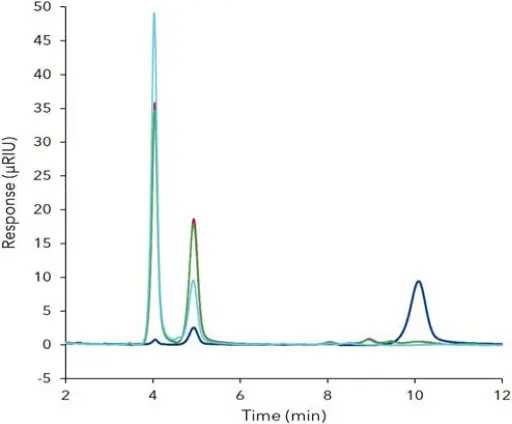
Fig. 2 Overlaid chromatograms of two honey and two honey substitute samples; blue – honey substitute, red – bee honey, green – blossom honey, light blue – agave nectar
Materials and Methods
The AZURA® dedicated system for sugar analytics with an additional autosampler was used for this application. The system consisted of an isocratic AZURA P 6.1L pump, an AZURA AS 6.1L autosampler, an AZURA CT 2.1 column thermostat, an AZURA RID 2.1L refractive index detector, and an Eurospher II 100-3 NH2 150 x 4 mm column with precolumn. The isocratic method run for 12 min at a flow rate of 1.2 mL/min with 80 % acetonitrile used as eluent. The column thermostat was set to 35 °C, the data rate of the detector was set to 20 Hz, and 5 μL of sample and standards were injected. The four standards were first dissolved in water 1:40 (w/v), then mixed 1:1:1:1 (v/v/v/v), filtered (0.45 µm) and finally diluted 1:1 (v/v) with acetonitrile to achieve a 12.5 mg/mL stock solution. The samples were dissolved in water 1:20 (w/v), filtered (0.45 µm), and diluted 1:1 (v/v) with acetonitrile before injection.
Conclusion
The honey samples contained more than 60 % fructose and glucose, as expected. The ratio of fructose and glucose was also typical of honey. The more glucose a honey has, the faster it tends to crystallize. The examined honey substitute and agave nectar showed a different kind of sugar pattern. The high maltose content indicates that honey substitute is not a natural product such as honey. Natural honey normally contains high concentrations of glucose and fructose and, in proportion, substantially less maltose. The data demonstrated the effective chromatographic separation of fructose, glucose, sucrose, and maltose using the AZURA dedicated system and an excellent linearity and retention time repeatability. In addition to the determination of sugars this application can also be used to differentiate between natural products such as honey and possible substitutes of the food industry.
Additional Results
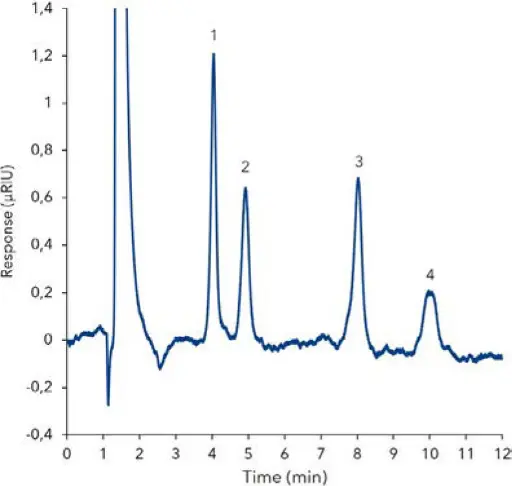
Fig. A1 Chromatogram of the 0.39 mg/mL sugar standard; 1) fructose, 2) glucose, 3) sucrose, 4) maltose
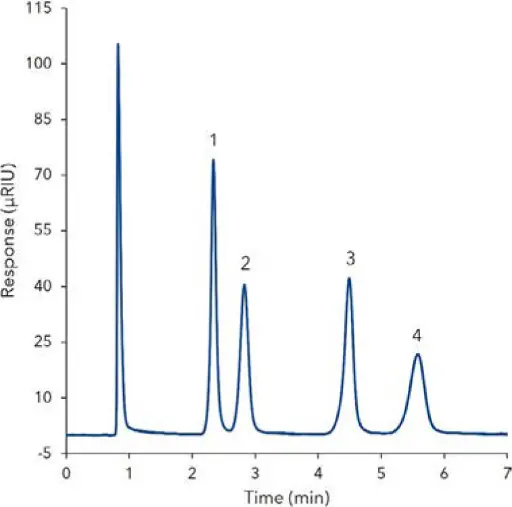
Fig. A2 Overlaid chromatograms of sugar standard. 1) fructose, 2) glucose, 3) sucrose, 4) maltose; Increasing the flow rate to 2 mL min reduces the run time to 7 min. The overlay of the 6 runs shows that the method still has a high reproducibility. However, it should be noted that the lifetime of the column is shortened under these conditions and a regular calibration is recommended
Additional Materials and Methods
Tab. A1 Method parameters
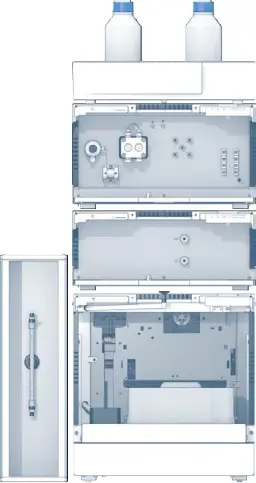
Tab. A2 System configuration & data
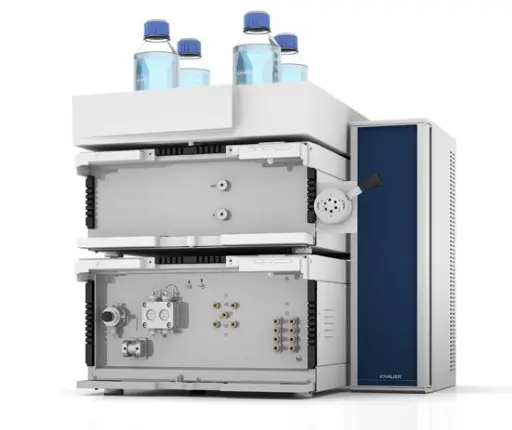
Dedicated AZURA® Sugar Analytical System
Related KNAUER Applications
VFD0160 – Determination of sugars and natural sugar substitutes in different matrices
VFD0155 – Semi preparative xylitol purification with dedicated sugar purification system
VFD0150 – Alternative xylitol extraction via hplc purification from fermented biomass
VSP0013 – Simplified scale up for sugars with the AZURA RID 2.1L extended dynamic range option
References
AID Zucker, Sirupe, Honig, Zuckeraustauschstoffe und Süßstoffe (Nr. 1157)
Honigverordnung vom 16. Januar 2004 (BGBI I S. 92)
Codex Alimentarius Commission, 2001; GB18796-2005, 2005
Application details