
Science with Passion

Application No.: VFD0146 Version 1 07/2016
Sensitive online SPE determination of bisphenol A in water samples
Juliane Böttcher, Kate Monks; applications@knauer.net
KNAUER Wissenschaftliche Geräte GmbH, Hegauer Weg 38, 14163 Berlin

Summary
In this application a method for the sensitive determination of bisphenol A (BPA) from water samples is presented. The use of online solid phase extraction (SPE) coupling avoids time consuming and manual sample preparation steps, making the method well-suited for routine analyses of BPA in low concentration samples like drinking water.
Introduction
Solid phase extraction is an effective preparation method for concentrating analytes prior to HPLC analysis. Classically, this method is done offline via time consuming steps. The advantages of online coupling result in a reduction of analysis time, sample contamination and analyte loss. This automated method is perfectly suited for pre-concentration of BPA in drinking water. The main source for BPA is the industrial production of polycarbonates and polyvinyl chloride (PVC) where it is a major constituent. It is also an important monomer in the production of polycarbonate. BPA is known for its endocrine effects similar to the hormone estrogen even at very low dosage and is associated with environmental and health problems. Based on previous studies a maximum entry <1 μg/mL in cold drinking water is expected. In warmed-up water (70 °C) a concentration up to 30 μg/mL is possible.
Results
After calibration by direct injection using an autosampler, the recovery rate is determined with the online SPE column in the flow path. Differing concentrations down to 0.07 ng/mL have been extracted from prepared water samples with constant extraction time. Fig 1 shows the chromatogram of three different concentrations with same online SPE extraction time. Fig 2 shows an original drinking water sample spiked with BPA. Afterwards the extraction time was varied using a solution with a constant concentration of 0.1 ng/mL. A recovery rate of 98 % for BPA was found.
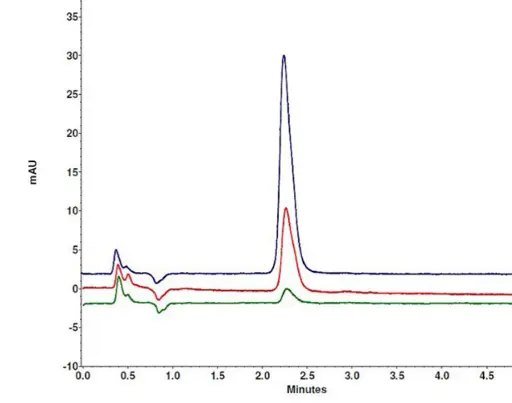
Fig.1 To determine the recovery rate of calibration points, two different methods are taken as a basis. First three differing concentration (c1=0.07 ng/mL, c2=0.4 ng/mL, c3=1 ng/mL) have been extracted with the same extraction time. In this part recovery rates of 93 % for bisphenol A were found (n=4 for each concentration).
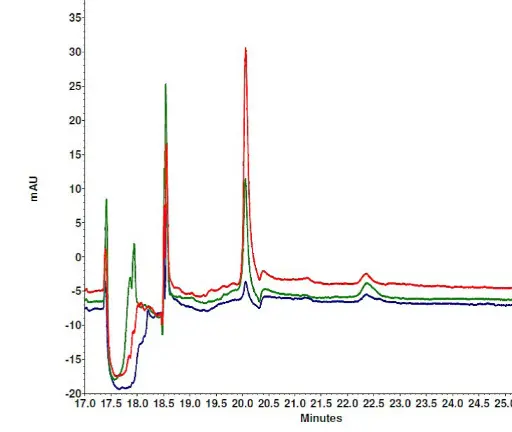
Fig.2 Chromatogram of three different concentrations with same online SPE extraction time.
Materials and Methods
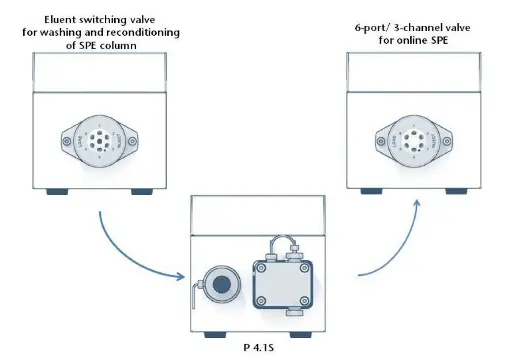
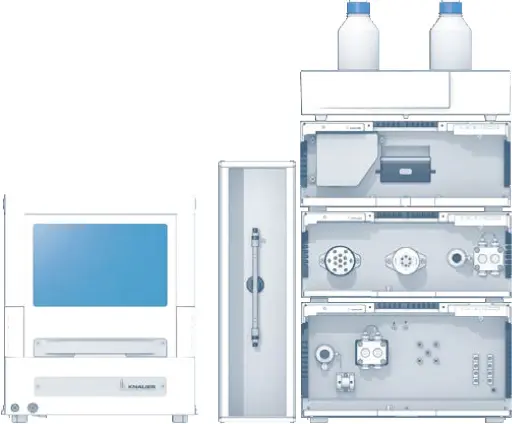
An AZURA® Analytical HPLC Plus system was used for this application. It consist of an AZURA P 6.1L LPG pump, an autosampler 3950, an AZURA CT 2.1 column thermostat, a AZURA MWD 2.1L multi wavelength detector and an assistant AZURA ASM 2.1L equipped with a 12 port multi position valve, a 6 port/2 position injection valve and a pump with 10 mL pump head. The analytical method runs isocratic at a flow rate of 0.6 mL/min with a mixture of acetonitrile and water 50:50 (v/v). The column thermostat was set to 30 °C and the detector recorded at 227 nm. The used columns are filled with KNAUER Eurospher II 100-3 C18A silica. The SPE method parameters are divided into different steps, including column conditioning, sample extraction, sample analysis, and reconditioning of of the SPE column.
Conclusion
The method presented in this application note is well suited for the analysis of bisphenol A in water samples like drinking water and allows varying the extraction time dependent on the expected bisphenol A concentration. For a higher and better evaluable peak signal the time the sample flushes over the extraction cartridge can simply be increased. With this sensitive method it is possible to successfully quantify even low concentrated samples and extracts and equipped with the AZURA ASM 2.1L the system can easily be used in continuous operation.
Additional Results
Tab. A1 SPE Parameters
Additional Materials and Methods
Tab. A2 Method parameters
Analytical
Tab. A3 System configuration & data
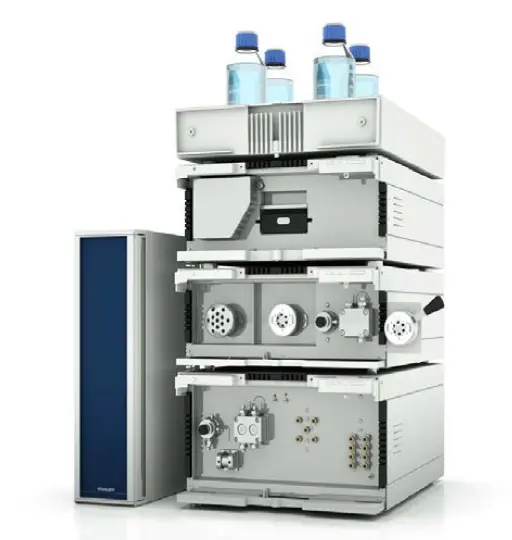
Dedicated AZURA® Online SPE System
References
Ligang Chen, Hui Wang, Qinglei Zeng, Yang Xu, Lei Sun, Haoyan Xu, Lan ding, “Online Coupling of Solid-Phase Extraction to Liquid Chromatography—A Review”, Journal of Chromatographic Science, Vol. 47, September 2009
Jordáková I., Dobiás J., Voldrich M., Poustka J. Determination of Bisphenol A, Bisphenol F, Bisphenol A diglycidyl Ether and Bisphenol F Diglycidyl Ether migrated from food cans using Gas Chromatography- Mass spectrometry. Czech J. Food Sci.2003 Vol. 21, No. 3: 85-90
Umweltbundesamt, Abteilung Umwelthygiene. Telegramm: Umwelt + Gesundheit. „Bisphenol A“ – Wir haben ein Problem. Ausgabe 04/2008
Umweltbundesamt, Pressestelle „Bisphenol A Massenchemikalie mit unerwünschten Nebenwirkungen“, aktualisierte Fassung Juli 2010, http://www.umweltbundesamt.de/uba-infomedien/mysql_ medien.php?anfrage=Kennummer&Suchwort=3782
Application details