
Science with Passion

Application No.: VCH0016
Version 1 02/2018
Determination and quantification of acrylic acid derivatives
Juliane Böttcher, Kate Monks; applications@knauer.net
KNAUER Wissenschaftliche Geräte GmbH, Hegauer Weg 38, 14163 Berlin

Summary
We are constantly exposed to acrylic monomers as part of our everyday lives. Diverse forms can be found at home, at work, on the street, or at the supermarket. End products based on acrylic monomers are utilized in many products from paints and lacquers to adhesives, water treatment products, and plastics to detergents, or textile fibers. In this application, four common acrylic acid derivatives were quantified with the AZURA® HPLC Plus system.
Introduction
Acrylate monomers used to form acrylate polymers are based on the structure of acrylic acid or are derivatives of it. Acrylic acid and some acrylate oligomers and monomers can affect human health as eye and skin irritants. Residual monomers might be exposed to consumers and that is why the content of residual monomers in acrylic polymers needs to be examined. Methyl methacrylate, 2-hydroxyethyl methacrylate, ethylhexyl acrylate, and isobornyl acrylate are examples of acrylic acid derivatives and were determined in this application.
Results
A mixed standard of the four acrylate monomers was used to determine a calibration with the following concentrations for each compound: 0.001 mg/mL, 0.002 mg/mL, 0.004 mg/mL, 0.01 mg/mL, and 0.02 mg/mL. The four detected peaks are baseline separated. Fig 1 shows the chromatogram of the acrylate mix standard at a concentration of 0.01 mg/mL. For all compounds the limit of detection (LOD, S/N=3) and the limit of quantification (LOQ, S/N=10) were calculated based on the measurement of the lowest calibration concentration. Tab 1 displays a summary of the determined quantification results.
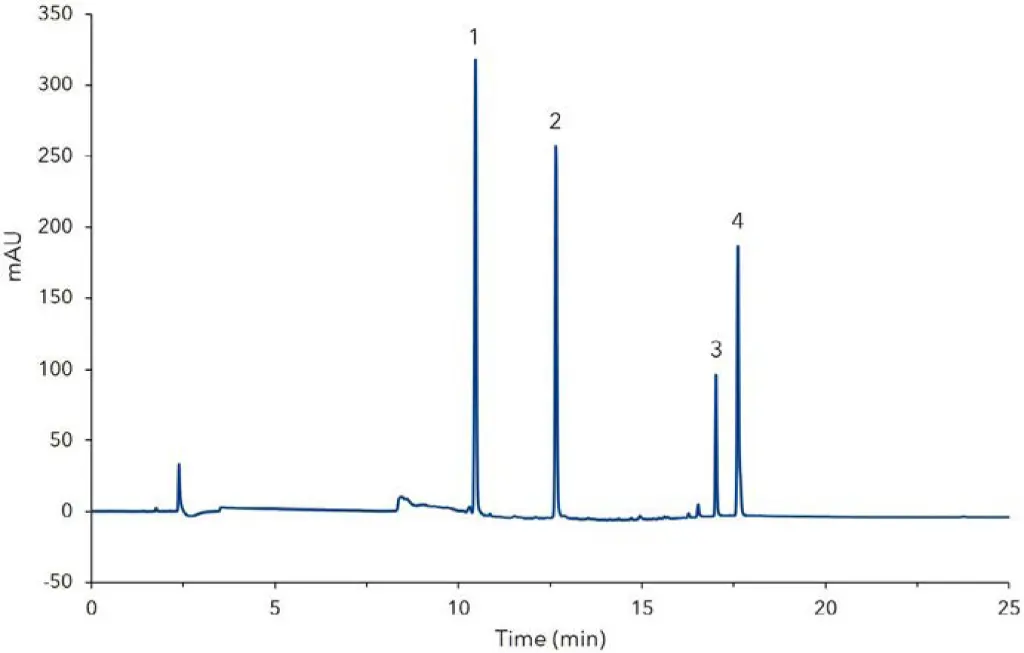
Fig. 1 Measurement of standard mix (0.01 mg/mL); 1) 2-Hydroxyethyl methacrylate, 2) Methyl methacrylate, 3) Ethylhexyl acrylate, 4) Isobornyl acrylate
Tab. 1 LOD and LOQ of acrylic monomers
|
Substance |
LOD (µg/mL) |
LOQ (µg/mL) |
|---|---|---|
|
2-Hydroxyethyl methacrylate |
0.022 |
0.07 |
|
Methyl methacrylate |
0.032 |
0.11 |
|
Ethylhexyl acrylate |
0.075 |
0.25 |
|
Isobornyl acrylate |
0.042 |
0.14 |
|
Substance |
LOD (µg/mL) |
LOQ (µg/mL) |
|---|---|---|
|
2-Hydroxyethyl methacrylate |
0.022 |
0.07 |
|
Methyl methacrylate |
0.032 |
0.11 |
|
Ethylhexyl acrylate |
0.075 |
0.25 |
|
Isobornyl acrylate |
0.042 |
0.14 |
Materials and Methods
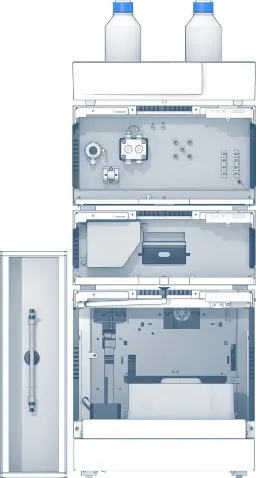
All standards were provided by the Fraunhofer-Institut für Fertigungstechnik und Angewandte Materialforschung IFAM [2]. For this application an AZURA analytical system was used which consisted of an AZURA P 6.1L quaternary LPG pump, an AZURA DAD 6.1L diode array detector, an AZURA CT 2.1 column thermostat and an AZURA AS 6.1L autosampler. The flow was set to 1 mL/min at a column temperature of 40 °C. The detection wavelength was set to 210 nm. The sampling rate was set to 1 Hz and the time constant to 0.2 s. 10 µl of the standards were injected. The column with the dimensions 150 x 4.6 mm ID with precolumn was filled with Eurospher II 100-3 C18 silica.
Conclusion
The developed gradient consisted of two different elution steps. The first gradient step from water to acetonitrile separates the acrylic monomers. In the second step from acetonitrile to tetrahydrofuran, polyacrylates potentially present in the polyacrylate matrix can be eluted/washed from the column. These two steps are useful when both polar and non-polar acrylates are to be separated. Furthermore, this simplifies the sample preparation which in the end leads to a reduced analysis time.
Additional Materials and Methods
Tab. A1 Method parameters
|
Eluent A |
Water + 0.1 % phosphoric acid |
|||
|---|---|---|---|---|
|
Eluent B |
Acetonitrile |
|||
|
Eluent C |
Tetrahydrofuran |
|||
|
Gradient |
Time (min) |
% A |
% B |
% C |
|
0 |
100 |
0 |
0 |
|
|
5 |
100 |
0 |
0 |
|
|
15 |
0 |
100 |
0 |
|
|
25 |
0 |
100 |
0 |
|
|
28 |
0 |
0 |
100 |
|
|
38 |
0 |
0 |
100 |
|
|
41 |
0 |
100 |
0 |
|
|
51 |
0 |
100 |
0 |
|
|
51.1 |
100 |
0 |
0 |
|
|
60 |
100 |
0 |
0 |
|
|
Flow rate |
1 mL/min |
Run time |
60 min |
|
|
Column temperature |
40 °C |
Injection mode |
Partial loop |
|
|
Injection volume |
10 µL |
Data rate |
1 Hz |
|
|
Detection wavelength |
210 nm |
Time constant |
0.2 s |
|
|
Eluent A |
Water + 0.1 % phosphoric acid |
|||
|---|---|---|---|---|
|
Eluent B |
Acetonitrile |
|||
|
Eluent C |
Tetrahydrofuran |
|||
|
Gradient |
Time (min) |
% A |
% B |
% C |
|
0 |
100 |
0 |
0 |
|
|
5 |
100 |
0 |
0 |
|
|
15 |
0 |
100 |
0 |
|
|
25 |
0 |
100 |
0 |
|
|
28 |
0 |
0 |
100 |
|
|
38 |
0 |
0 |
100 |
|
|
41 |
0 |
100 |
0 |
|
|
51 |
0 |
100 |
0 |
|
|
51.1 |
100 |
0 |
0 |
|
|
60 |
100 |
0 |
0 |
|
|
Flow rate |
1 mL/min |
Run time |
60 min |
|
|
Column temperature |
40 °C |
Injection mode |
Partial loop |
|
|
Injection volume |
10 µL |
Data rate |
1 Hz |
|
|
Detection wavelength |
210 nm |
Time constant |
0.2 s |
|
Tab. A2 System configuration & data
|
Instrument |
Description |
Article No. |
|---|---|---|
|
Pump |
AZURA® P6.1L, LPG 10 mL |
|
|
Autosampler |
AZURA® AS 6.1L |
|
|
Detector |
AZURA® DAD 2.1L |
ADC01 |
|
Flow cell |
PressureProof Cartridge 10 mm, 10 µL |
|
|
Column |
Eurospher II 100-3 C18, Vertex Plus Column 150 x 4.6 mm ID with precolumn |
|
|
Thermostat |
AZURA® CT 2.1 |
|
|
Software |
ClarityChrom 7.2 |
|
Instrument |
Description |
Article No. |
|---|---|---|
|
Pump |
AZURA® P6.1L, LPG 10 mL |
|
|
Autosampler |
AZURA® AS 6.1L |
|
|
Detector |
AZURA® DAD 2.1L |
ADC01 |
|
Flow cell |
PressureProof Cartridge 10 mm, 10 µL |
|
|
Column |
Eurospher II 100-3 C18, Vertex Plus Column 150 x 4.6 mm ID with precolumn |
|
|
Thermostat |
AZURA® CT 2.1 |
|
|
Software |
ClarityChrom 7.2 |
References
[1] https://chemicals.basf.com/global/en/Petrochemicals/acrylic-monomers
[2]Fraunhofer-Institut für Fertigungstechnik und Angewandte Materialforschung IFAM
Related KNAUER Applications
VCH0015 – Quantitative determination of primary aromatic amines in recycled cold-cure and flexible foams
Application details
|
Method |
HPLC |
|---|---|
|
Mode |
RP |
|
Substances |
2-hydroxyethyl methacrylate, methyl methacrylate, ethylhexyl acrylate, isobornyl acrylate |
|
CAS number |
868-77-9, 80-62-6, 103-11-7, 5888-33-5 |
|
Version |
Application No.: VCH0016 | Version 1 02/2018 | © KNAUER Wissenschaftliche Geräte GmbH |
|
Method |
HPLC |
|---|---|
|
Mode |
RP |
|
Substances |
2-hydroxyethyl methacrylate, methyl methacrylate, ethylhexyl acrylate, isobornyl acrylate |
|
CAS number |
868-77-9, 80-62-6, 103-11-7, 5888-33-5 |
|
Version |
Application No.: VCH0016 | Version 1 02/2018 | © KNAUER Wissenschaftliche Geräte GmbH |