
Science with Passion

Application No.: VPH0071 Version 1 11/2019
Purification of chamazulene by preparative HPLC and its scale-up
Yannick Krauke, Kate Monks; applications@knauer.net
KNAUER Wissenschaftliche Geräte GmbH, Hegauer Weg 38, 14163 Berlin
Summary
Extraction of natural components from plants that are used for medical treatments is widely applied. Often the extraction process results in an oil, such as the chamomile blue oil with many different compounds. Usually only some of these components are responsible for the medical properties of the whole extract. In chamomile oil, chamazulene is one of these medical active compounds. Here, the preparative purification of chamazulene by HPLC from chamomile blue oil is described.
Introduction
Chamomile plants are known for their medical properties, featuring anti-inflammatory, analgesic and sedative effects. These result from the various phenolic compounds found in the flowers. One of those compounds is matricin, which is converted to chamazulene during the distillation process [1, 2]. Chamazulene gives the chamomile oil, also known as “chamomile blue”, its characteristic blue colour. It was shown that chamazulene alone has anti-inflammatory and antioxidant activity [3]. Different HPLC methods are established to analyze chamomile samples from different sources. Various extraction and distillation processes are described. But so far, no published preparative HPLC method for purification of chamazulene is available [2]. The present application uses preparative HPLC to purify pure chamazulene from commercially available “chamomile blue” oil.
Results
The chamomile blue oil was diluted in methanol and water (90:10; v/v). The insoluble components were removed by filtration. The comparison of the oil sample and the chamazulene standard chromatograms revealed the chamazulene peak at a retention time of 7.6 min (Fig. 1). The spectra from 190 to 400 nm of the chamomile oil sample and the standard proved that the identified peak at 7.6 min is chamazulene (Fig. 2). The profiles of both spectra are nearly identical. The applied analytical method showed a baseline separation of the chamazulene peak from the nearest earlier and later eluting peaks (Fig. 1). Therefore, the method was directly transferred to a semi-preparative scale. A column with the same length but larger inner diameter (4.6 to 20 mm ID), larger particles (5 to 10 qm) and an increased flow rate of 25 mL/min was used. Different sample volumes were injected. The results revealed that 1 mL sample load lead to a good separation of the chamazulene from other components in the sample (Fig. 3). For the final purification 2 mL of sample were injected and the chamazulene peak was collected using a fractionation valve (Fig. 4). The fraction was analysed with the analytical method and compared to the chamazulene standard. The result showed that the fractionation was successful as only the peak of chamazulene was detected (Fig. 5). Quantification of chamazulene in the fraction of the 2 mL injection revealed a 100 % recovery of the chamazulene from the sample. The dilution was approximately 1:10 (Tab. 1). As the purification was successful in the semi–preparative scale, the method was further scaled–up to a column with 50 mm ID. The column length was shortened from 250 to 150 mm to reduce solvent consumption and fasten the method. The method was adapted, increasing the flow rate to 150 mL/min and the injection volume to 10 mL (Fig. 6). Analysis of the fraction and comparison with the chamazulene standard revealed that the fraction contained chamazulene without any other detectable impurities (Fig. 7). The recovery of chamazulene was 82 % in the fraction of the 10 mL injection (Tab. 1).
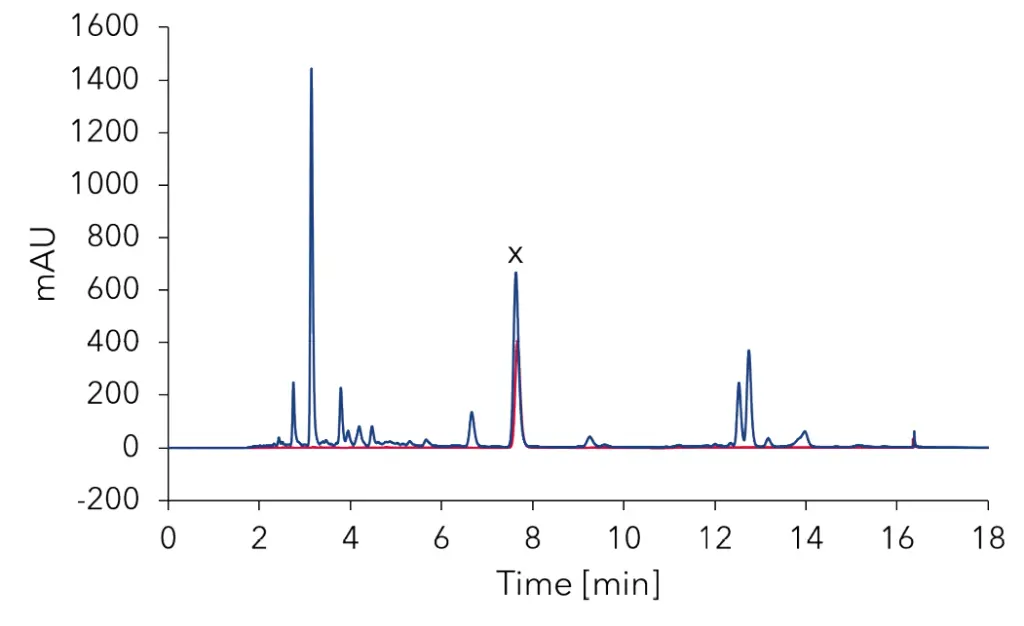
Fig. 1 Overlay chromatograms of chamazulene standard (red) and chamomile blue oil sample (blue). x – chamazulene peak; standard: 0.75 mg/mL, 1 µL injection; sample: 1:10 dilution, 1 µL injection; 1.3 mL/min.
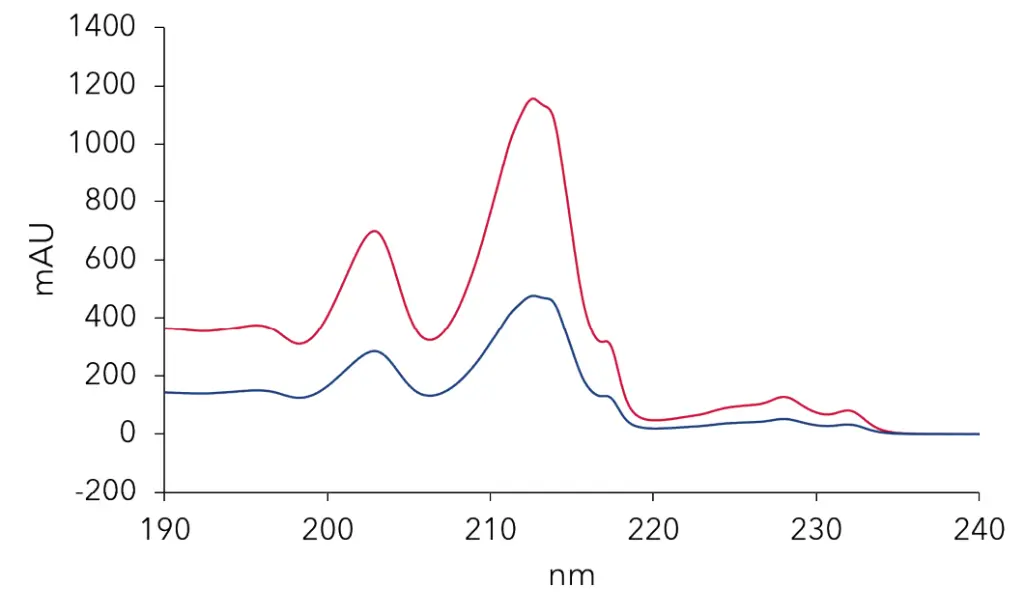
Fig. 2 Spectrum chamazulene standard (red) and chamomile oil sample (blue) at 7.6 min.
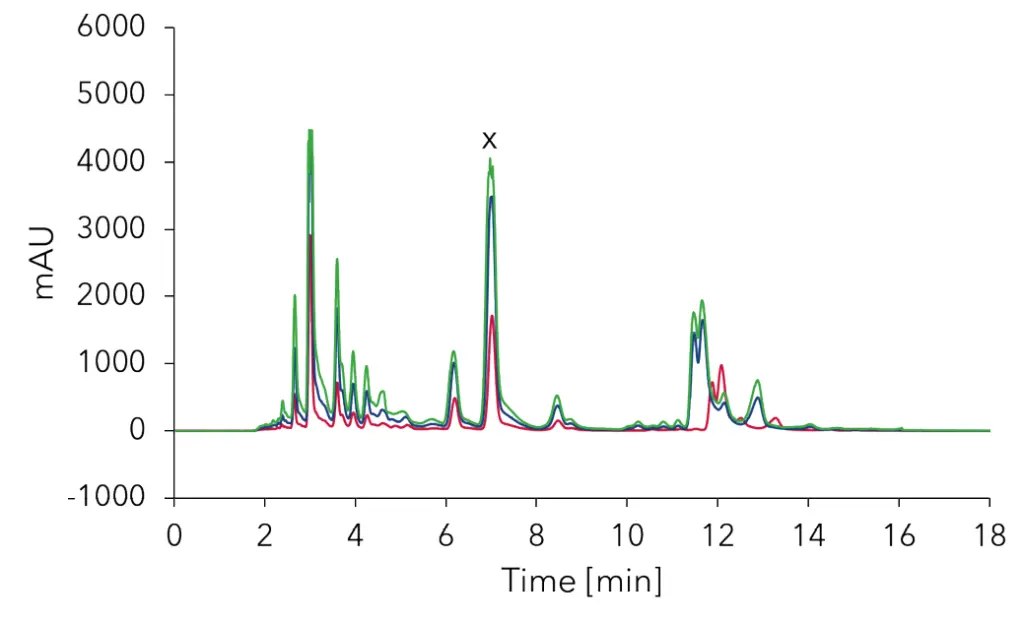
Fig. 3 Overload study. Chromatograms of different injection volumes on
semi-preparative column: red 200 µL, blue 500 µL, green 1000 µL. x – chamazulene peak; chamomile oil 1:10 dilution; C18 20 x 250 mm, 10 µm, 25 mL/min.
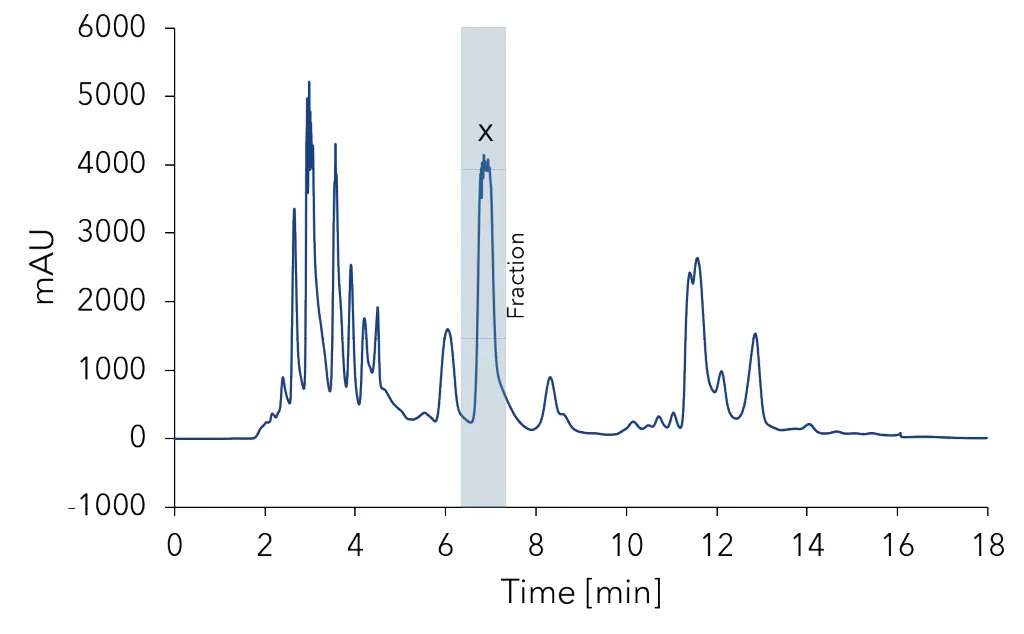
Chromatogram chamazulene purification. Collected fraction highlighted in grey. 2 mL injection volume; x – chamazulene peak;
C18 20 x 250 mm; 10 µm; 25 mL/min.
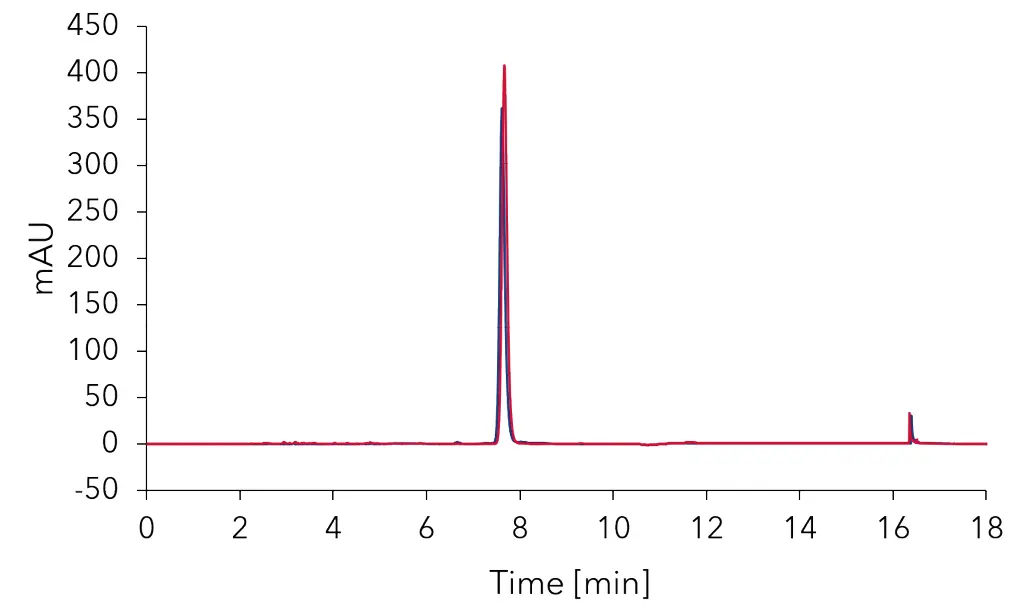
Overlay fraction from Fig. 4 in blue and chamazulene standard
(0.75 mg/mL) in red on analytical column.
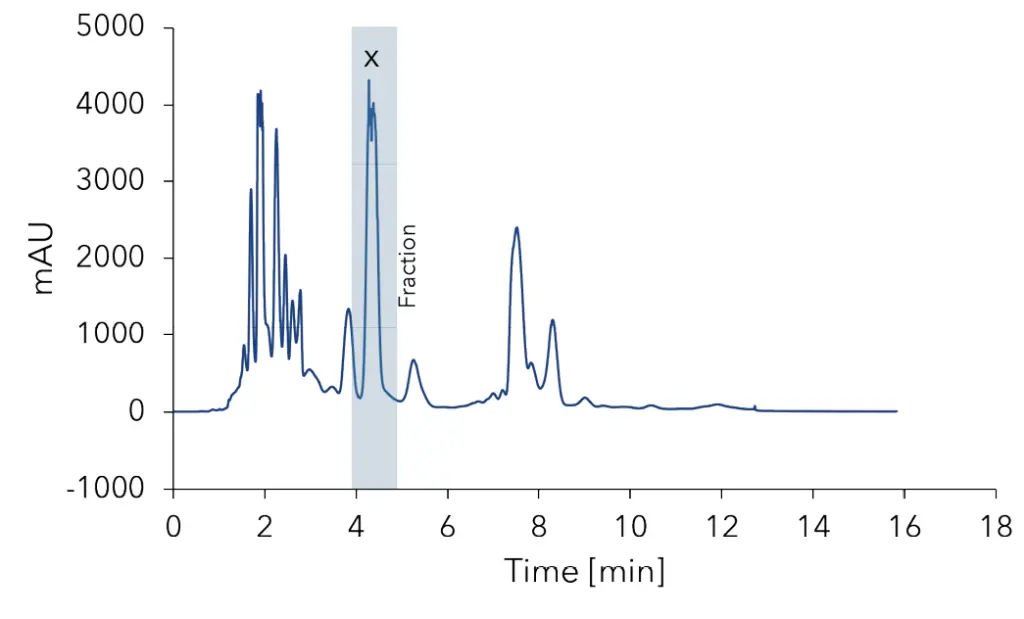
Chromatogram chamazulene purification. Collected fraction highlighted in grey. 10 mL injection volume; x – chamazulene peak;
C18 50 x 150 mm; 10 µm; 150 mL/min.
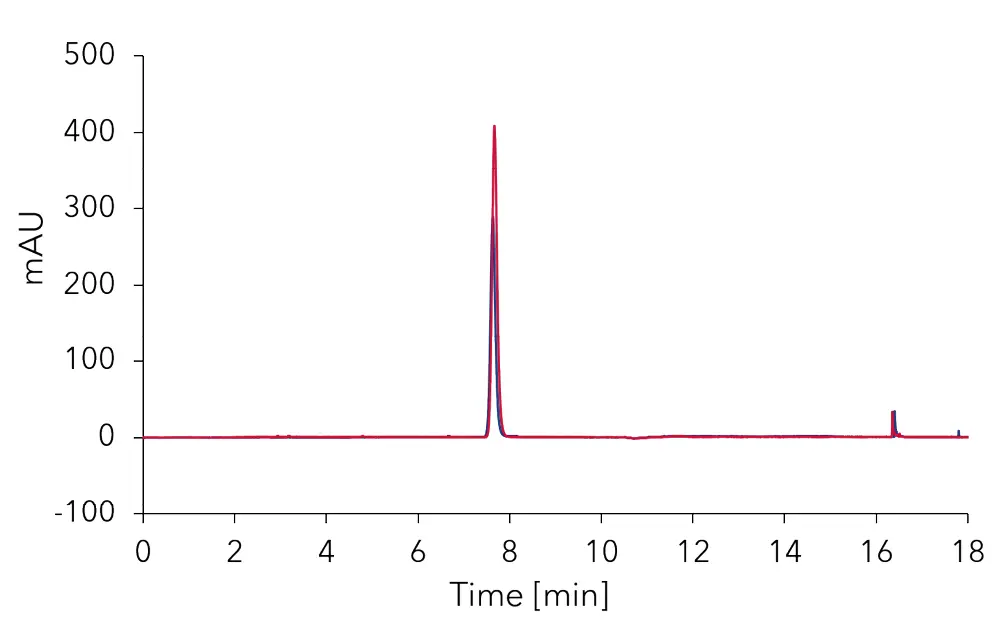
Overlay fraction from Fig. 6 and chamazulene standard
(0.75 mg/mL) on analytical column.
Quantification of chamazulene concentration in the fractions of
2 and 10 mL injection from purification
2 mL injection | 10 mL injection | |
Chamazulene concentration sample [mg/mL] | 1,240 | 1,048 |
Total amount chamazulene injected | 2,48 | 10,48 |
Chamazulene concentration fraction [mg/mL] | 0,133 | 0,101 |
Fraction volume [mL] | 19 | 85 |
Total amount chamazulene in fraction [mg/mL] | 2,526 | 8,619 |
Recovery [%] | 101,80 | 82,20 |
Sample Preparations
The chamazulene standard (Sigma Aldrich) was dissolved in methanol to desired concentrations for calibration curve and filtered (0.45 µm). A 5-point calibration curve was calculated with following concentrations in triplicates: 0.015, 0.150, 0.375, 0.750 and 1.500 mg/mL chamazulene. Blue chamomile essential oil “Kamillen Öl Blau” was purchased by manufacturer/distributor ASAV Apoth.Serv.Arzneim.Vetr.GmbH; PZN 06984428; 2 mL. The oil was diluted in a ratio of 1:10 with methanol and water (90:10; v/v). The insoluble fraction was removed by filtration through a 0.45 µm filter.
Conclusion
A preparative reverse phase method was developed for the purification of chamazulene from chamomile blue oil sample. The chamazulene was purified in high purity (approximatly 100 %) and with high recovery (> 100 %) in semi-preparative scale (20 mm ID column). The high recovery can be explained by error propagation during the measurements. The chamazulene was identified in the sample and fraction by comparing retention time and spectra with the chamazulene standard. To increase the throughput, the method was adapted to a 50 mm ID column with the same particle size as the semi–preparative column. The pump was easily upgraded to higher flow rates by replacing the 100 mL pump head with a 250 mL pump head. From the 10 mL injected sample 82 % chamazulene were recovered by fractionation. The recovery could be increased by enlarging the fraction window, but could lead to impurities in the fraction. After the development of a reverse phase method for preparative HPLC purification of chamazulene from chamomile blue oil, an alternative normal phase HPLC method could be interesting. Normal phase separations are often used in industrial scale due to better solubility for some samples and easier evaporation of the used solvents.
Materials and Methods
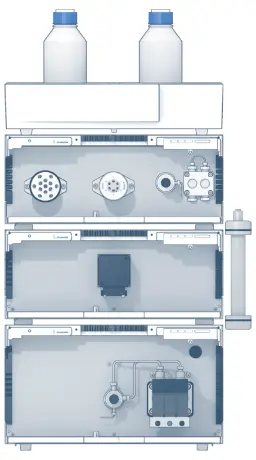
Tab. 2 Configuration analytical system
Instrument | Description | Article No. |
Pump | AZURA P 6.1L LPG 10 mL/min, sst | |
Autosampler | AZURA AS 6.1L, 700 bar | |
Detector | AZURA DAD2.1L | |
Flow cell | Light guide 10mm / 2 µL / 50 bar | |
Thermostat | AZURA CT 2.1 | |
Column | Eurospher II 100-5 C18, 250 x 4.6 mm ID | |
Software | ClarityChrom 8.1 – workstation, autosampler control included | |
Software | ClarityChrom 8.1 - PDA extension |
Analytical method - pump parameters
Eluent A | H2Odd | ||
Eluent B | Acetonitril | ||
Flow rate | 1.3 mL/min | ||
Pump program | Time (min) | %A | %B |
0.00 | 10 | 90 | |
10.00 | 10 | 90 | |
10.02 | 0 | 100 | |
16.00 | 0 | 100 | |
16.02 | 10 | 90 | |
22.00 | 10 | 90 |
Analytical method - method parameters
Column temperature | 25 °C |
Injection volumen | 5 µL |
Injection mode | Partial loop |
Detection | UV 245 nm / 285 nm / 3D 190 – 400 nm |
Data rate | 20 Hz |
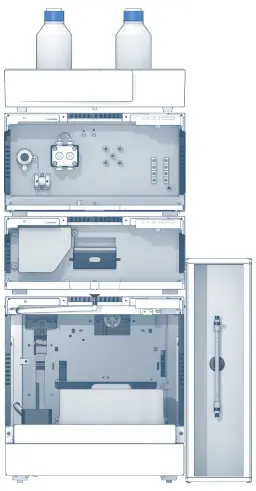
Configuration preparative system
Instrument | Description | Article No. |
Pump | AZURA P 2.1L, 100 mL/min sst | |
Ternary LGP module | AZURA LPG ternary module for Pump P 2.1L | |
Pump head | Pump head 250 mL/min, sst | |
Detector | UVD 2.1L | |
Assistant | Left: 6 Mpos,1/8””, sst Middle: 6Port2Pos,1/16”, sst Right: P4.1S, 50 mL, sst | |
Flow cell | 3 µL; 1/16” | |
Column | Eurospher II 100-10 C18, 250 x 20 mm ID | |
Column | Eurospher II 100-10 C18, 150 x 50 mm ID | |
Software | PurityChrom®Basic |
Preparative methods - pump parameters
Eluent A | 90:10 Acetonitrile:H2Odd (v/v) | |||||
Eluent B | 100 % Acetonitrile | |||||
ID 20 mm column | ID 50 mm column | |||||
Flow rate | 25 mL/min | 1.0 mL/min | ||||
Pump program | Time (min) | %A | %B | Time (min) | %A | %B |
0.00 | 100 | 0 | 0.00 | 100 | 0 | |
8.00 | 100 | 0 | 5.45 | 100 | 0 | |
8.02 | 0 | 100 | 5.47 | 0 | 100 | |
14.00 | 0 | 100 | 11.45 | 0 | 100 | |
14.02 | 100 | 0 | 11.47 | 100 | 0 | |
18.00 | 100 | 0 | 18.00 | 100 | 0 |
Preparative methods - method parameters
ID 20 mm column | ID 50 mm column | |
Column temperature | ambient | ambient |
Injection volumen | 1 mL, 2 mL | 10 mL |
Injection mode | Injection loop | Injection loop |
Detection | UV 245 nm | UV 245 nm |
Data rate | 2 Hz | 2 Hz |
References
[1] Srivastava, J. K., Gupta, S. Extraction, characterization, stability and biological activity of flavonoids isolated from chamomile flowers. Mol Cell Pharmacol 1(3), 138 (2009).
[2] Haghi, G., Hatami, A., Safaei, A., Mehran, M. Analysis of phenolic compounds in Matricaria chamomilla and its extracts by UPLC-UV. Res Pharm Sci 9(1), 31-7 (2014).
[3] Salihovic, M., Sapcanin, A., Spirtovic-Halilovic, S., Zavrsnik, D. DFT structural analysis of chamazulene. Bull Chem Technol Bosnia Herzegovina 46, 27–32 (2016).
Application details
Method | Preparative HPLC |
Mode | RP |
Substances | Chamazulene |
CAS number | 529-05-5 |
Version | Application No.: VPH0071 Version 1 11/2019 | ©KNAUER Wissenschaftliche Geräte GmbH |