UV/VIS Detection in HPLC – The Workhorse of Modern Liquid Chromatography
When most analysts think of HPLC detectors, the first thing that comes to mind is the UV/VIS absorption detector. From pharmaceuticals to food analysis to environmental testing, UV detection is so widespread that it’s often the go-to starting point for new HPLC applications.
It's no surprise that it's so popular: UV detectors are sensitive, robust, stable, affordable, and compatible with nearly all HPLC workflows, including gradient elution. Whether you're just starting your journey in HPLC or you’re a seasoned pro, refining complex methods, understanding how UV/VIS detection works is crucial for efficient analysis and reliable data interpretation.
Let's dive deeper into this essential detection technique for HPLC analysis!
💡How UV/VIS Detection Works
UV/VIS detectors in HPLC are in-line devices that measure the absorption of ultraviolet or visible light at one or multiple wavelengths as analytes pass through a flow cell (Figure 1). This process is based on Beer-Lambert’s Law, which relates absorbance to the concentration of a substance: The absorbance is directly proportional to the concentration of the sample in the flow cell.
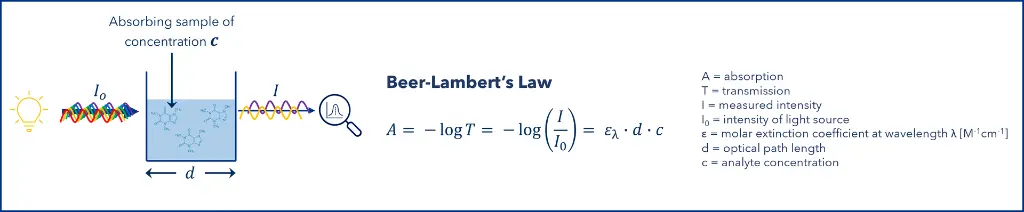
Figure 1: UV detection principle with absorbance according to the Beer-Lambert’s Law. (Graphic by KNAUER)
As compounds elute from the column, those that absorb light at the chosen wavelength reduce the light intensity reaching the detector. This reduction is converted into a peak on the chromatogram. This signal can be used to quantify the amount of a compound emerging from the HPLC column.
💡Which Compounds Absorb UV or Visible Light?
Absorbance generally occurs due to electronic transitions from molecular orbitals in structures like:
- Aromatic rings
- Conjugated double bonds
- Heterocycles
- Peptide and protein chromophores
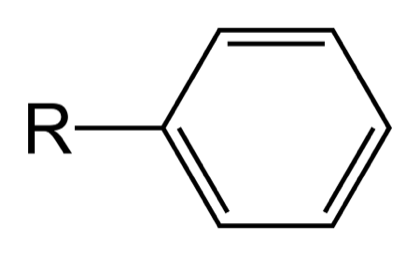
Table 1 shows the typical UV absorption maxima of different organic chromophoric groups. UV/VIS detectors can respond throughout a wide wavelength range (e.g., 190 - 700 nm), which enables the detection of a broad spectrum of compound types.
This is why UV detection is such a powerful tool for common small-molecule pharmaceuticals and biological analytes.
| Chromophoric Group | Lambda max in nanometers | Epsilon max |
|---|---|---|
|
Alkyne

|
225 | 160 |
|
Carbonyl

|
280 | 16 |
|
Carboxyl

|
204 | 41 |
|
Amide

|
214 | 41 |
|
Azo

|
339 | 5 |
|
Nitro

|
280 | 22 |
|
Nitroso

|
300 | 100 |
|
Nitrate

|
270 | 12 |
|
Olefin conjugated

|
217-250 | >20.000 |
|
Alkylbenzenes

|
250-260 | 200-300 |
|
Phenol
|
270 | 1.450 |
|
Aniline

|
280 | 1.430 |
|
Naphthalene

|
286 | 9.300 |
|
Styrene

|
244 | 12.000 |
| Chromophoric Group | Lambda max in nanometers | Epsilon max |
|---|---|---|
|
Alkyne
|
225 | 160 |
|
Carbonyl
|
280 | 16 |
|
Carboxyl
|
204 | 41 |
|
Amide
|
214 | 41 |
|
Azo
|
339 | 5 |
|
Nitro
|
280 | 22 |
|
Nitroso
|
300 | 100 |
|
Nitrate
|
270 | 12 |
|
Olefin conjugated
|
217-250 | >20.000 |
|
Alkylbenzenes
|
250-260 | 200-300 |
|
Phenol
|
270 | 1.450 |
|
Aniline
|
280 | 1.430 |
|
Naphthalene
|
286 | 9.300 |
|
Styrene
|
244 | 12.000 |
Table 1: Overview of UV absorption characteristics of organic functional groups with chromophore (light-absorbing) properties. (Graphic by KNAUER)
💡Types of UV/VIS Detectors
In HPLC you'll find three main types of UV/VIS detectors: fixed-wavelength, variable-wavelength (VWD) or multiple-wavelength (MWD), and diode array or photodiode array (DAD/PDA) detectors. Fixed-wavelength models use light at a single, specific wavelength emitted directly from the lamp. Variable-wavelength and diode array detectors, on the other hand, use a broad-spectrum light source, letting you choose one or multiple wavelengths to monitor.
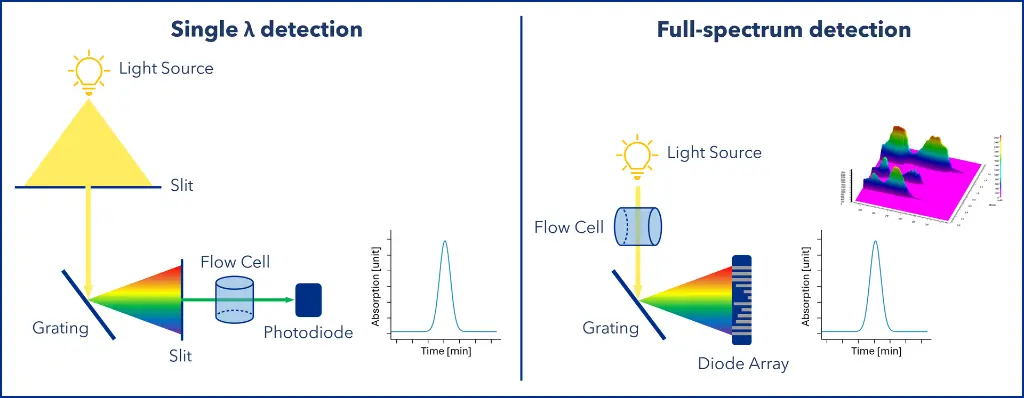
Figure 2: Schematic of optical designs in UV/VIS detectors. Left: In a standard UV/VIS detector, a monochromator selects a single wavelength, which passes through the flow cell, and the transmitted light is measured by a photodiode to produce a signal. Right: In a diode array detector, the full light spectrum passes through the flow cell, and the transmitted light is dispersed by a fixed grating onto an array of photodiodes. (Graphic by KNAUER)
1. Fixed Wavelength Detectors
Fixed wavelength detectors measure absorbance only at one specific wavelength. These kinds of UV detectors are simple, robust, and cost-effective, offering high sensitivity at specific wavelengths. Because of their straightforward design, you tend to find this design in educational, compact or portable systems.
Early designs relied on a low-pressure mercury lamp as the light source due to its very intense, monochromatic emission line at 254 nm. By adding phosphor to the source or using a zinc lamp or optical filters, other wavelengths such as 280 nm, 265 nm or 214 nm could be used for detection as well. In modern instruments, mercury lamps have largely been replaced by LEDs for improved stability and longevity. The most common wavelengths here are 254 nm or 260 nm, and 280 nm.
In these detectors, light passes through the flow cell containing the mobile phase and analyte. The transmitted light is measured by a photodiode and converted into an electrical signal. Most systems use a reference cell to compare the sample signal to the reference (often air), and the difference is converted to absorbance according to the Beer-Lambert law.
While less flexible than variable or diode array detectors, fixed wavelength models remain a reliable and economical option for routine applications where consistent sensitivity at a single wavelength is key.
2. Single or Variable Wavelength Detectors (UVD, VWD)
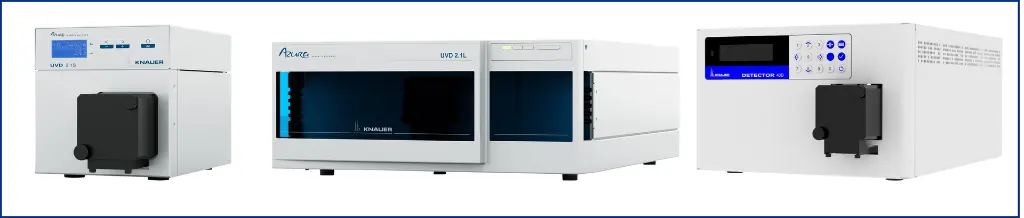
Figure 3: KNAUER’s single variable wavelength UV/VIS detectors. From left to right: AZURA® UVD 2.1S, AZURA® UVD 2.1L, BlueShadow 40D. (Graphic by KNAUER)
Single or variable wavelength detectors also measure absorbance at a single wavelength, but unlike fixed wavelength detectors, that wavelength can be selected across a wide range (typically 190 - 700 nm). This flexibility makes them the standard detector for most routine HPLC applications.
A broad-spectrum light source, usually a deuterium lamp, produces continuous UV/VIS radiation. The polychromatic light spectrum is directed into a monochromator, which is made up of an entrance slit, a rotating diffraction grating and an exit slit. The motorized grating disperses the light spectrum, and depending on its position, a particular wavelength can be selected through the exit slit and then passes through the flow cell. The transmitted light is measured by a photodiode, which converts the light energy into electrical signals (Figure 2, Left). For most instruments available on the market today, a dual-beam design is common. Here, after the light has passed through the exit slit, a beam splitter or a semi-permeable mirror divides the beam into a sample and a reference beam. The intensity of each beam is monitored by a separate photodiode and translated into a quantitative signal, following the Beer–Lambert law. Only the sample beam passes through the flow cell.
Because the wavelength can be optimized for each analyte, and even programmed to change during a run, such as monitoring one peak at 220 nm and another at 280 nm, UVDs or VWDs provide excellent sensitivity and selectivity. These detectors offer an excellent balance between performance, flexibility, and simplicity, making them ideal for compounds that absorb at specific wavelengths or are light-sensitive, since the sample is not exposed to the whole light spectrum during detection.
3. Multi-Wavelength Detectors (MWD)

Figure 4: KNAUER’s multiwavelength UV/VIS detectors. From left to right: AZURA® MWD 2.1L, AZURA® VWD 2.1L, BlueShadow 50D. (Graphic by KNAUER)
Multi-wavelength detectors can measure absorbance at several wavelengths simultaneously, typically ranging from 190 to 600 nm, in some cases up to 1000 nm. Most common are models measuring up to four wavelengths at once, thus these detectors capture more information in a single run.
MWDs are usually build on the design of variable-wavelength models and also employ a deuterium lamp for UV/VIS detection. A tungsten lamp can be added for extension of the visible range, allowing broad spectral coverage. Some manufacturers offer a slimmed-down version of a diode array detector as an MWD at a lower cost without the spectral scanning capability and 3D functionality.
As a kind of hybrid between UVDs/VWDs and DADs, MWDs are price-attractive devices for operation at UV absorbance maximum with wavelength switching option, ideally suited for analytes with multiple chromophores, like many pharmaceutical compounds.
4. Diode Array / Photodiode Array Detectors (DAD/PDA)
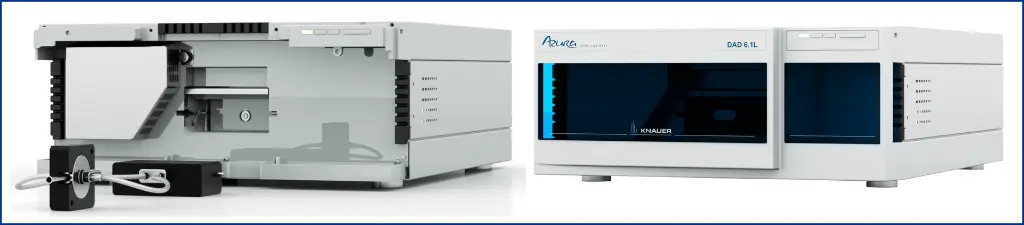
Figure 5: KNAUER’s diode array UV/VIS detectors. From left to right: AZURA® DAD 2.1L, AZURA® DAD 6.1L. (Graphic by KNAUER)
Diode Array Detectors (DAD), also known as Photodiode Array Detectors (PDA), measure the entire UV/VIS spectrum of a sample simultaneously, typically from 190 to 1000 nm. Unlike single- or multi-wavelength detectors that monitor only selected wavelengths, they record absorbance across the full spectrum for every peak, providing both quantitative and spectral information in a single run.
In a DAD/PDA, the entire light from a deuterium and tungsten lamp directly passes through the flow cell, then the transmitted light is dispersed by a diffraction grating onto an array of photodiodes, commonly consisting of 256, 512 or 1024 diodes. Each diode measures light intensity at a specific wavelength at the same time, generating a three-dimensional dataset (absorbance vs. time vs. wavelength) (Figure 2, Right).
This capability allows for
- Compound identification through UV/VIS spectral matching and library searches.
- Peak purity checks by comparing the consistency of absorbance profiles at different points across the peak to detect co-eluting impurities/compounds with different UV/VIS spectral characteristics.
- Retrospective wavelength selection without rerunning the sample. If a run was acquired at full-spectrum mode, chromatograms can be reprocessed at a different detection wavelengths later.
- Comprehensive method development, especially for complex or unknown samples.
Of course, a DAD can also be operated to collect data only at one or more wavelengths without capturing the full spectrum.
Because they are able to combine multi-wavelength quantitation and full spectral scanning, DAD/PDA detectors have become the standard in modern pharmaceutical, analytical and research laboratories, offering an excellent balance between sensitivity, flexibility, and data richness, ideal for method development and analyzing complex mixtures or samples of unknown composition.
To summarize, the higher flexibility of a DAD in terms of wavelength selection as well as getting more detailed information from your samples is the reason for being the first choice for most labs. For routine analysis, the extra sensitivity of the simple variable wavelength detector is more attractive.
💡Key Performance Characteristics of UV/VIS Detectors
UV detectors are popular because of their great balance of sensitivity, stability, and affordability. Their standard performance specifications include:
Sensitivity
The typical detection limits are in the ng to µg range, depending on the analyte and system design.
Linearity
One of the strengths of UV detection is its excellent linear dynamic range, often over 4 - 5 orders of magnitude, ensuring that quantification is straightforward and reliable.
Noise and Drift
The low noise levels and baseline stability of UV detectors enhance quantification, especially in gradient methods.
Flow Cell Design
Flow cells used are typically made of stainless steel or fused silica, with a path length of 50 mm or shorter, and cell volumes of 2 - 10 μL. They are designed with low dead volume to minimize band broadening. Additionally, specialized micro, semi-preparative, or preparative flow cells are readily available for almost any specific application, also in biocompatible versions. Discover KNAUER’s full range of flow cells here.
💡Advantages & Limitations of UV/VIS Detection in HPLC
UV/VIS detectors are among the most widely used detectors in HPLC because they are simple, reliable, and highly effective for many analytes. Most small-molecule pharmaceuticals, active pharmaceutical ingredients (APIs) and many natural products absorb UV light, making this technique the default choice in analytical and quality control laboratories for routine analyses, regulated pharmaceutical testing and method validation.
Key Advantages
- Simple and cost-effective instrumentation
- Highly reliable and easy to operate, with minimal maintenance
- Excellent quantitative accuracy and precision (< 0.2% RSD) with a wide linear range (> 10⁵)
- High sensitivity for compounds that absorb UV light (high molar absorptivity ε)
- Compatible with gradient elution and common HPLC solvents
- Relatively insensitive to changes of mobile phase (flow rates and refractive index) or temperature fluctuations
- Nondestructive detection, allowing further analysis if needed
- Automation-friendly, with built-in diagnostics and wavelength calibration in many systems
Limitations
Despite its strengths, UV/VIS detection has some limitations:
- Requires a chromophore – compounds without UV-absorbing groups cannot be detected effectively
- Lower selectivity compared with techniques like fluorescence or mass spectrometry as closely related compounds with unaltered chromophore moieties can have very similar UV/VIS spectra
- Detector response varies between compounds depending on their molar absorptivity ε
- Solvent UV cutoffs can limit mobile-phase choices and method design, especially at low wavelengths
- Reduced sensitivity at very high or very low wavelengths possible
In practice, these limitations are manageable for most applications. However, for non-chromophoric compounds, more universal detectors such as refractive index (RID), evaporative light scattering (ELSD), or charged aerosol detection (CAD) may be preferred.
Side Note: Mobile Phase Considerations and UV Cutoffs
Solvents and additives can absorb UV light themselves. Thus, when using UV/VIS detection in HPLC, the mobile phase must be UV-transparent at the selected detection wavelength to ensure reliable detection.
The UV cutoff of a solvent is the wavelength at which its absorbance reaches 1 absorbance unit (AU). Operating at or below this wavelength can lead to high background absorbance, increased noise, and unstable baselines, lowering sensitivity. The chosen wavelength should therefore be above the solvent’s UV cutoff. Table 2 summarizes UV Cutoffs of common solvents and additives used in HPLC.
Keep in mind that buffer components and acidic modifiers can also absorb strongly below 220 - 230 nm, which may limit the use of very low detection wavelengths further. Selecting UV-transparent solvents and additives is therefore an important part of HPLC method development to avoid high noise and baseline drift.
Table 2: UV Cutoff values of common solvents and additives used in HPLC.
💡When UV/VIS Detection Works Well — and When It Doesn’t
UV/VIS detection works best for compounds that absorb strongly in the UV range (about 190 - 400 nm) and are stable in solution. It is particularly effective for analytes present at moderate concentrations and containing chromophores such as aromatic rings or conjugated double bonds.
Common UV-active compounds include:
- Pharmaceuticals and APIs
- Aromatic compounds
- Amino acids, peptides and proteins (usually detected at 214, 220, or 280 nm)
- Pesticides
- Food additives and dyes
- Natural products such as flavonoids and phenolics
Many compounds also show some absorption below 220 nm due to σ → σ* transitions, although solvent absorbance becomes more critical when detecting at these low wavelengths.
When UV Detection Is Not Ideal
UV detection is less suitable for compounds that lack chromophores, such as:
- Sugars
- Triglycerides and many lipids
- Small organic acids
- Some polymers or inorganic ions
These analytes absorb little or no UV light, resulting in poor sensitivity. UV detection can also struggle with very low analyte concentrations, complex matrices, or co-eluting compounds with similar spectra. In such cases, alternative detectors like ELSD, CAD, RID, FLD or mass spectrometry (MS) may be more appropriate. These will be described in detail in upcoming posts in our “Seeing is Believing - Detection Made Easy” blog series.
Typical Applications

Figure 6: Applications for UV Detection in HPLC. (Graphic by KNAUER. Icons generated by DALL-E 3, OpenAI, GPT-5.4; March 10th, 2026)
Because of the features described above, UV/VIS detection is widely used across many fields such as pharmaceutical analysis to ensure product quality through assays, impurity testing, dose uniformity, and stability studies, environmental monitoring for tracking aromatic pollutants and pesticides in water or soil, or food and beverage analysis, e.g. for quantifying colorants and phenolic compounds in products like wine or tea.
At KNAUER, we use UV/VIS detectors in a variety of real-world applications, exploring their full potential across industries. For example. UV/VIS detection enables profiling key organic compounds in wine and grape juice for quality comparison, supports oligonucleotide quality control when combined with MS for impurity profiling and mass confirmation, and allows characterizing cannabinoids in CBD aroma oils to verify regulatory compliance such as THC limits. It is also applied in advanced cannabinoid purification workflows such as CBG isolation, as well as in method optimization, e.g., improving baseline stability in TFA-containing mobile phases.
Discover all our case studies and application examples here.
💡Final Thoughts
UV/VIS detection is the backbone of modern HPLC because it hits the sweet spot between sensitivity, simplicity, robustness and cost-effectiveness.
While it’s not universal, it is great for most UV-active analytes found in pharmaceutical, environmental, food, and research laboratories. Plus, DAD/PDA technology adds a lot of analytical power with only a small increase in complexity.
Embrace in UV/VIS detection today, and check out KNAUER’s wide selection of UV/VIS detectors or contact our Sales team for support in choosing the right detector for your application.
In the next article of this blog series, we'll take a look Refractive Index Detection (RID), a universal alternative when analytes lack chromophores and UV detection is no longer an option.
For further information on this topic, please contact our author: huhmann@knauer.net
Resources
L. R. Snyder, J. J. Kirkland, J. W. Dolan, Introduction to Modern Liquid Chromatography, 3rd Edition, John Wiley & Sons, Inc., Hoboken, New Jersey, 2010.
D. A. Skoog, F. J. Holler, S. R. Crouch, Principles of Instrumental Analysis, 7th Edition, Cengage Learning, Boston, 2018.
R. P. W. Scott, Liquid Chromatography Detectors. In J. Chromatogr. Library, Vol. 11, Elsevier Scientific Publishing Company, Amsterdam, 1977, pp. iii-ix, 1-248.
V. R. Meyer, Praxis der Hochleistungs-Flüssigchromatographie, 10., vollst. überarb. u. erw. Auflage, Wiley-VCH, Weinheim, 2009.
G. Aced, H. J. Möckel, Liquidchromatographie, Apparative, theoretische und methodische Grundlagen der HPLC, VCH Verlagsgesellschaft mbH, Weinheim, 1991.
M.W. Dong, J. Wysocki, Ultraviolet detectors: Perspectives, Principles, and Practices, LCGC North Amer., 2019, 37(10), 750-759.
M. W. Dong, HPLC and UHPLC for Practicing Scientists, 2nd Edition, John Wiley & Sons, Inc., Hoboken, New Jersey, 2019.