Special Delivery:
Lessons from Lipid Nanoparticles
Imagine you're on vacation and stumble across the perfect souvenir: a beautiful handmade ceramic vase, a set of delicate glasses, or a unique mirror crafted by a local artist. You've found something special, something you would love to take home. But the problem is: How do you get it home in one piece? Wrapping it in a few T-shirts and hoping the airport baggage handlers are having a particularly gentle day is hardly a reliable strategy. And nobody wants to arrive home after a long journey only to open their suitcase and discover a collection of shards mixed in with their clothes.
The same struggle applies in medicine when delivering fragile therapeutic molecules like mRNA. These molecules are delicate cargo that need careful packaging to survive the trip through the body. Without proper protection, they can degrade or get lost before reaching their intended target cells.
Lipid nanoparticles (LNPs) act like custom packaging that shields these sensitive molecules. They guard the therapeutic cargo against damage, guide it through the complex biological environment, and ensure it arrives intact exactly where it’s needed. While this blog won't provide packing tips for your next vacation treasure, LNPs might offer some inspiration. Because when it comes to transporting fragile cargo, protection is everything.
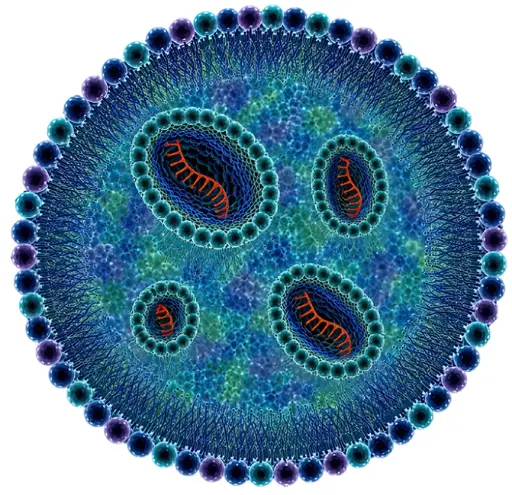
Figure 1: Schematic illustration of the structure of a lipid nanoparticle. The therapeutic cargo (e.g., mRNA) is encapsulated within the particle and surrounded by a lipid matrix. Source: KNAUER Wissenschaftliche Geräte GmbH.
Remember the COVID-19 pandemic and the rise of mRNA vaccines? What many don't realize is that the breakthrough of these vaccines was not only made possible by the mRNA itself, but also by solving a much less visible challenge: packaging.
In many ways, this challenge resembles transporting a fragile package. The cargo must be protected from damage, survive a complex journey, arrive at the correct destination, and finally be unpacked at the right place. For decades, drug delivery has been one of the major bottlenecks in pharmaceutical development. Many promising therapeutic molecules showed excellent activity in the laboratory but failed to reach their target efficiently in vivo. Some were rapidly degraded, others could not cross biological barriers, and many caused unwanted side effects because they distributed throughout the body instead of reaching specific cells or tissues. These challenges become particularly pronounced for fragile or complex active pharmaceutical ingredients (APIs), including nucleic acids, proteins, peptides, and gene-editing components.
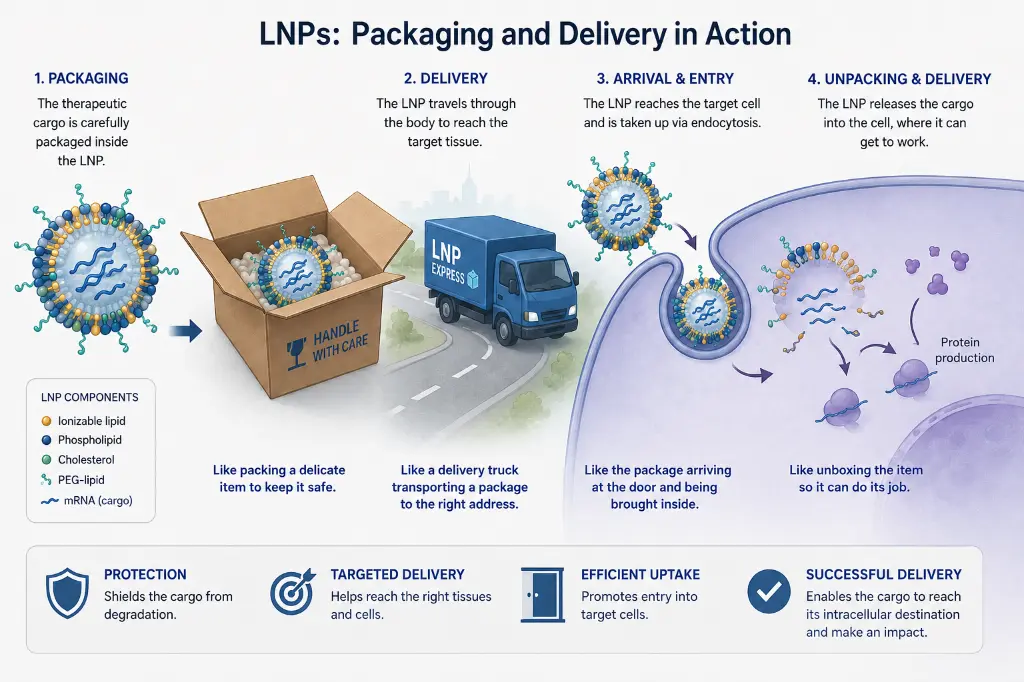
Figure 2: Schematic example of the key steps of LNP-mediated drug delivery, from encapsulation and systemic transport to cellular uptake and intracellular release of the therapeutic cargo. Source: Author's own illustration.
When it comes to drug delivery, there is no one-size-fits-all solution. The ideal carrier depends on the physicochemical properties of the API, the target tissue, and the intended route of administration. Regardless of the application, successful delivery systems must protect their cargo, transport it efficiently to the desired site of action, and release it in a controlled manner. These requirements are particularly demanding for complex and sensitive therapeutic modalities, making the design of effective delivery systems a critical aspect of modern pharmaceutical development. Among the various delivery platforms investigated, lipid nanoparticles have emerged as one of the most successful and clinically validated technologies, particularly for nucleic acid therapeutics such as mRNA and siRNA.
Protection of Therapeutic Cargo
Just as a fragile vase requires protective packaging to survive a flight home, the primary function of a delivery system is to protect the active pharmaceutical ingredient before it reaches its target. Naked nucleic acids (like mRNA) are rapidly degraded in biological fluids and often exhibit circulation half-lives of only minutes. Effective delivery systems shield these molecules from degradation and improve their stability during transport.
Efficient Cellular Uptake
Protecting the cargo is only the first challenge. Even a perfectly wrapped package is of little use if it never reaches its recipient. Effective delivery systems help therapeutic agents to reach the desired tissues, enter target cells, and navigate intracellular barriers to reach their site of action. Many therapeutic molecules are too large, too fragile, or too highly charged to cross the cell membrane on their own. Delivery systems can help overcome this barrier by promoting internalization into cells and increasing the likelihood that the therapeutic cargo reaches its intended intracellular target.
Tunability & Versatility
Not every item requires the same packaging strategy. A ceramic vase, a mirror, and a set of wine glasses all have different requirements. Likewise, different therapeutic applications demand different delivery characteristics. An ideal delivery platform should therefore allow its properties to be tailored for specific cargos, target tissues, and administration routes while maintaining safety, efficacy, and manufacturability.
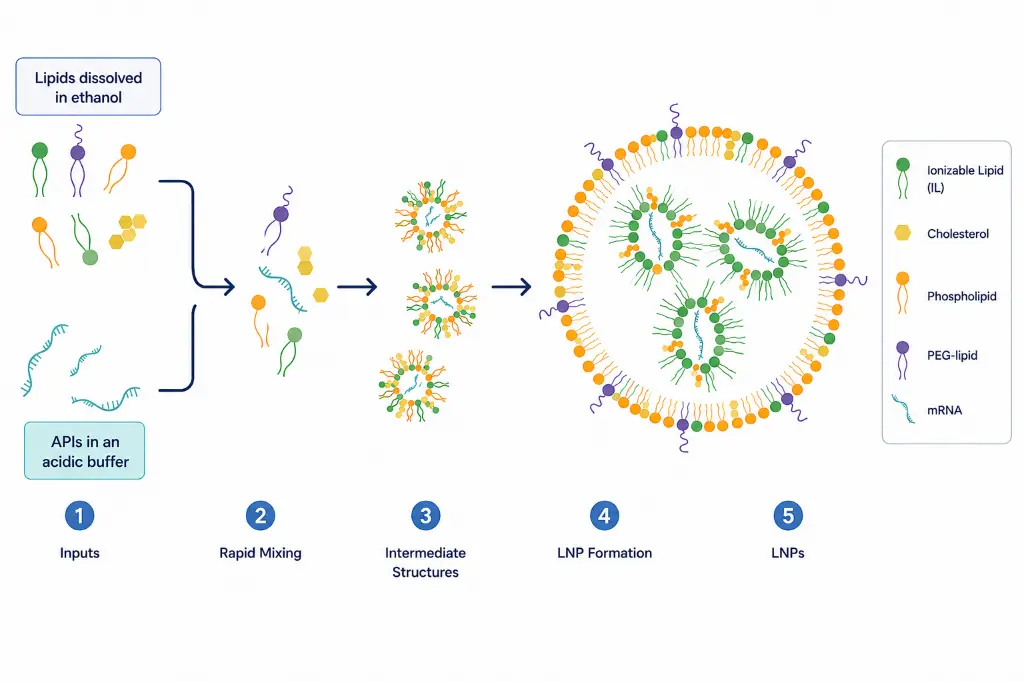
Figure 3: Schematic illustration of the self-assembly process during lipid nanoparticle formation by rapid mixing. Adapted from: Cayman Chemical Lipid Nanoparticle Manual.
Why are LNPs so effective?
Among the many delivery technologies that have been developed, lipid nanoparticles have emerged as one of the most versatile and successful platforms.
Modern LNPs are typically composed of four key components: ionizable lipids, phospholipids, cholesterol , and PEGylated lipids. Together, these components form a highly efficient molecular packaging toolkit, with each component contributing unique properties that help protect, transport, and deliver fragile therapeutic cargo.
Importantly, the exact chemical composition of an LNP strongly influences its biological behavior. Critical quality attributes (CQAs) such as particle size distribution, stability, circulation time, biodistribution, encapsulation efficiency, and morphology can all be tuned by adjusting the lipid composition. Their flexible design is one of the reasons why LNPs have become such a versatile platform technology, enabling applications ranging from vaccines and gene silencing therapies to protein replacement and gene editing approaches.
Ionizable Lipids – The Functional Core
Much like the protective wrapping around a fragile souvenir, ionizable lipids shield the therapeutic cargo during its journey through the body. During nanoparticle formation, they become positively charged, allowing them to bind and package negatively charged nucleic acids. Once administered, they return to a largely neutral state, helping them travel through the body with fewer unwanted interactions.
After the nanoparticle enters a cell, it becomes trapped inside a small compartment called an endosome. As the environment inside the endosome turns acidic, the ionizable lipids regains a positive charge. This helps the nanoparticle break out of the compartment and release its cargo into the cell, where the therapeutic payload can finally do its job.
In short, ionizable lipids help both package the cargo and unpack it at the right destination.
Phospholipids - Structural Organization
While ionizable lipids package the cargo, phospholipids help give the nanoparticle its shape and stability. Like the foam inserts inside a shipping box, they provide structural support and help keep everything in place.
Often referred to as helper lipids, phospholipids such as DSPC or DOPE contribute distinct properties to the formulation. Some promote particle stability, while others enhance interactions with cellular membranes and support intracellular delivery. Altogether, phospholipids help keep the package intact during transport while contributing to efficient delivery at its destination.
Cholesterol – Membrane Packing and Stability
Much like a sturdy shipping box protects a fragile item, cholesterol helps the nanoparticle withstand the challenges it encounters in the body. It also influences nanoparticle morphology and cargo retention. Cholesterol acts as a molecular reinforcement within the nanoparticle, helping hold the structure together and reducing cargo leakage during transport. By fitting between neighboring lipid molecules, it improves particle stability and helps maintain nanoparticle integrity throughout its journey.
As a result, sterols not only strengthen the nanoparticle but also influence how effectively the therapeutic cargo reaches its target.
PEGlyted Lipids – Kinetic Stabilizers
PEGlyted lipids form a protective outer coating around the nanoparticle. Much like the stretch wrap used to secure a package during shipping, they create a hydrophilic barrier that helps prevent nanoparticles from sticking together and contributes to control over particle size.
After administration, this coating helps the nanoparticle travel through the body by reducing unwanted interactions with proteins and the immune system. Depending on their structure, PEG-lipids may gradually detach from the particle surface, allowing the nanoparticle to interact more effectively with cells once it reaches its destination.
Formulation Is Only Half the Story
The performance of lipid nanoparticles depends not only on their composition, but also on how they are formed. Even the best combination of lipids can only deliver its full potential when all components come together under precisely controlled conditions.
LNPs are created through a rapid self-assembly process. When a lipid solution in ethanol meets an aqueous solution containing the therapeutic cargo, the lipids spontaneously reorganize into nanoparticles and encapsulate the payload within milliseconds. Because particle formation happens so quickly, the mixing process plays a critical role in determining particle size, encapsulation efficiency, and overall formulation quality.
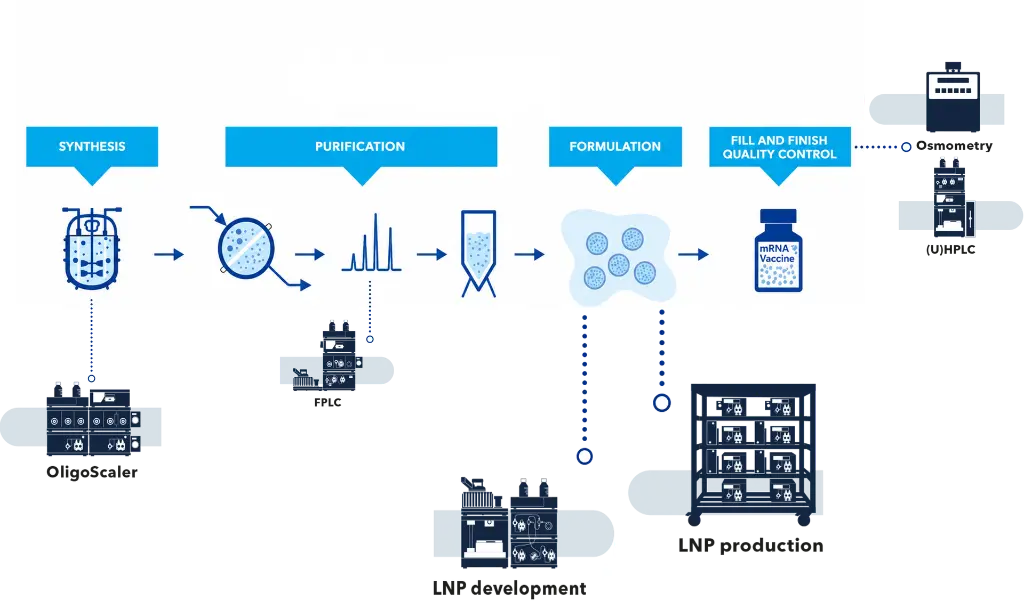
Figure 4: Overview of the manufacturing workflow for an mRNA-based therapeutic, including oligonucleotide synthesis, purification, LNP formulation, fill-and-finish, and quality control. Author's own illustration, adapted from: KNAUER Wissenschaftliche Geräte GmbH.
To support this process, KNAUER offers a portfolio of advanced mixing and flow technologies for LNP development and production. From early-stage formulation screening to scalable manufacturing, these solutions provide the precise control required for reproducible nanoparticle formation. One example is the Impingement Jets Mixer (IJM), which enables highly controlled and efficient mixing for the rapid assembly of LNPs.
As drug delivery technologies continue to advance, ongoing innovation in mixing and processing solutions is essential to meet the evolving needs of LNP applications. By combining expertise in fluid handling, mixing, process analytics, and scalable manufacturing, these technologies help researchers and manufacturers develop robust, reproducible, and future-ready LNP production processes.
In Part 2 of this series, we will explore what makes an effective lipid nanoparticle in the first place. Which critical attributes must LNPs fulfill to function as successful drug delivery systems? And how can the mixing process determine whether these requirements are met? Join us as we take a closer look at the science behind LNP formation and the key role mixing plays in shaping nanoparticle performance.
Additional Resources
Explore KNAUER's LNP Production Platforms, supporting every stage of LNP development: from
R&D screening to production scale.
To learn more or discuss your application with our experts, please contact us at sales@knauer.net
For further information on this topic, please contact our author: regeler@knauer.net