
Science with Passion

Application No.: VEV0081
Version 1 05/2019
GPC vs. SPE and subsequent determination of polycyclic aromatic hydrocarbons using GC/MS
Hagen Schlicke¹, Max von Delbrück¹, Kate Monks¹; applications@knauer.net
A. Bertin², S. Iacobellis², T. Bonato²
S. Guidotti3
¹KNAUER Wissenschaftliche Geräte GmbH, Hegauer Weg 38, 14163 Berlin;
²Laboratorio di ricerca S.E.S.A.,Italy,
3Labservice Analytica S.R.L, Italy

Summary
Polycyclic aromatic hydrocarbons (PAHs) are of great importance as pollutants in the environment because of their persistence, their toxicity, and their ubiquitous spread. The AZURA® GPC Cleanup system automates work-intensive and time-consuming cleanup tasks based on gel permeation chromatography (GPC). The improved reproducibility and quality of the cleanup leads to a robust application for determination of PAHs using GC/MS analysis.
Introduction
Polycyclic aromatic hydrocarbons (PAHs) are ubiquitous environmental pollutants generated primarily during the incomplete combustion of organic materials. The removal of PAHs from the atmosphere by dry and wet deposition processes are strongly influenced by their gas/particle partitioning. Atmospheric deposition is a major source for PAHs in soil [1] which can be determined by various extraction and purification processes, subsequently detected by a GC/MS using the reference method UNI EN 15527. Our main purpose is to demonstrate that the purification of environmental matrix with high organic component using the gel permeation chromatography purification (AZURA GPC Cleanup, FS conditioned resins CHEX/DCM), compared to a SPE purification, allows are well-defined separation time of the analytes and it can provide narrow bands without their physical chemical interaction with the column, resulting in less chance of loss of analytes [2]. This differs from other separation techniques which depend upon chemical or physical interactions to separate analytes [3].
Results
The comparison of analytical chromatograms obtained from GC-MS serve the evaluation of the baseline (Fig 1a). The overlays result obtained clearly confirm that the signal-to noise (S/N) and also the matrix effect of the sample is broadly reduced with the GPC purification compared with the SPE purification (Fig 1b). The GPC purification procedure allows also an improvement for the identification of the third mass (Fig 2).
Fig. 1a Overlay of chromatograms obtained from GC-MS; blue – SPE, red – GPC
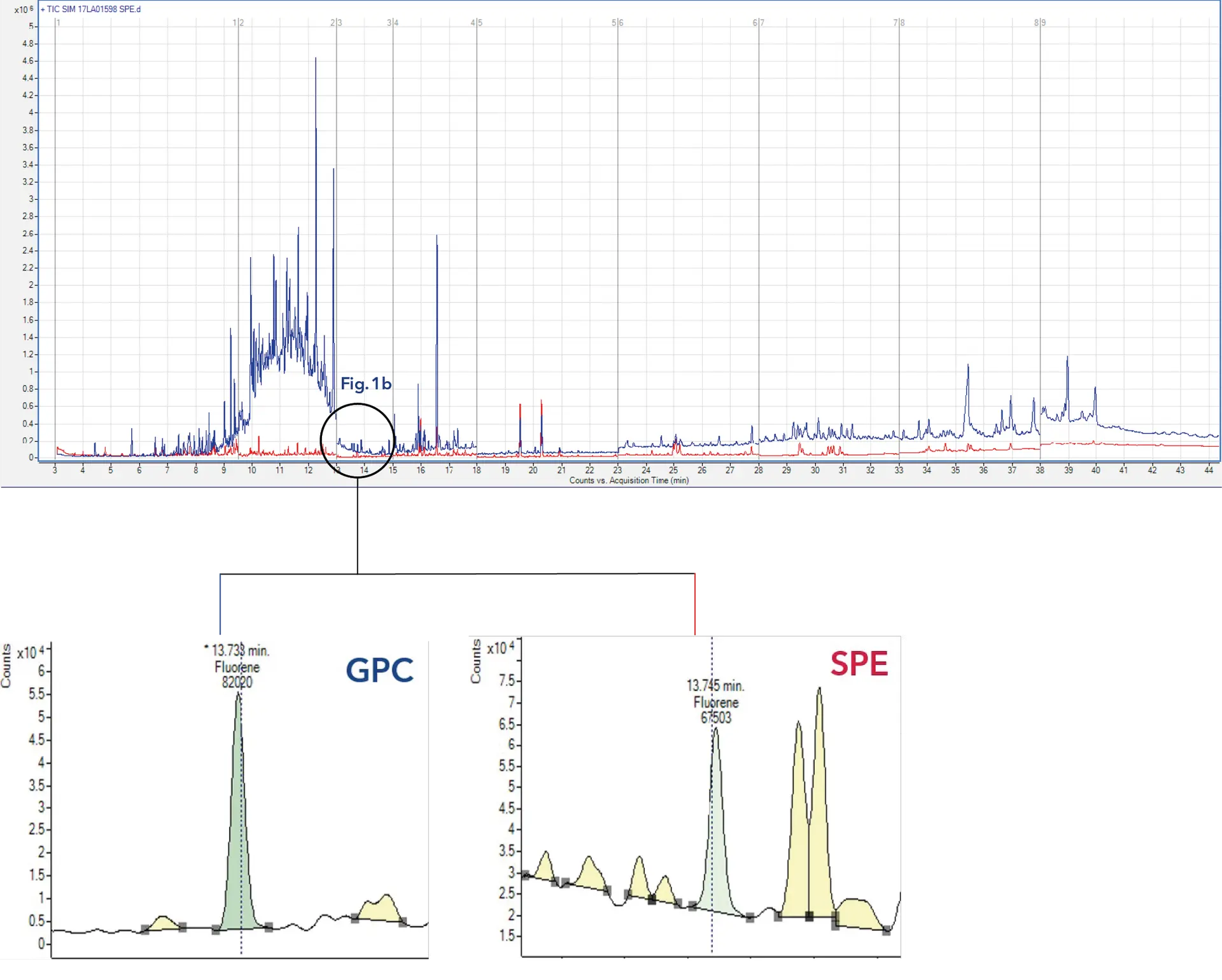
Fig. 1b Selected ion 166,1 (Fluorene)
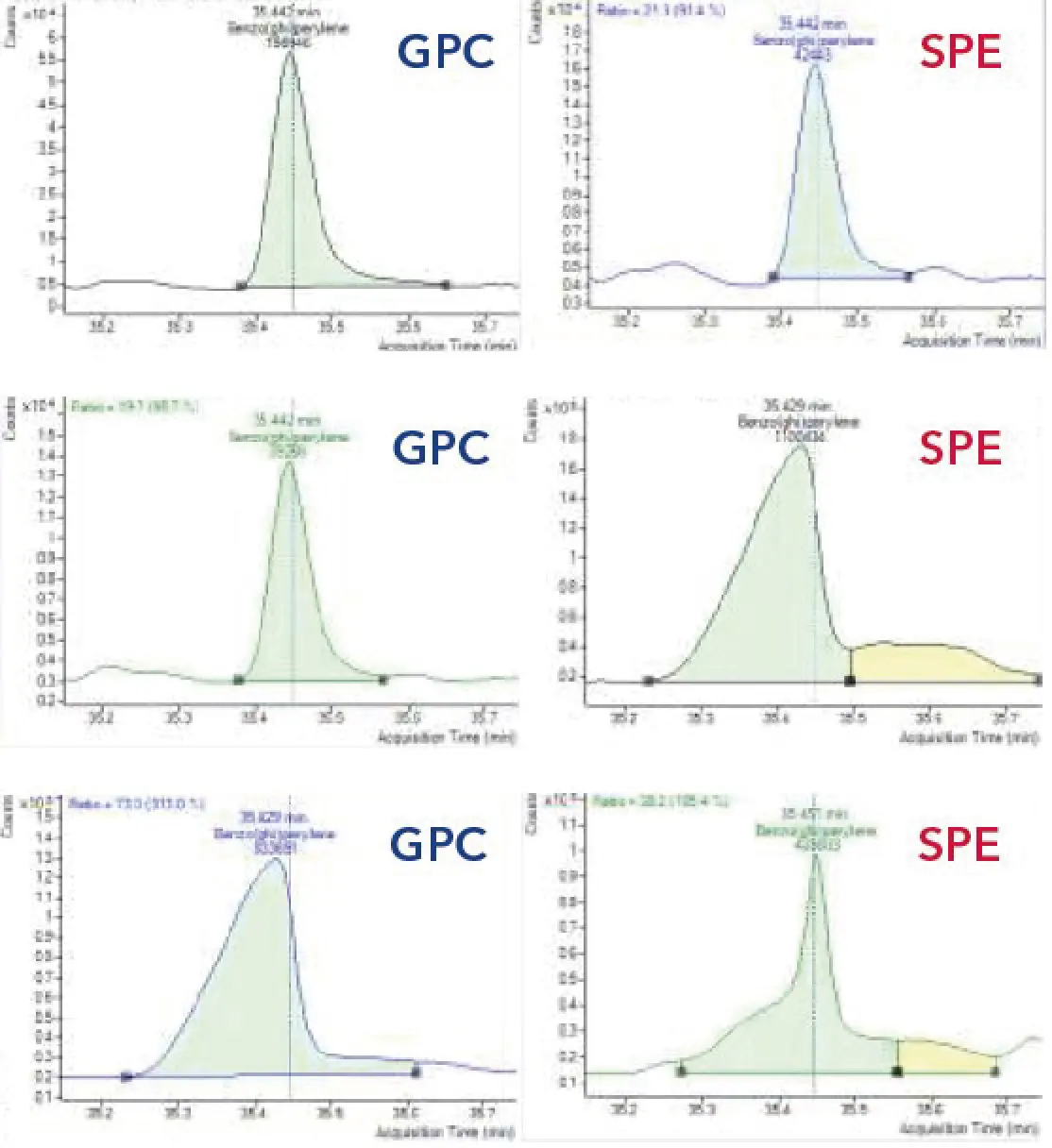
Fig. 2 Identification of the third mass
Materials and Methods
For the purification procedure a mud sludge sample (20 g) of civil waste was used. The analysis is based on UNI EN 15527: 2008 Determination of polycyclic aromatic hydrocarbons (PAH) in waste by gas chromatography with mass spectrometric detection (GC /MS). Extraction technique information: Soxhlet extraction (BUCHI B-811 system:100 extraction cycles with Acetone/Hexane – 1/1 v/v). Cleanup information: AZURA GPC Cleanup system; GPC column: 450 mm x 10 mm Phase: Biobeads SX3 – 10g; Mobile Phase: CEX/DCM – 70/30 (v/v); Flow rate: 1 mL/min Injected volume: 1 mL (concentrated sample corresponding to 4 g of sample). After Cleanup the sample volume has been reduced to 1 mL by evaporation. The extract is concentrated to minimum volume and diluted to 5 mL with GPC mobile phase. For the analysis a GC-MS single quadrupole 5975C (Agilent) was used and a volume of 1 µL was injected.
Conclusion
The GPC cleanup procedure of mud sludge samples prior analysis of PAHs with GC/MS technique is a good alternative to SPE purification steps. Advantages like better S/N ratios and third mass identification are obvious. The automatization of the GPC Cleanup using AZURA GPC Cleanup system yields high efficiency of the application.
Additional Materials and Methods
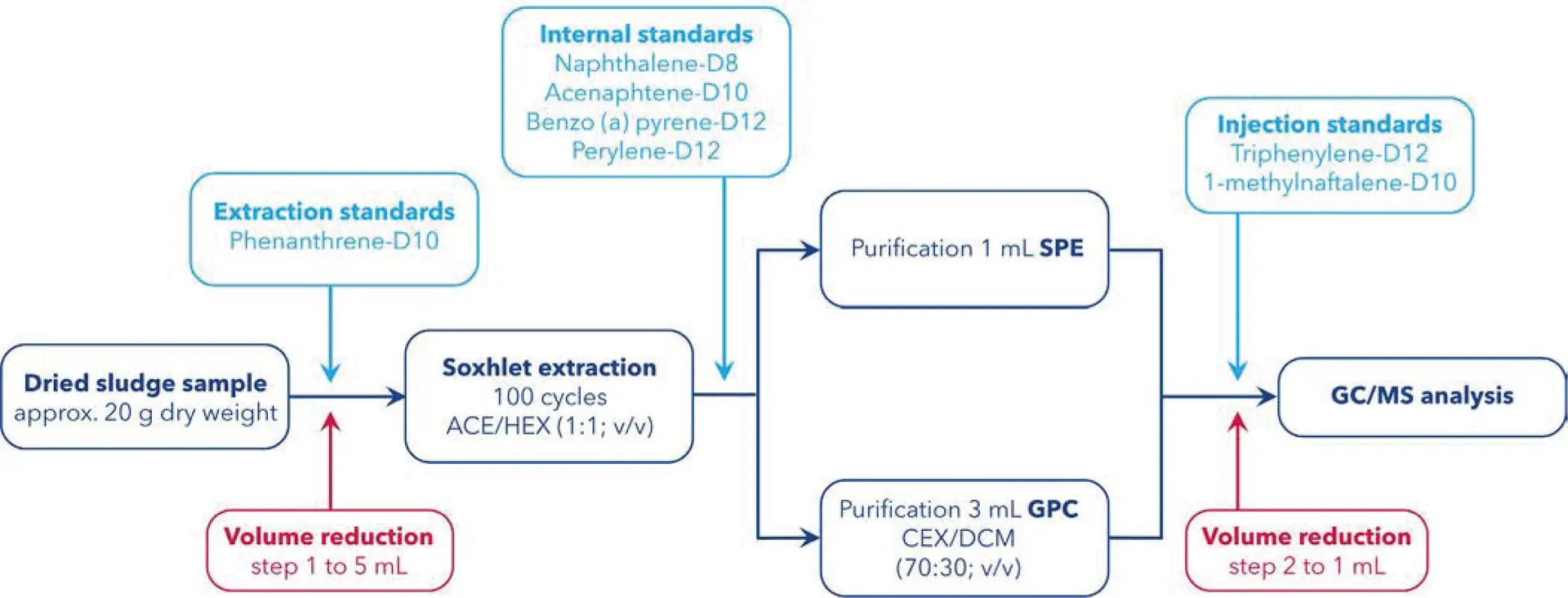
Fig. A1 Scheme of analytical method
Tab. A1 System configuration
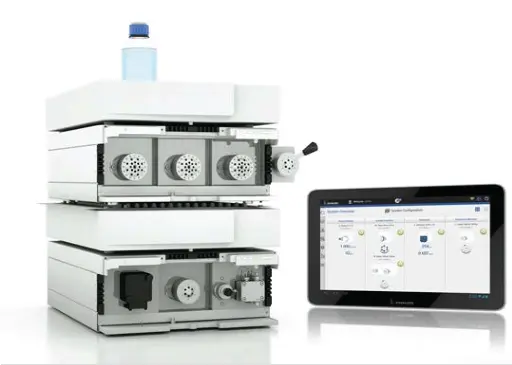
AZURA® GPC Cleanup system with Mobile Control
References
[1] Hussein I. Abdel-Shafy, Mona S.M. Mansour. Egyptian Journal of Petroleum (2015)
[2] A. Bertin, S.Iacobellis, T.Bonato, Laboratorio di ricerca S.E.S.A., S.Guidotti, Labservice Analytica S.R.L
[3] Skoog, D.A. Principles of Instrumental Analysis, 6° ed.; Thompson Brooks/Cole: Belmont, California, 2006 , Chapter 28.
Related KNAUER Applications
VFD0153 – GPC Cleanup of olive oil samples
VFD0146 – Sensitive online SPE determination of bisphenol A in water samples
VFD0152 – Determination of aflatoxin M1 in milk
Application details