Why Mixing Matters
Welcome back to LNPs made easy!
In Part 1 of this series, we explored what lipid nanoparticles (LNPs) are, why they became the driving force behind mRNA vaccines during the COVID-19 pandemic, and how each of their four lipid components contributes to protecting and delivering fragile genetic cargo. We compared LNPs to carefully packaged parcels, where every layer serves a different purpose to ensure that the delivery reaches the right destination safely. But having the right packaging materials is not all that matters.
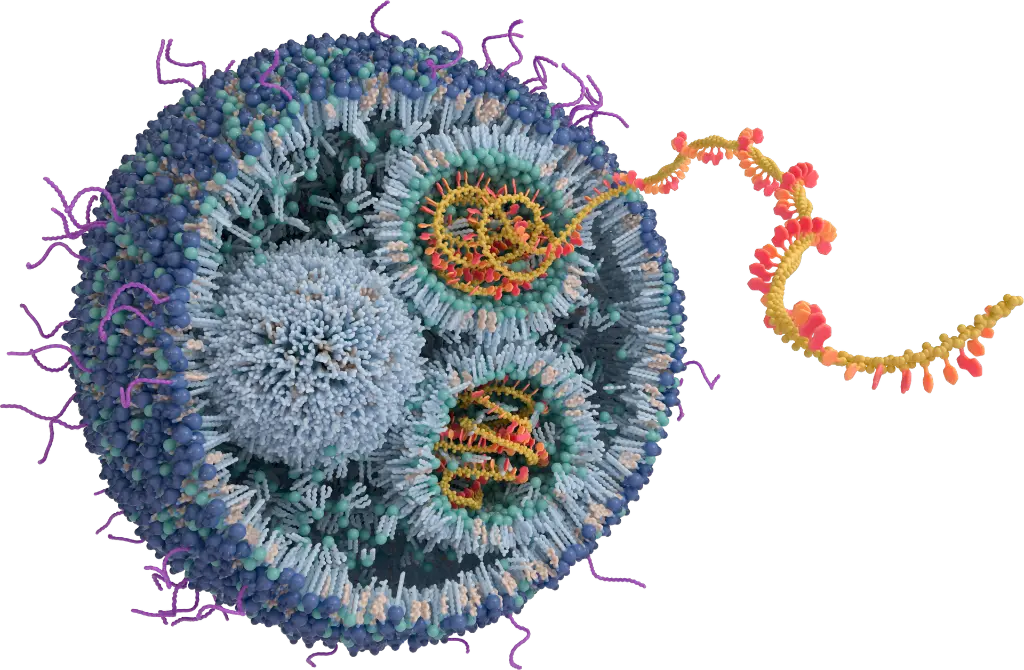
Figure 1: Illustration of the structure of a lipid nanoparticle. The therapeutic cargo (e.g., mRNA) is encapsulated within the particle and surrounded by a complex lipid matrix. Source: KNAUER Wissenschaftliche Geräte GmbH.
One Size Doesn´t Fit All
At first glance, all lipid nanoparticles may look alike. Yet there is no such thing as the "perfect" LNP. Instead, the ideal nanoparticle depends entirely on its intended application. For example, LNP designed for liver delivery are typically engineered to be around 80–100 nm, allowing them to pass through the liver's natural fenestrations. In contrast, nanoparticles intended for brain delivery often benefit from even smaller sizes, while larger particles are more readily cleared by the body's filtration systems.
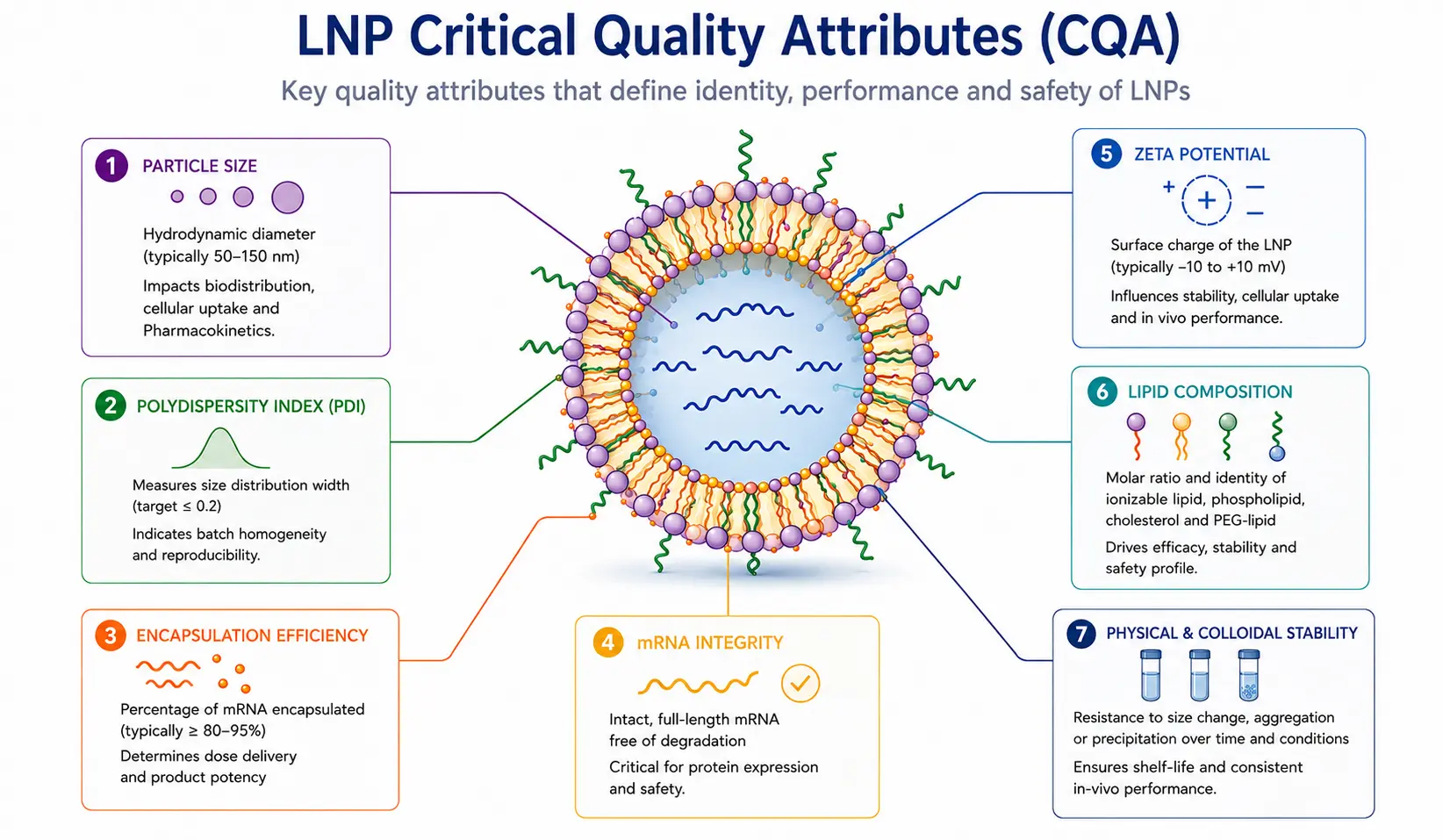
Figure 2: Overview of the key Critical Quality Attributes (CQAs) that define the quality, performance, and safety of lipid nanoparticles. Source: Image created with AI assistance
Size, however, is only one part of the story. Attributes such as particle size, size distribution, encapsulation efficiency, morphology, surface charge, and stability all influence where LNPs travel, how efficiently they enter cells, and ultimately how well they perform as medicines. Together, these measurable properties are known as Critical Quality Attributes (CQAs).
These CQAs are not determined by the chemical formulation alone. The way lipids and the therapeutic cargo meet ultimately determines what an LNP is capable of doing and how it can be used in the field of medical applications.
The Birth of a Lipid Nanoparticle
Forming LNP is a bit like baking cakes. Two people can use exactly the same ingredients, follow the same recipe, and bake in the same oven. Yet one cake turns out light, fluffy, and perfectly risen, while the other is dense, uneven, or even collapses before it cools. The ingredients didn’t change. What changed was how they were mixed together. Lipid nanoparticles are much the same.
Scientists can use the exact same lipids, the same mRNA, and the same formulation, yet end up with nanoparticles that behave very differently. Some deliver their genetic cargo efficiently into cells, while others fail to protect the mRNA, lack stability, or simply don’t work as intended.
So, what makes the difference?
It lies in the very first milliseconds of nanoparticle formation. The birth millisecond of an LNP, so to speak. Unlike many manufactured objects, lipid nanoparticles are not assembled piece by piece. Instead, they form spontaneously through a process called self-assembly. The process begins with two separate solutions: one contains the lipids dissolved in ethanol, while the other contains active pharmaceutical ingredients (APIs) dissolved in an acidic aqueous buffer. Individually, neither solution contains nanoparticles. Everything changes the moment those two streams meet in a mixing chamber.
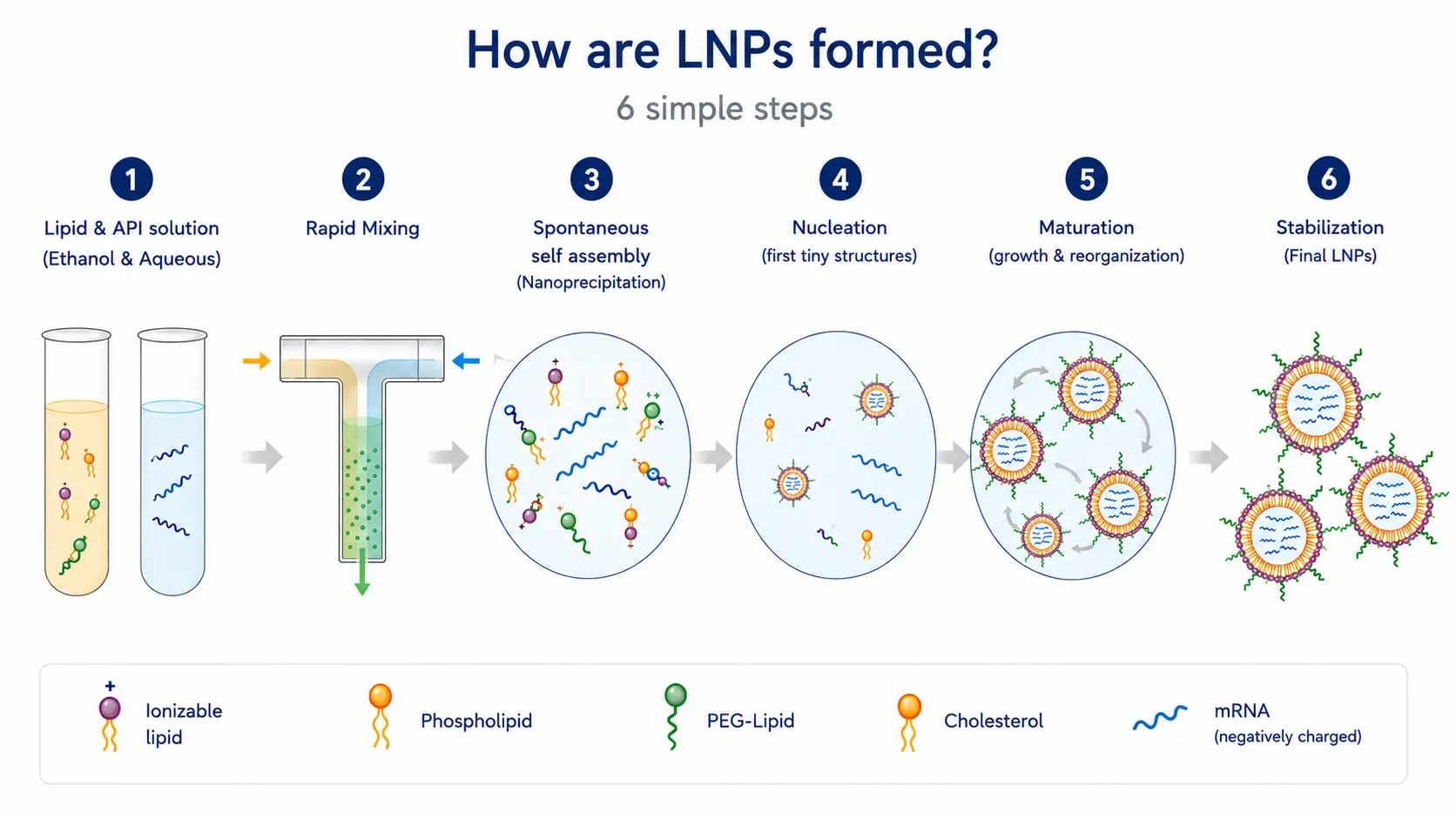
Figure 3: Six-step process of lipid nanoparticle formation following rapid mixing of lipid and aqueous API solutions. Source: Image created with AI assistance
As the two liquids mix, the changing environment causes the individual lipid components to reorganize. This initiates nucleation and is the first step in nanoparticle formation. Over the following milliseconds, these initial structures continue to grow, reorganize, and mature into stable lipid nanoparticles through a process known as self-assembly.
Think of self-assembly as the formation of a soap bubble. When you blow a soap bubble, nobody assembles the soap molecules one by one. Instead, they spontaneously organize into a stable film around the air because this arrangement is energetically favorable.
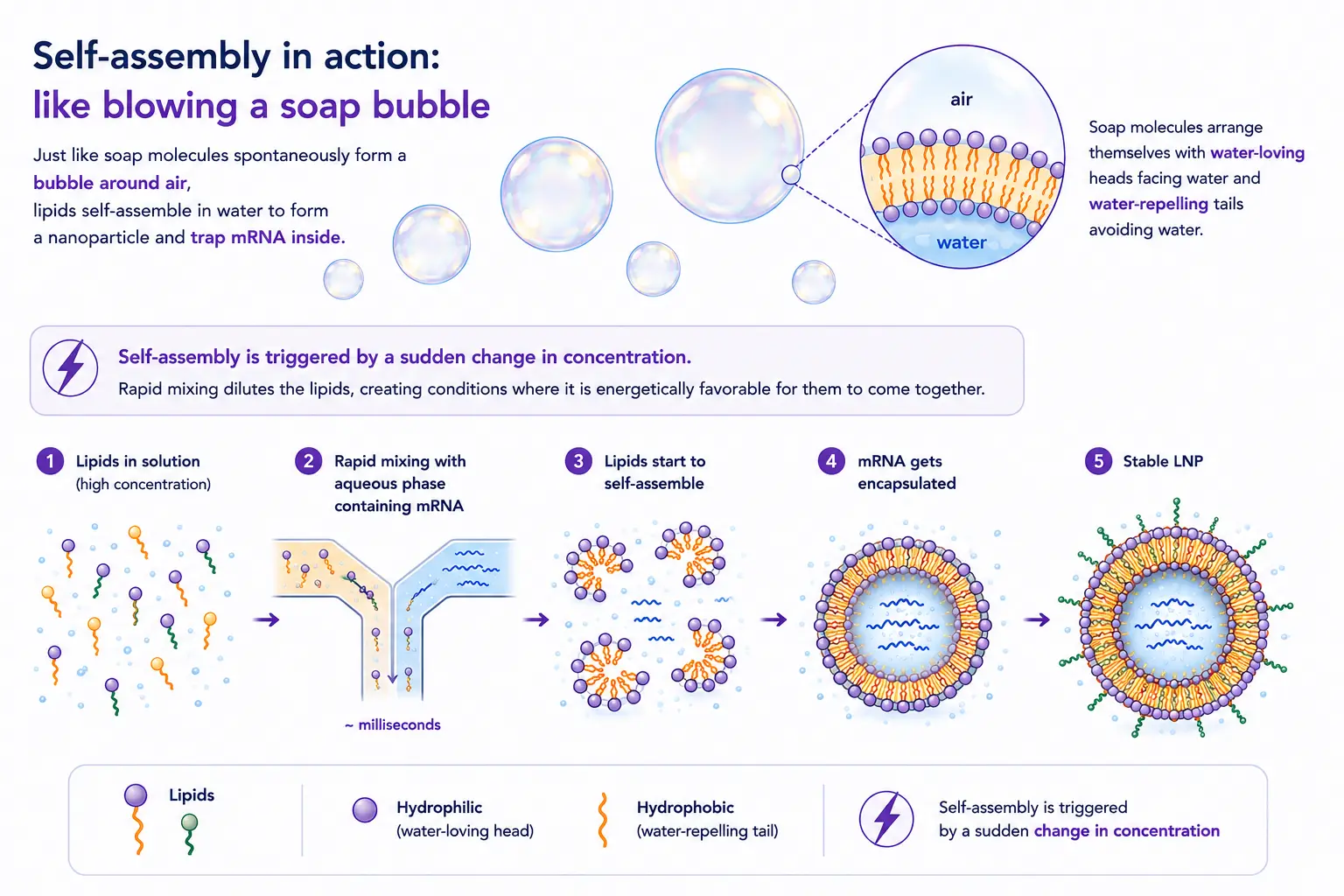
Figure 4: Schematic illustration of lipid nanoparticle self-assembly following the rapid mixing of a lipid solution with an aqueous mRNA-containing phase. Source: Image created with AI assistance
Lipid nanoparticles form in much the same way. As soon as lipids encounter the aqueous environment, they spontaneously rearrange into a stable nanostructure. Their water-loving (hydrophilic) head groups naturally face the surrounding water, while their water-repelling (hydrophobic) tails turn away from it and cluster together. During this self-assembly process, the mRNA becomes encapsulated within the forming lipid nanoparticle.
Although this entire process takes only a few milliseconds, it determines the conditions under which every particle is born and ultimately shapes its Critical Quality Attributes.
From Mixing to Medicine
When the lipid solution and the aqueous API solution meet, thousands of nanoparticles begin to form almost simultaneously. If the two liquids mix rapidly and uniformly, every particle experiences nearly identical conditions. As a result, the particles form at the same time, grow in a similar way, and develop consistent CQAs. This leads to a narrow size distribution, high encapsulation efficiency, and reproducible performance.
If mixing is slower or less uniform, the situation changes. Different regions of the solution contain different local concentrations of lipids and API. Some particles begin forming earlier, while others continue growing for longer. Instead of producing one uniform nanoparticle population, the process creates particles with different sizes, structures, and encapsulation efficiencies.
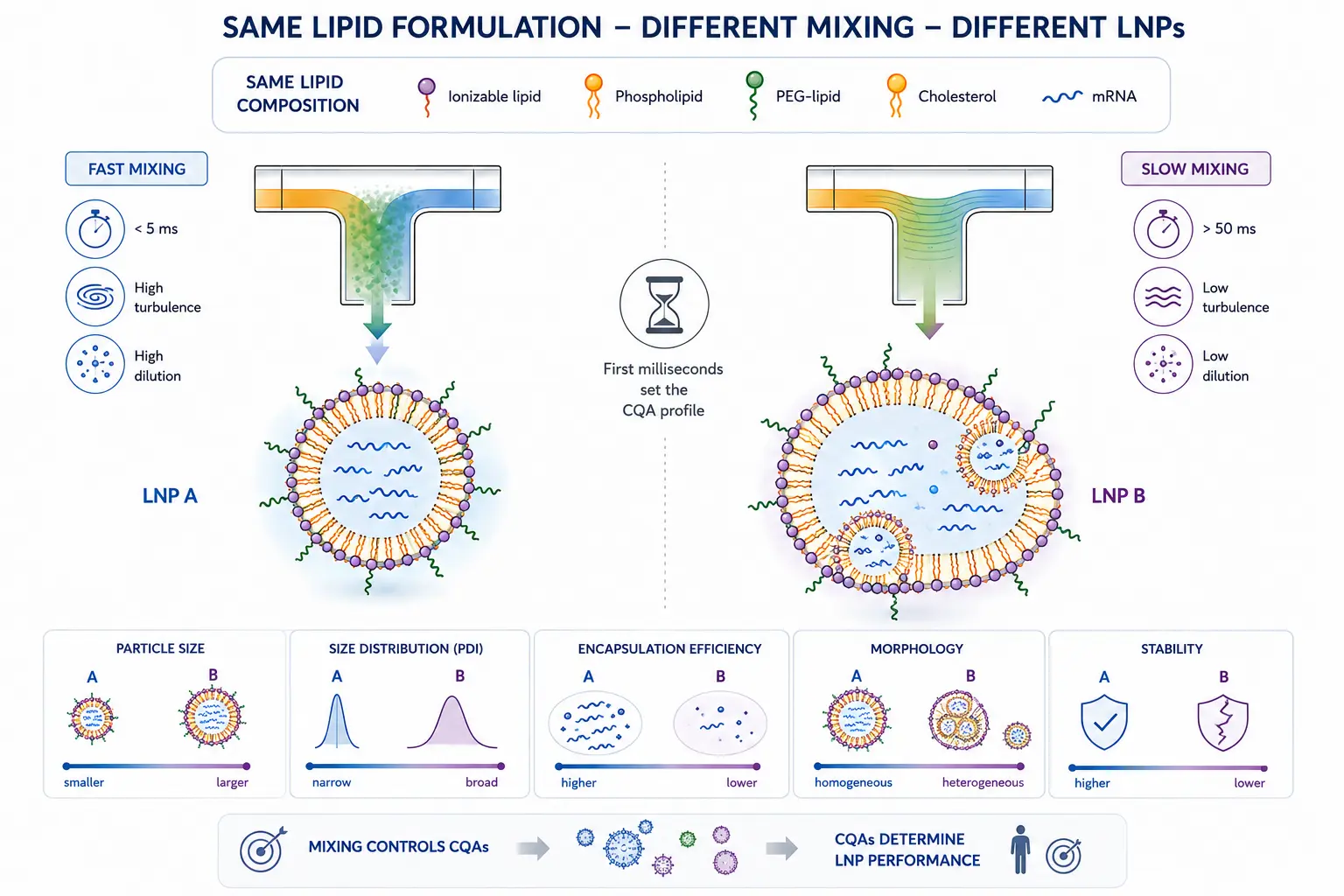
Figure 5: The impact of mixing conditions on the Critical Quality Attributes of LNPs. Source: Image created with AI assistance
In other words, the mixing process creates the environment in which every nanoparticle is born. And because these first milliseconds determine the CQAs, they ultimately influence how well an LNP performs as medicine.
Engineering the First Millisecond
If the first milliseconds determine the quality of an LNP, one obvious question remains:
How to control a process that happens so quickly?
The answer lies in the mixing technology.
Once you dive into LNP manufacturing, you'll quickly discover an overwhelming variety of mixing technologies. it varies from simple manual stirring to T-mixers, microfluidic devices, herringbone mixers, and impinging jet mixers. This diversity exists for a reason: every mixer creates a different mixing environment.
Its geometry determines how the lipid and aqueous streams meet, how rapidly they mix, and how much time lipids have to nucleate, grow, and mature before the nanoparticles are stabilized. Because LNP self-assembly takes place so fast, even subtle differences in the mixing process can significantly influence the resulting CQAs.
Over the years, conventional bulk mixing methods such as manual stirring have largely been replaced by advanced continuous mixing technologies that provide faster and more homogeneous mixing. Among these, Impinging Jet Mixers (IJMs) have become one of the most widely used approaches for LNP manufacturing. By forcing two liquid streams to collide head-on at high velocity, IJMs create highly controlled mixing conditions that enable the formation of uniform, reproducible lipid nanoparticles with consistent attributes.
This mixing principle forms the foundation of KNAUER's LNP manufacturing platforms. By combining precise flow control with impinging jet mixing, the systems support reproducible LNP production from early formulation screening and process development to scalable manufacturing.
In LNP manufacturing, the mixer is much more than a piece of equipment. It is the heart that defines the environment in which every nanoparticle begins its life.
In Part 3, we'll dive deeper into the engineering behind Impinging Jet Mixing and discover why this technology provides the foundation for a fully scalable LNP platform, enabling seamless translation from R&D to production.
Additional Resources
Explore KNAUER's LNP Production Platforms, supporting every stage of LNP development: from
R&D screening to production scale.
To learn more or discuss your application with our experts, please contact us at sales@knauer.net
For further information on this topic, please contact our author: regeler@knauer.net