
Science with Passion

Application No.: VFD0174 Version 1 02/2019
Determination of six steviol glycosides using reversed phased HPLC and online SPE
Johannes Menke, Yannick Krauke, Juliane Böttcher, Kate Monks; applications@knauer.net
KNAUER Wissenschaftliche Geräte GmbH, Hegauer Weg 38, 14163 Berlin

Summary
Steviol glycosides are the main sweetening compounds in Stevia rebaudiana and can be used as natural sugar substitutes, because they have a far higher sweetening power than normal sucrose or glucose. The sweetness is estimated to be about 400 times higher. This gradient method provides a fast determination of six steviol glycosides using reversed phase HPLC and UV detection. Furthermore, an automated matrix reduction is achieved by online SPE (solid phase extraction), speeding up sample preparation and guaranteeing a high sample throughput.
Introduction
For several years research has been undertaken to find sugar substitutes that are calorie free but have the same taste and properties as classic sugar, for diabetics and as part of a calorie-controlled diet. One popular substitute is the so-called “Stevia” which is a mixture of steviol glycosides isolated from the plant Stevia Rebaudiana (REF1). The steviol glycoside rebaudioside A is the main compound of interest as it is the sweetest and less bitter compound of the extract but often a mixture of rebaudioside A and stevioside is found in the “Stevia” products. In addition, also other steviol glycosides like rebaudioside B, rebaudioside C, dulcoside A and steviolbioside are commonly present in stevia mixtures and were therefore also analytes of interest in the developed method, as they are not desired in finished products. A determination method for steviol glycosides in stevia samples, with partly automated sample preparation and matrix reduction could thus be used for an easy quality control of stevia food products.
Results
A gradient method for six steviol glycosides was developed beforehand (application note VFD0168). For this method a manual SPE protocol was used which was then transferred to the online SPE approach. The online SPE method was previously applied in preparative HPLC (application note VFD0171). For the analytical method valve switching sequences, as well as washing and conditioning solutions, were adopted from the preparative method. An extract of dried stevia leaves was used as sample. The extraction was performed as described in the application note for the original analytical method (VFD0168) as well as the 5-point calibration with mix-standard solutions of rebaudioside A, stevioside, rebaudioside C, dulcoside A, rebaudioside B and steviolbioside. The calibration was set for a range from 0.01 mg/mL to 0.15 mg/mL of each individual compound. The injection volume was 20 µL in full loop mode.
The flow passing the SPE column was monitored to see the effect of the washing procedure (Fig 1). After 7 min the main column flow was directed to the detector by swit.
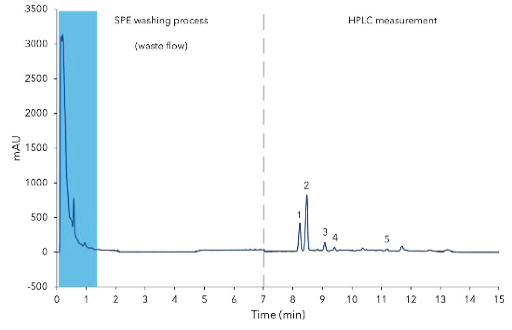
Fig. 1 Measurement of washing process; blue area: matrix; 1) rebaudioside A, 2) stevioside, 3) rebaudioside C, 4) dulcoside A, 5)steviolbioside; 20 µL injection of Stevia extract; 0-7 min) measuring of SPE washing process, 7-15 min) measuring of HPLC
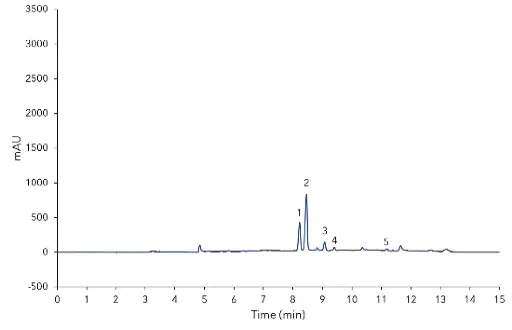
Fig. 2 Measurement of sample only; 1) rebaudioside A, 2) stevioside, 3) rebaudioside C, 4) dulcoside A, 5) steviolbioside; 20 µL injection of Stevia extract
Materials and Methods
As analytical system an AZURA Online SPE System equipped with an autosampler AS 6.1L, a binary high-pressure gradient pump P 6.1L with 10 mL pump head, a CT 2.1L column thermostat and a diode array detector DAD 2.1L was used as described in application note VFD0168. The SPE module of the system consists of an AZURA assistant ASM 2.1L equipped with a 12 port multi position 1/8 ” sst valve (solvent selection), a 6 port 2 position 1/16 ” sst injection valve, a P4.1S 50 ml sst feed pump. Injection was automated using an autosampler AZURA AS 6.1L. The eluent was a composition of A: water and B: acetonitrile and was also used to elute the analytes from the SPE column. As washing solution a premixed composition of 20:80 acetonitrile:water (v/v) was used. Conditioning of the column was performed with acetonitrile. A Vertex Plus column filled with Eurospher II 100-5 C18 silica in a dimension 250 x 4.6 mm ID with precolumn was used. For the SPE a column with the same material, but with dimension 30 x 4.6 mm ID was chosen. The sample was applied to an already conditioned and equilibrated SPE column, followed by a washing procedure. Next, elution on the SPE column is started by introduction of the water:acetonitrile gradient in reverse flow. Subsequently, the flow is then directed to the main column. Meanwhile the SPE column is conditioned and reequilibrated with washing solution using the feed pump.
Conclusion
This method enhances the already fast and robust analysis of steviol glycosides provided by the previous HPLC method keeping all its advantages but adding the capabilities of online SPE. Thus, an easy matrix reduction can be achieved very fast only adding 3 minutes to the original runtime of 12 minutes. This automated matrix reduction saves up time otherwise needed for manual solid phase extraction and allows a high sample throughput. In addition, the analytical main column is spared from being exposed to high concentrations of matrix, enhancing the columns longevity. The monitoring of the washing process also easily allows an optimization of the process. Although the method is now extended to a runtime of 15 min, the overall process of stevia analysis was shortened by a great deal. Additionally, since the SPE column is conditioned for the next run meanwhile sample analysis thus saving even more time.
Additional Materials and Methods
Tab. A1 Method parameters (analytical method)
Tab. A2 Pump parameters (main pump)
Tab. A3 Pump parameters (SPE assistant feed pump)
Tab. A4 SPE assistant valve program
Tab. A5 System configuration & data
Related KNAUER Applications
VFD0168 – Oh so sweet – Quantification of steviol glycosides in Stevia samples with RP-HPLC
VFD0170 – Scale-Up of an analytical HPLC method for steviol glycosides to a preparative approach
VFD0171 – Advantages of preparative online SPE compared to batch LC for stevia purification
VFD0155 – Sensitive online SPE determination of Bisphenol A in water samples
References
[1] “Stevia Leaf to Stevia Sweetener: Exploring Its Science, Benefits, and Future Potential” P. Samuel, K. T. Ayoob, B. A. Magnuson, et al. J Nutr, Volume 148, Issue 7, 1 July 2018, Pages 1186S–1205S
Application details
|
Method |
HPLC |
|
Mode |
RP |
|
Substances |
steviol glycosides |
|
CAS number |
58543-16-1, 57817-89-7, 63550-99-2, 64432-06-0, 58543-17-2, 41093-60-1 |
|
Version |
Application No.: VFD0174 | Version 1 02/2019 | ©KNAUER Wissenschaftliche Geräte GmbH |