
Science with Passion

Application No.: VFD0169 Version 1 12/2018
Determination of sugars in honey – comparison of refractive index and light scattering detection
Juliane Böttcher, Kate Monks; applications@knauer.net
KNAUER Wissenschaftliche Geräte GmbH, Hegauer Weg 38, 14163 Berlin

Summary
Determination of the sugar content and their composition in honey allows a prediction about the origin of honey and determines how it should be labelled. Because of honey being one of the most popular natural food stuffs and its growing consumption, it is necessary to carry out quality control. Here, the dedicated AZURA® Sugar Analytical System with autosampler upgrade was used for the analysis of sugar in honey. Moreover, refractive index and light scattering detection for this application were compared.
Introduction
There are well over 50 different kinds of honey on the market, which differ in consistency, colour, and taste. In Germany, the honey ordinance differentiates honey according to the origin, type of extraction, the form of supply or the intended use. Natural bee honey consists of approx. 39 % fructose and approx. 34 % glucose. [1] For example, blossom honey (Blütenhonig) must contain at least 60 % fructose and glucose [2]. In addition, small amounts of sucrose or maltose can be detected [1]. Internationally, products containing more than 5 % sucrose or maltose must no longer be labeled as „pure“ honey [3]. The Association of Official Analytical Chemist (AOAC) designed a method for the analysis of sucrose, fructose, and glucose in honey (AOAC 977.20). The method is originally performed in HILIC mode, here a KNAUER Eurokat Pb polymer column was used. Since KNAUER has produced its own honey from a bee colony located in the garden, this honey was taken as one of the samples. Furthermore, one commercially available honey and agave nectar were analysed. This application is also used to illustrate the difference between the detection with the AZURA RID 2.1L and the SEDEX LT100 ELSD.
Results
The most important carbohydrates for the evaluation of honey: fructose, glucose, sucrose, and maltose were determined here. Sucrose and maltose were not baseline separated but the resolution was good enough to clearly identify and quantify them. A calibration in a range from 0.03 mg/mL to 1.50 mg/mL for the ELSD and from 0.30 mg/mL to 3.00 mg/mL for the RID was prepared. Fig 1 shows the traces of a mixed standard at a level of 0.6 mg/mL for both detectors. Fig 2 and 3 show an overlay of the three different samples measured with ELSD and RID. The KNAUER honey and the fruit blossom honey showed a similar profile. Both contain more fructose than glucose. Residues of maltose and sucrose were detected. The agave nectar contains more fructose. In comparison its fructose amount is about 1.3 times higher than measured for the honey samples. Tab A1 (additional results section) summarizes the calculated results for all samples. Calculated results of both detectors are similar. The deviation of certain values might occur due to different calibration functions and different sensitivities of the detectors. The total sugar content (averaged value from both detectors) of the KNAUER honey and fruit blossom honey was around 77 % and 73 %, respectively.
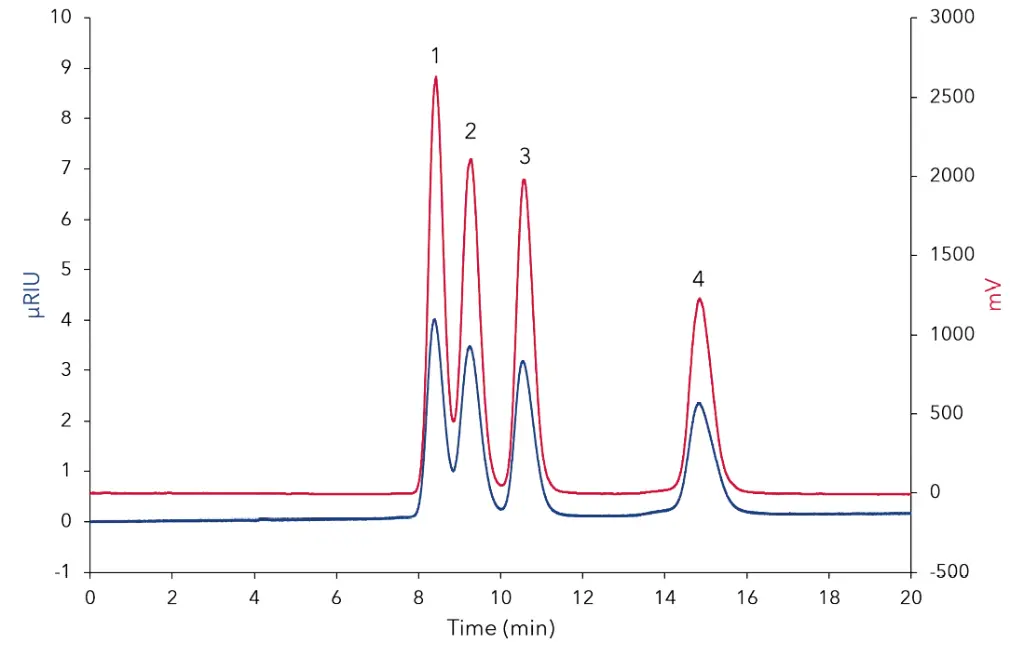
Fig. 1 ELSD trace (red) and RID trace (blue) of a mixed standard at 0.60 mg/mL; 1) sucrose, 2) maltose, 3) glucose, 4) fructose
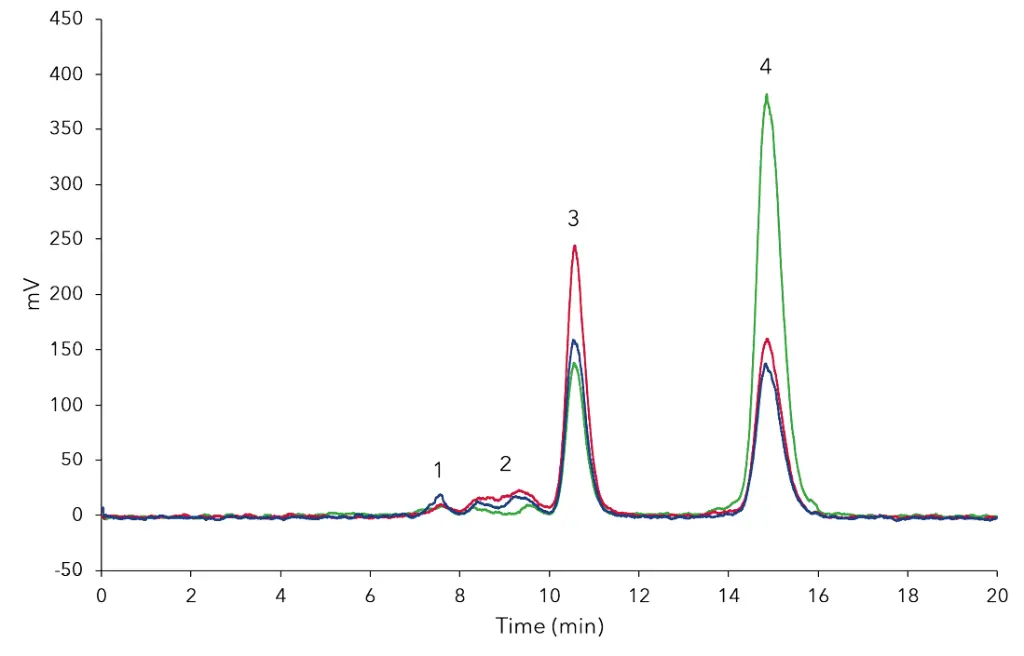
Fig. 2 Overlay of measured samples; ELSD traces: Knauer honey – blue,blossom honey – red, agave nectar – green; 1) sucrose, 2) maltose, 3) glucose, 4) fructose
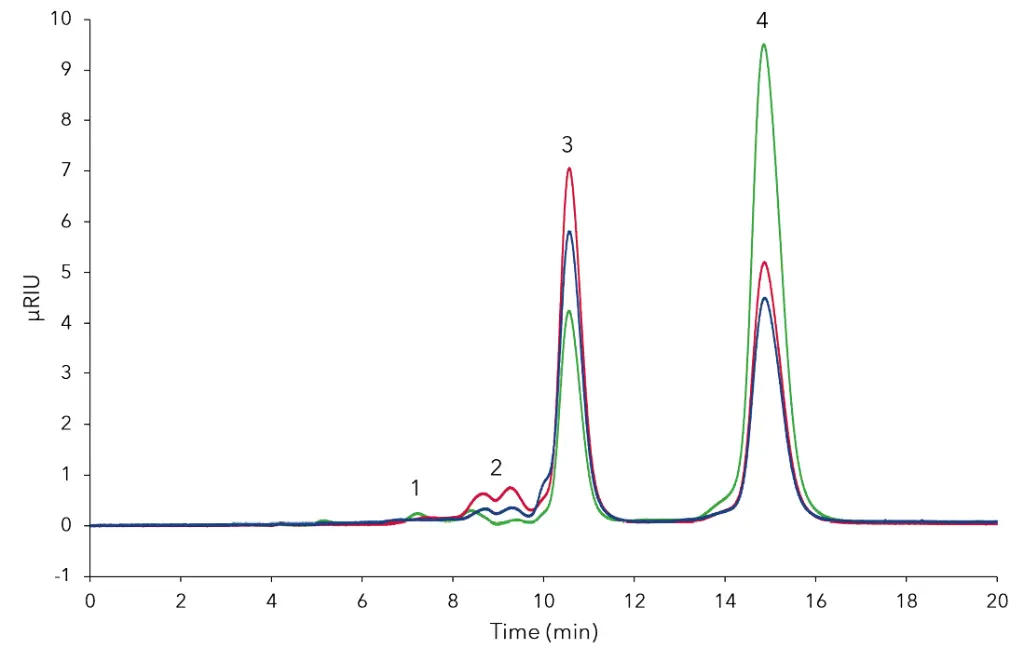
Fig. 3 Overlay of measured samples; RID traces: Knauer honey – blue, blossom honey – red, agave nectar – green; 1) sucrose, 2) maltose, 3) glucose, 4) fructose
Materials and Methods
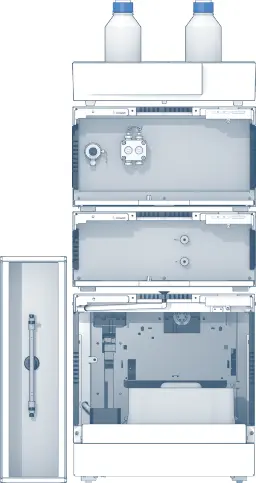
The AZURA® dedicated system for sugar analytics with an additional autosampler was used for this application. The system consisted of an isocratic AZURA P 6.1L pump, an AZURA AS 6.1L autosampler, an AZURA CT 2.1 column thermostat, and an AZURA RID 2.1L refractive index detector. For the comparison also a SEDEX LT100 ELSD was used. The isocratic method ran at a flow rate of 0.8 mL/min at a column temperature of 75 °C. Water was used as eluent. Detector settings of the RID 2.1L were set to 20 Hz. Nitrogen pressure of ELSD was 3.5 bar. Eluent goes through the nebulizer with a temperature of 65 °C, the filter was set to 10 s and the gain was dynamic. The samples were weighed, and 10 mL of water were added. Before injection a further dilution with water in a ratio 1:100 (ELSD) and 1:10 (RID) was carried out.
Conclusion
Obviously, the ELSD provides a much higher sensitivity. A concentration of 0.03 mg/mL was also measured with the RID, but the peaks were too low in comparison to the ELSD and could therefore not be considered for calibration. Chromatograms of this concentration are displayed in the additional results section. The advantage of the RID 2.1L lies in its high linear range up to 1000 µRIU or more when using the extended dynamic range. It was no problem here to inject the undiluted samples but due to the chosen calibration range a dilution was necessary. The honey samples contained more than 60 % fructose and glucose, as expected. The ratio of fructose and glucose was also typical for honey. The more glucose a honey has, the faster it tends to crystallize. The agave nectar showed a different kind of sugar pattern. [1] No matter which detector is chosen, besides the determination of sugars, this application can also be used to differentiate between natural products such as honey and possible substitutes.
Additional results
Tab. A1 Calculated amounts of sugar in samples
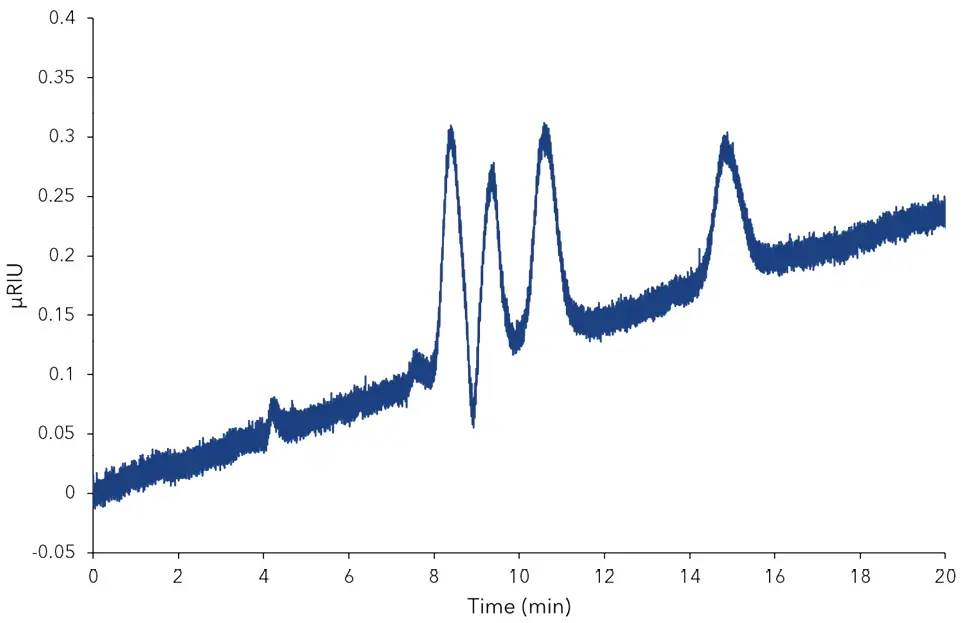
Fig. A1 RID trace of mixed standard at 0.03 mg/mL
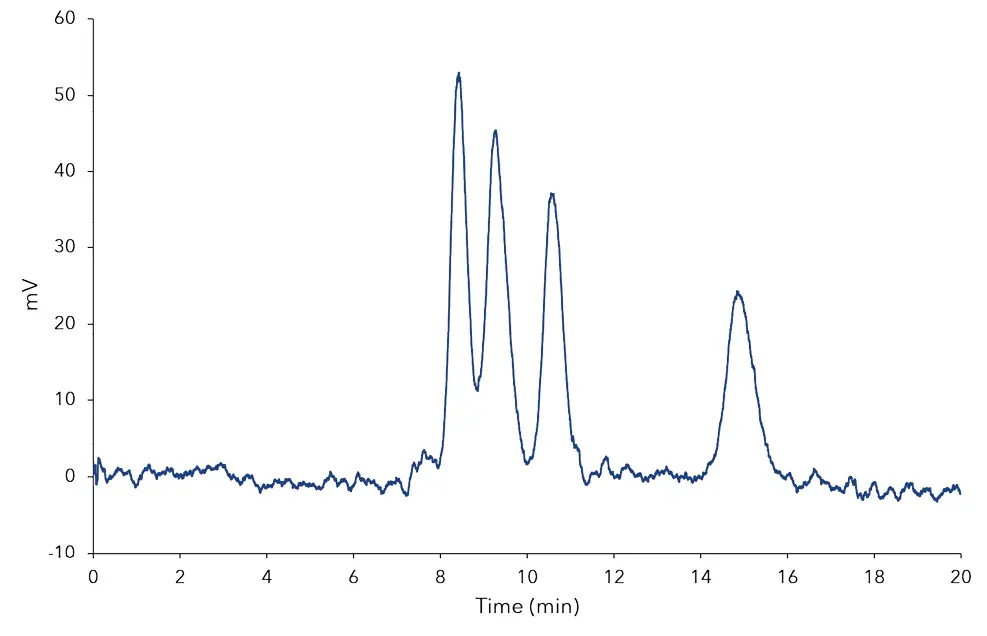
Fig. A2 ELSD trace of mixed standard at 0.03 mg/mL
Additional Materials and Methods
Tab. A2 Method parameters
Tab. A3 System configuration
Related KNAUER Applications
VFD0160 – Determination of sugars and natural sugar substitutes in different matrices
VFD0161 – Determination of sugars in honey using HILIC separation and RI detection
VFD0155 – Semi preparative xylitol purification with dedicated sugar purification system
VSP0013 – Simplified scale up for sugars with the AZURA RID 2.1L extended dynamic range option
References
[1] AID Zucker, Sirupe, Honig, Zuckeraustauschstoffe und Süßstoffe (Nr. 1157)
[2] Honigverordnung vom 16. Januar 2004 (BGBI I S. 92)
[3] Codex Alimentarius Commission, 2001; GB18796-2005, 2005
Application details
|
Method |
HPLC |
|
Mode |
Ion exclusion, Ligand exchange |
|
Substances |
Glucose, sucrose, maltose, fructose |
|
CAS number |
57-48-7, 14431-43-7, 57-50-1, 6363-53-7 |
|
Version |
Application No.: VFD0169 | Version 1 12/2018 | ©KNAUER Wissenschaftliche Geräte GmbH |