
Science with Passion

Application No.: VEV0079
Version 1 12/2017
Determination of aromatic hydrocarbon types according to DIN EN 12916:2016
Juliane Böttcher, Kate Monks; applications@knauer.net
KNAUER Wissenschaftliche Geräte GmbH, Hegauer Weg 38, 14163 Berlin

Summary
In this work aromatic hydrocarbons were determined under normal phase conditions using an AZURA® analytical HPLC plus system with RI detection according to the DIN EN 12916:2016. The instrumental setup and method can be used to determine the content of hydrocarbons in motor diesel fules, which is important for protecting the environment and public health. The standards used for system suitability according to DIN EN 12916:2016 are also part of the calibration used in the IP391(2000)/ASTM D6591 methods but the method settings are slightly divergent.
Introduction
The content of hydrocarbons in motor diesel fuels affects exhaust emissions and fuel combustion characteristics. These emissions are measured by the cetane number which is an indicator of the combustion speed of diesel fuel and compression needed for ignition [1]. It is important to measure these values due to an incomplete burning, for protecting the environment and public health. The DIN EN 12916:2016 is suitable for the determination of monoaromatic (MAH), diaromatic (DAH) and tri+ – aromatic (T+AH) hydrocarbons in diesel fuels containing up to 30 % (v/v) fatty acid methyl esters (FAME) and petroleum distillates with a boiling range of 150 °C up to 400 °C. The amount of polycyclic aromatic (Poly-AH) hydrocarbons will be calculated as the sum of diaromatic and tri+- aromatic hydrocarbons. [2] Working according to this regulatory also requires a system suitability test to make sure that chosen HPLC hardware as well as the selected column are suitable for the application.
Results
The detailed requirements and calculations for performing the system suitability are described in DIN EN 12916:2016. After achieving all necessary system specifications, a calibration was made. Fig 1 exemplary shows the separation of system calibration standard 1 (SCS 1) containing cyclohexane, 1-phenyldodecane, o-xylene, hexamethyl benzene, naphthalene, dibenzothiophene and 9-methylanthracene. The calibration standard consists of three different compounds: 1,2-dimethyl benzene, fluorene and phenanthrene. Tab 1 shows the concentrations for each compound at four different levels. Fig 2 shows the chromatogram of calibration standard A. The calculation of the number of hydrocarbons in real samples corresponds to retention times of MAH, DAH and T+AH determined in the calibration.
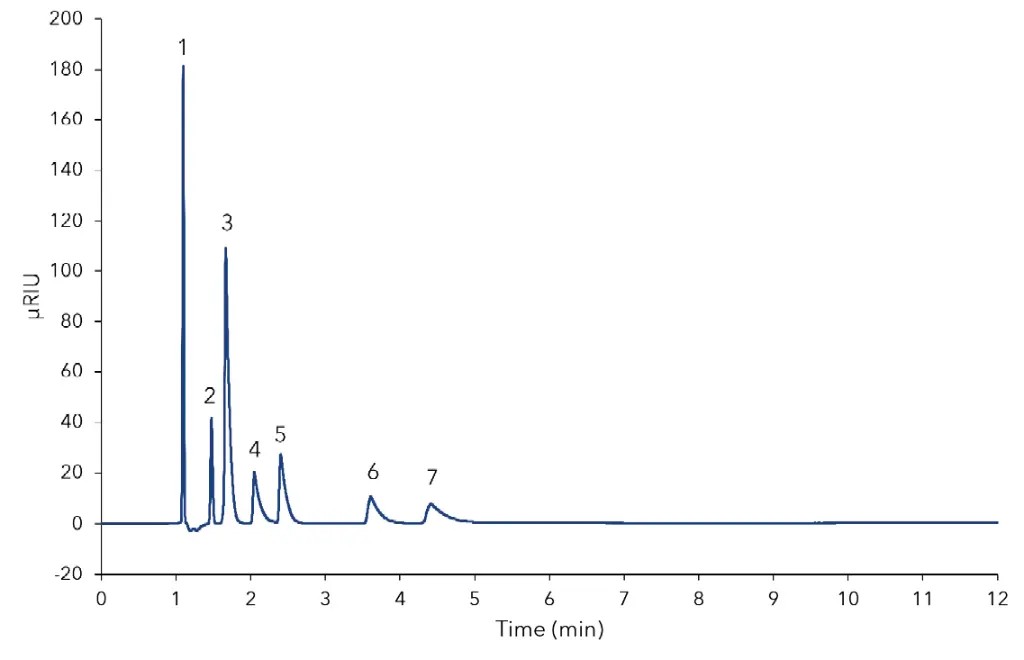
Fig. 1 System calibration standard 1 (SCS 1), 1) cyclohexane, 2) 1-phenyldodecane, 3) 1,2-dimethyl benzene, 4) hexamethyl benzene, 5) naphthalene,
6) dibenzothiophene,7) 9-methylanthracene
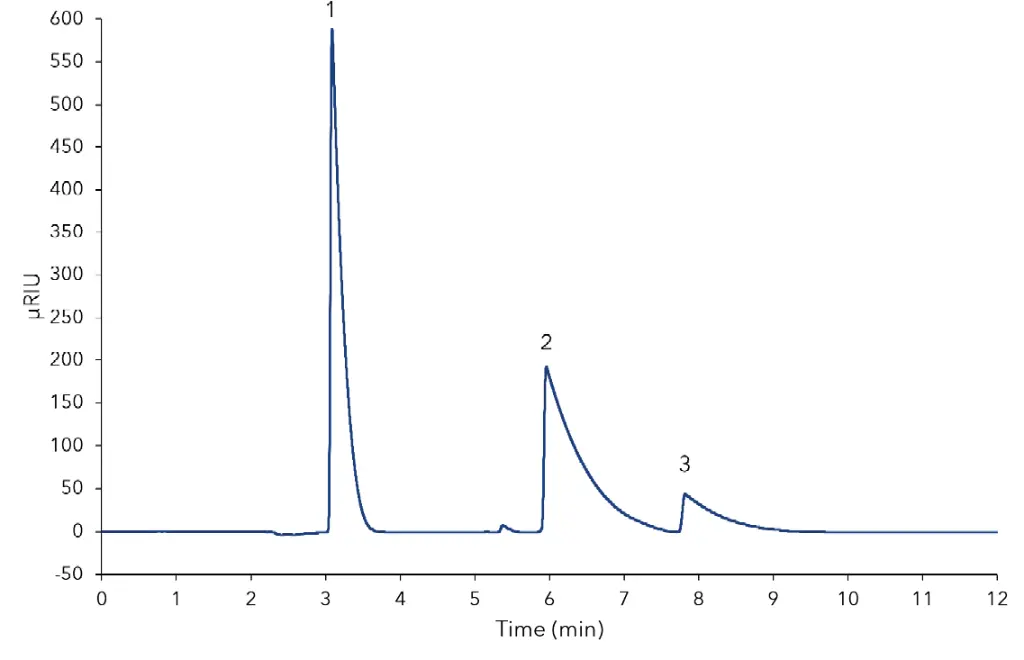
Fig. 2 Calibration standard level A, 1) 1,2-dimethyl benzene, 2) fluorene,
3) phenanthrene
Tab. 1 Calibration concentrations at four different levels
Materials and Methods
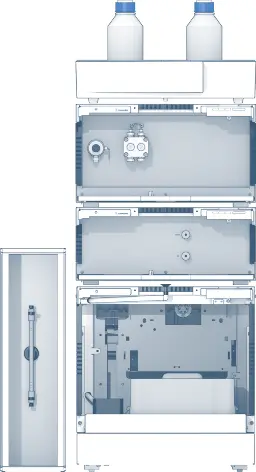
An analytical AZURA HPLC system was used for this application. It consisted of an isocratic AZURA P 6.1L pump, suitable for normal phase application. Furthermore, an AZURA RID 2.1L detector, an AZURA AS 6.1L autosampler and an AZURA CT 2.1 column thermostat. The eluent was n-heptane at a flow rate of 1.2 mL/min. The column temperature was set to 25 °C. Detector settings were set to 20 Hz with a time constant of 0.05 s. The column in a dimension 250 x 4 mm ID was filled with Nucleodur 100-5 NH2 silica.
Conclusion
Using this instrumental setup, it is possible to determine mono and di-aromatic hydrocarbons according to the DIN EN 12916:2016.
Additional Materials and Methods
Tab. A1 Method parameters
Tab. A2 System configuration & data
References
[1] http://www.astm.org/Standards/D6591.htm
[2] DIN EN 12916:2016 Petroleum products – Determination of aromatic hydrocarbon types in middle distillates – High performance liquid chromatography method with refractive index detection, German version
Related KNAUER Applications
VEV0080 – Determination of mono- and polyaromatic hydrocarbons in petrol with AZURA® Analytical HPLC system using RI detection
Application details