
Science with Passion

Application No.: VFD0182 Version 1 01/2020
Determination of aflatoxins in cereal baby food samples – from extraction to high efficient detection
Kristin Folmert, Kate Monks; applications@knauer.net
KNAUER Wissenschaftliche Geräte GmbH, Hegauer Weg 38, 14163 Berlin
In Kooperation mit Macherey Nagel, LCTech GmbH
Aflatoxins are the best known group of mycotoxins produced as secondary metabolites by fungi, mainly by Aspergillus flavus and Aspergillus parasiticus, but to a smaller extent also by other strains [1]. Aflatoxins can be produced on cereals in the field or during storage, especially under warm conditions and high humidity. Aflatoxins are stable compounds that are not destroyed during food processing like cooking or baking. That is why they also can be present in derived products such as processed cereal-based foods and baby foods for infants and young children. During the first several months of life, at the age of 4 to 6 months, infants require the gradual replacement of breast milk with infant cereal products, which are frequently the first solid meal used in infant feeding. Infants are more susceptible to aflatoxins and other mycotoxins. Due to their rapid growth rate, liver damage and other toxic influences are more critical than for adults. In addition, infants have increased vulnerability to contaminants than adults due to their lower body weight, reduced ability to detoxify hazardous agents and a more restricted diet [2]. Most baby foods for infants and young children are multi-cereal, as many different grains are used as ingredients, so increasing the probability of aflatoxin contamination. Although many aflatoxins exist, only a limited number is important in analytical practice. Aflatoxin B1 is most widespread and can be found in food and feed products such as peanuts, pistachios, corn and cottonseed, dried fruits and all processed products. It is highly toxic and the WHO classified it as a group 1 carcinogen [3]. The aflatoxins B2, G1 and G2 are usually found accompanying B1, in lower concentrations in the contaminated samples (Fig. 1). Governmental institutions and health protection agencies like FDA, WHO and European Commission apply these methods on a large scale to control marketed food products and animal feed [3,4,5]. Additionally, the presence of aflatoxins B1, B2, G1 and G2 in a variety of processed and unprocessed foods is controlled in countries around the world. The lowest maximum aflatoxin level of 0.1 µg/kg for processed cereal-based foods and all kinds of dietary foods for special medical purpose, both for babies, infants and young children are set by the European Commission according to regulation EG 1881/2006 [6]. From 2013 to 2018 the Rapid Alert System for Food and Feed of the European Commission (RASFF) registered 44 notifications for aflatoxins in cereals and bakery products and two in baby food [7]. The alerts affecting baby foods were notified by Switzerland (aflatoxin B1 at 0.18 µg/kg) and the Netherlands (aflatoxin B1 from 0.21 to 0.39 µg/kg) [2]. The required verification method is HPLC with fluorescence detection and preliminary sample extraction. Unfortunately, aflatoxins B1 and G1 show only minimal fluorescence and are thus difficult to detect. Irradiating the aflatoxins mixture with UV light of 254 nm, the aflatoxins B1 and G1 undergo photo-induced hydroxylation and can then be measured through fluorescence spectrometry more sensitively. The dedicated AZURA® Aflatoxin system consists of a fluorescence detector with coupled photochemical post column derivatization module. The photochemical post column derivatization enables a non-toxic and fast derivatization at room temperature. In comparison to previous methods, using saturated iodine reactions coils or with electrochemical generated bromine in a KOBRA cell, no toxic halogenic reagents were used for derivatization. Thus, no halogenic solvent waste was produced. The complete analytical method, including recovery, standard deviation and robustness evaluation, is described in AppNote VFD0178 [8]. The sample preparation for the analytical method described in this AppNote is suitable to reduce intensive matrix effects to enable a highly reproducible and sensitive quantification of the aflatoxins.
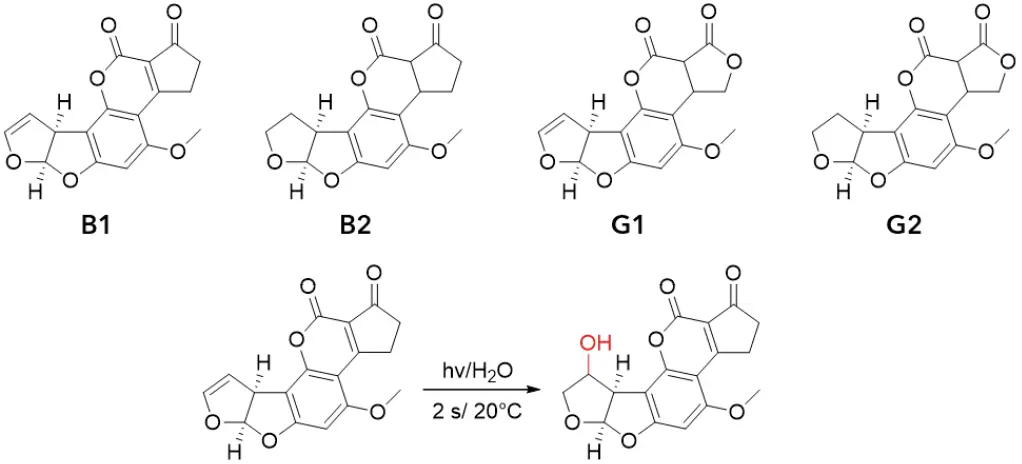
Fig. 1 Chemical structures of the four aflatoxins and the reaction mechanism of the photochemical activation.
Results
The sample preparation for the analytical aflatoxin analysis is based on three different extraction steps. During the first solid-liquid extraction aflatoxins can be extracted together with many other soluble compounds, removing most of the solid material. During the liquid-liquid extraction most fatty and hydrophobic compounds could be removed. Most of the resulting matrix peaks, especially in the critical time between 6.5 and 8 minutes, where the aflatoxins can be detected, could be removed during SPE extraction (Fig. 2). Two of the resulting peaks with higher fluorescence intensity up to 250 counts correspond to the solvents chloroform (tR= 2.0 min) and acetone (tR= 3.8 min). With almost all matrix peaks removed, a highly sensitive and robust aflatoxin analysis can be assured.
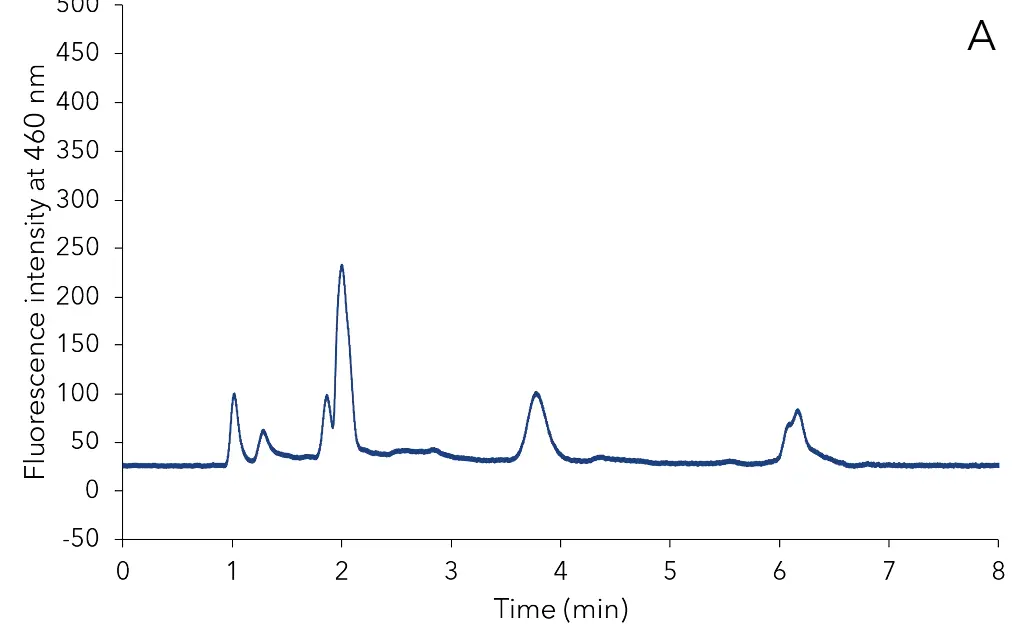
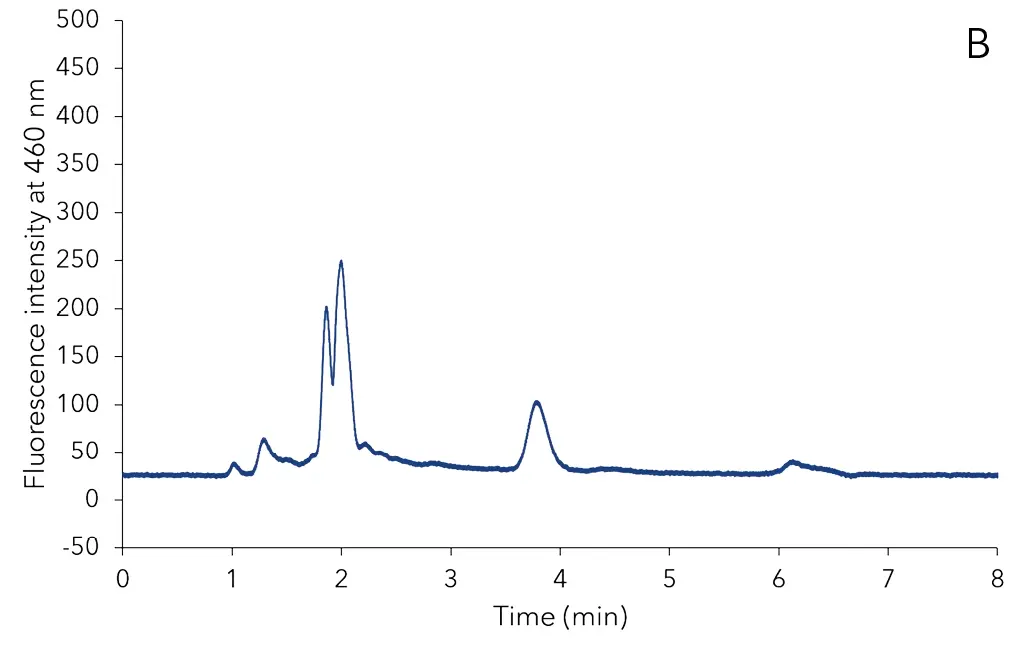
Fig. 2 Two different chromatograms of cereal containing baby food extraction samples without aflatoxins. The extract of baby puree on the left (A) and the extract of baby rusk on the right site (B).
In Fig. 3 a various mixture of different food sample extractions spiked with 20 ng/mL of the aflatoxins B1/G1 and 6 ng/mL B2/G2 was analyzed (blue). The determined limits of detection (LOD) were 0.05 ng/mL for aflatoxins B1/G1 and 0.015 ng/mL for B2/G2 (Fig. 3, red). These values are 3.4 and 11.3 times lower than requested from the European Commission [6].
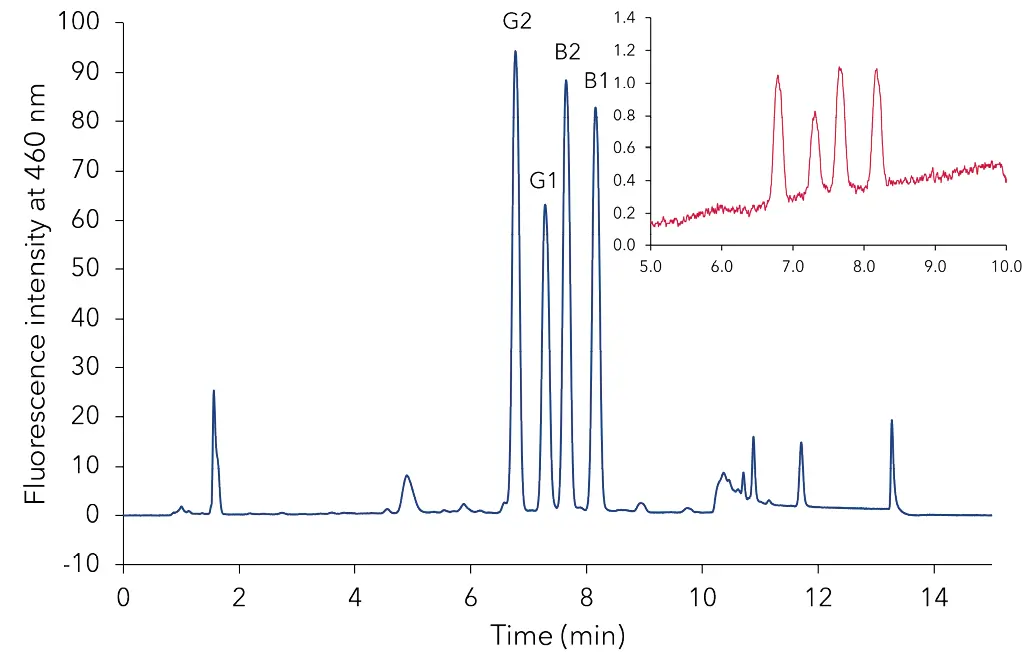
Fig. 3 Chromatogram of a mixture including equal parts of extraction products from peanuts, pistachios, cereal puree for babies and dried fruits (cherries, cranberries, raisins, aronia and plums) spiked with 20 ng/mL of the aflatoxins B1/G1 and 6 ng/mL B2/G2 (blue). Zoom into a chromatogram of a standard mixture of the four aflatoxins at the LOQ (red).
Sample Preparations
For sample preparation 50 g of commercially available baby rusk were grinded to a fine powder before suspending it with 20 mL MeOH:H₂O (17:3, v/v) for 30 minutes. Cereal baby puree was directly suspended with 20 mL MeOH:H₂O (17:3, v/v). The suspension was filtered and 40 mL of the extract were filled into an extraction funnel. The extract was degreased two times with 25 mL n-hexane and the aqueous phase was extracted two times with 25 mL chloroform. The organic extract was evaporated to 3 mL before SPE extraction. The SPE cartridges were provided by Macherey Nagel and filled with 3 mL SiOH with a specific loading capacity of 500 mg. The SPE cartridge was conditioned with 3 mL n-hexane followed by 3 mL chloroform before the extract was added. The bounded compounds from the extract, including the aflatoxins, were washed with n-hexane, diethyl ether and chloroform, 3 mL each. After washing, the collecting template was changed and the bounded compounds were removed by rinsing the SPE cartridge with 6 mL chloroform:acetone (9:1, v/v). The final extract was stored in a gas tight glass flask. The sample preparation was performed in three identical replicates to evaluate the reproducibility of the method. During sample preparation an analytical sample was collected after the extraction with MeOH/H₂O, before and after the SPE extraction to verify the success of the extraction step.
Conclusion
The described sample preparation for the extraction of aflatoxins from cereal based baby food products can be used for all kind of food and animal feed which could be affected by aflatoxins. Analytical control samples after every extraction step could verify that the sample preparation is very efficient for the reduction of matrix peaks. Additionally, using the UVE photochemical reactor for post column derivatization in combination with the AZURA Analytical HPLC system and Eurospher II C18 column, it was possible to detect the four aflatoxins B1, B2, G1 and G2 in one chromatographic run of a spiked sample with the very low LOD of 0.05 ng/mL for B1/G1 and 0.015 ng/mL for B2/G2.
Materials and Methods
Tab. 1 Instrument setup
Column temperature | 60 °C | Time constant | 0.2 s |
Injection volume | 10 µL | Excitation | 365 nm |
Injection mode | Full Loop | Emission | 460 nm |
Detection | FLD | Post column derivatization | 254 nm |
Data rate | 50 Hz | Flow rate | 2.4 mL/min |
Tab. 2 Pump program
Time (min) | Water (%) | ACN (%) | MeOH (%) |
0.0 | 83 | 5 | 12 |
0.5 | 83 | 5 | 12 |
9.0 | 54 | 34 | 12 |
9.1 | 0 | 100 | 0 |
12.0 | 0 | 100 | 0 |
12.1 | 83 | 5 | 12 |
15.0 | 83 | 5 | 12 |
Tab. 3 System configuration
Instrument | Description | Article No. |
Pump | AZURA P6.1L, LPG | |
Autosampler | AZURA AS 6.1L | |
Fluorescence detector | RF-20A | |
Thermostat | AZURA CT 2.1 | |
Column | Eurospher II 100-3 C18, 150 x 4.6 mm ID | |
Post column derivatization | UVE Box, 50 Hz | |
Interface box | IFU 2.1 Lan | |
Software | ClarityChrom 8.1 |
References
[1] Hedayati, M. T., Pasqualotto, A. C., Bowyer P., Denning, D. W. Aspergillus flavus: human pathogen, allergen and mycotoxin producer. Microbiology 153 (6), 1677-1692 (2007).
[2] Herrera, M., Bervis, N., Carramiñana, J. J., Juan, T., Herrera, A., Ariño, A., Lorán, S. Occurrence and exposure assessment of aflatoxins and deoxynivalenol in cereal-based baby foods for infants. Toxins 11 (3) 150 (2019).
[3] World Health Organization (WHO) Aflatoxins. Food safety digest, Department of food safety and zoonoses. Ref. No.: WHO/NHM/FOS/RAM/18.1 (2018).
[4] U.S. Department of Health and Human Services, Food and Drug Administration (FDA) Action levels for aflatoxins in animal food. CPG Sec. 683.100 (2019).
[5] The European Commission, Commission Regulation (EC) No 401/2006 of 23 February 2006 laying down the methods of sampling and analysis for the official control of the levels of mycotoxins in foodstuffs (2016).
[6] The European Commission, Commission Regulation (EC) No 1881/2006 of 19 December 2006 setting maximum levels for certain contaminants in foodstuffs (2006).
[7] Rapid Alert System for Food and Feed (RASFF), accessed on 31 January 2019, <https://webgate.ec.europa.eu/rasff-window/portal/>.
[8] Folmert, K., Margraf, M., Monks, K. Quick and easy determination of aflatoxins in food matrices with photochemical postcolumn derivatization. KNAUER, AppNote VFD0178, 1-4 (2019).
Related KNAUER Applications
VFD0152 – Determination of Aflatoxin M1 in milk
VFD0175 – Verification of the mycotoxin patulin from apple juice with isocratic HPLC
VFD0178 – Quick and easy determination of aflatoxins in food matrices with photochemical post column derivatization
VFD0179 – Determination of aflatoxines in peanut samples - from extraction to high efficient detection
VFD0180 – Determination of aflatoxines in pistachio samples - from extraction to high efficient detection
VFD0181 – Determination of aflatoxines in dried fruits - from extraction to high efficient detection
Application details
|
Method |
HPLC |
|
Mode |
RP |
|
Sample |
baby food: baby rusk and baby puree |
|
CAS number |
n/a |
|
Version |
Application No.: VFD0182 | Version 1 01/2020 | ©KNAUER Wissenschaftliche Geräte GmbH |