
Science with Passion

Application No.: VTN0048 Version 1 06/2026
Smart Monitoring & Optimization Solutions for SMB Processes: In-Line and Off-Line Tools for SMB Systems
Y. Krauke, U. Krop, K. Abraham; krauke@knauer.net
KNAUER Wissenschaftliche Geräte GmbH, Hegauer Weg 38, 14163 Berlin
Summary
For Simulated Moving Bed (SMB) chromatography processes different in-line and off-line tools are available and applied for monitoring and optimization. In-line tools such as pressure sensors, flowmeters, and detectors provide real-time control of critical parameters, while off-line analysis using HPLC verifies separation performance through sample testing.
Combining these tools enables better process control, faster optimization, and reliable, high-quality separations in both development and production.
Introduction
In liquid chromatography, the purification of target compounds is classically carried out using single column batch chromatography. More efficient approaches include semi – continuous systems with two to three columns and continuous multicolumn systems. The most widely used of the latter is the simulated moving bed (SMB) chromatography which enables the continuous separation of binary or pseudo-binary mixtures. SMB purification is used in various areas such as petrochemical, pharmaceutical or food industry for the production of fine chemicals in different quantities and purities ranging from gram to tons per day. SMB systems vary significantly in size from small lab scale systems operating columns with 8 mm inner diameter (ID) to industrial systems operating columns of one-meter ID or larger.
Ideally, an SMB process is developed in a smaller lab scale system to reduce solvent and sample consumption compared to development at production scale. Once the separation parameters are established, the SMB process allows for accurate up scaling from lab to production scale. During method development but also production, different tools can be used to monitor and control the process which can be distinguished between in-line and off-line measures. The most crucial parameter, in addition to measuring the pressure, is monitoring the flow rates of the pumps, outlets and/or zones accurately with additional flowmeters. Normally, SMB systems are not equipped with detectors, but UV or RI detectors can be integrated to monitor process stability.
A standard off-line tool is used to analyse samples taken for one switch or cycle at the raffinate and extract outlets. The resulting chromatograms are used to check, if the separation is working. Further, samples can be taken during the process allowing the depiction of concentration profiles in the different zones. These tools will be described in more detail in the following sections.
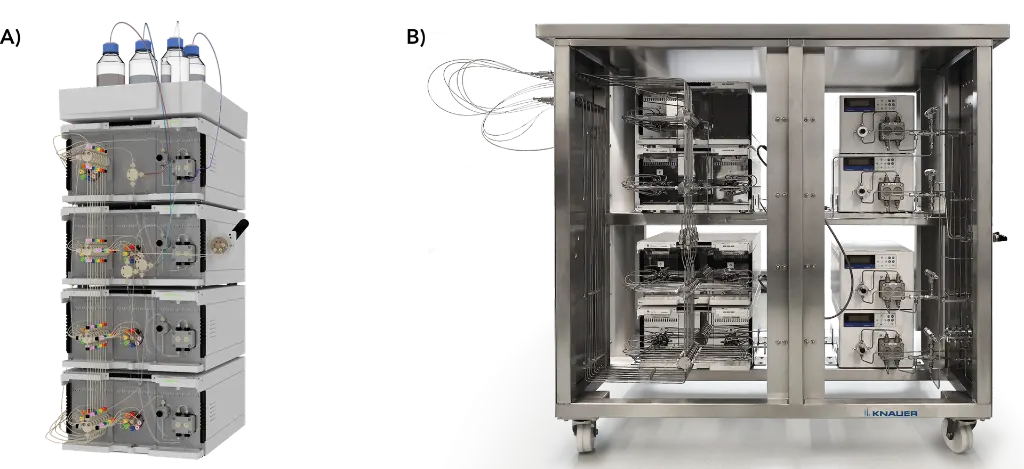
Fig. 1 A) KNAUER AZURA Lab Scale SMB system (PEEK version) with 7 x 8 port multiposition valves, 3 x 50 ml/min and 1 x 10 ml/min pumps and one manual valve for open/closed loop set-up, B) KNAUER Pilot Scale SMB system with 7 x 8 port multiposition valves, 3 x 250 ml/min and 1 x 100 ml/min pumps, in-line sampling valve, open/closed loop valve
Results
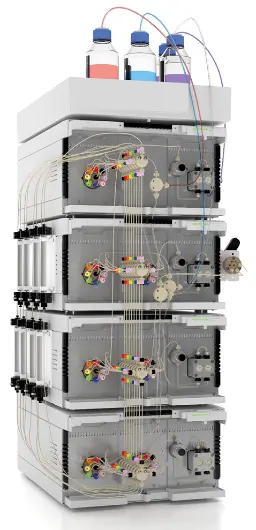
SMB processes are developed for and applied in different scales depending on their purpose. Processes with smaller columns (ID 8 mm – 20 mm) with flowrates of less than 40 ml/min are typically used for research and development purposes or small scale production. Larger scale production processes start with ID 50 mm columns and system flow rates starting at 100 ml/min. KNAUER offers two SMB system dimensions: the AZURA SMB Lab scale and the AZURA SMB Pilot scale systems (Fig. 1). Both systems use the same set-up to achieve SMB separation, using seven 8 - port multiposition valves and four pumps. Three pumps are integrated into the SMB circuit (Zone 1, Zone 2 and Zone 4 pump), the fourth pump is pumping the feed into the circuit (Fig. 2).
Most SMB systems are not equipped with any detection devices. Nonetheless, monitoring the process is important for both method development and production. Various tools exist which can be categorized in in-line and off-line tools (Fig. 2). In-line tools monitor the process directly via signal traces. For the off-line tools an additional analysis by an analytical HPLC is needed.
The two most common ways to surveil an SMB process are monitoring the pressure at the pumps (Fig.2 no. 1) and collecting outlet streams for one switch or over one full SMB cycle (Fig.2 no. 4). A precise flow rate in the different zones is critical for proper process performance, one or more flowmeters can be integrated into the system at different places to either measure the flow rate of the pumps directly or the flow of the different zones at various outlet points (Fig. 2 no. 2). The concentration profile of the different components can be monitored by collecting samples during one SMB cycle at fixed time points using an inline sampling valve (Fig. 2 no. 5). Detectors such as UV or RI can be integrated at the raffinate and extract outlets to monitor the stability of the process (Fig. 2 no.3). Values such as pump pressures, theoretical zone flow rates, pump flow rate of flow meters and signals of detectors (if included) are shown in the control panel and visualization of the SMB system in the PurityChrom®MCC software (Fig. 3). Also, the positions of the columns at a given time point are highlighted.
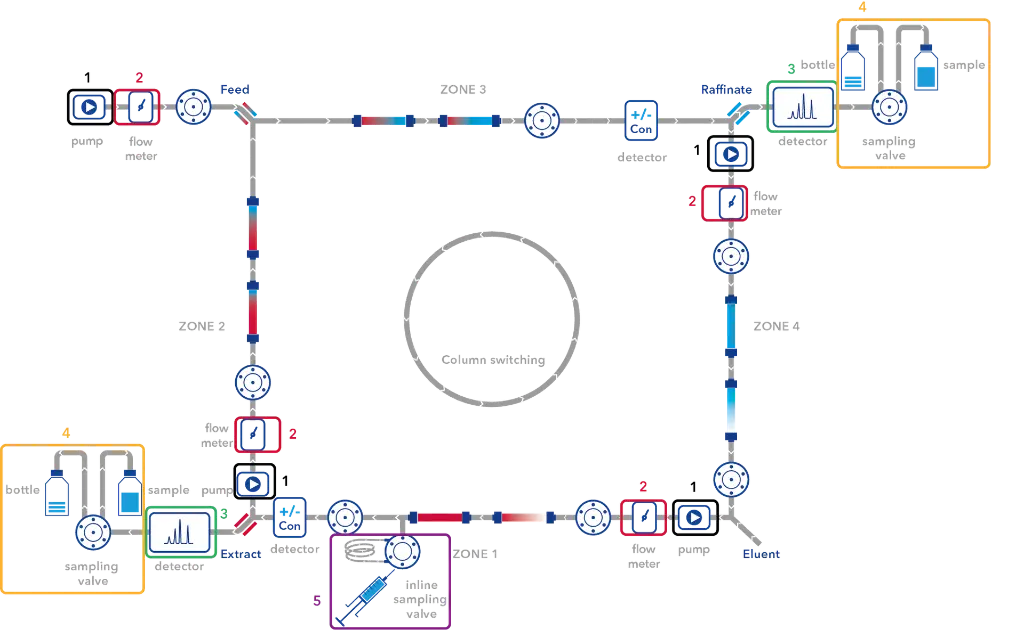
Fig. 2 Scheme of AZURA Lab SMB with a 2:2:2:2 column set-up and tools for in-line and off-line monitoring of the SMB process; 1) – pressure sensors pumps, 2) flow meter, 3) detectors at raffinate/extract outlet, 4) outlet sampling valve, 5) in-line sampling valve
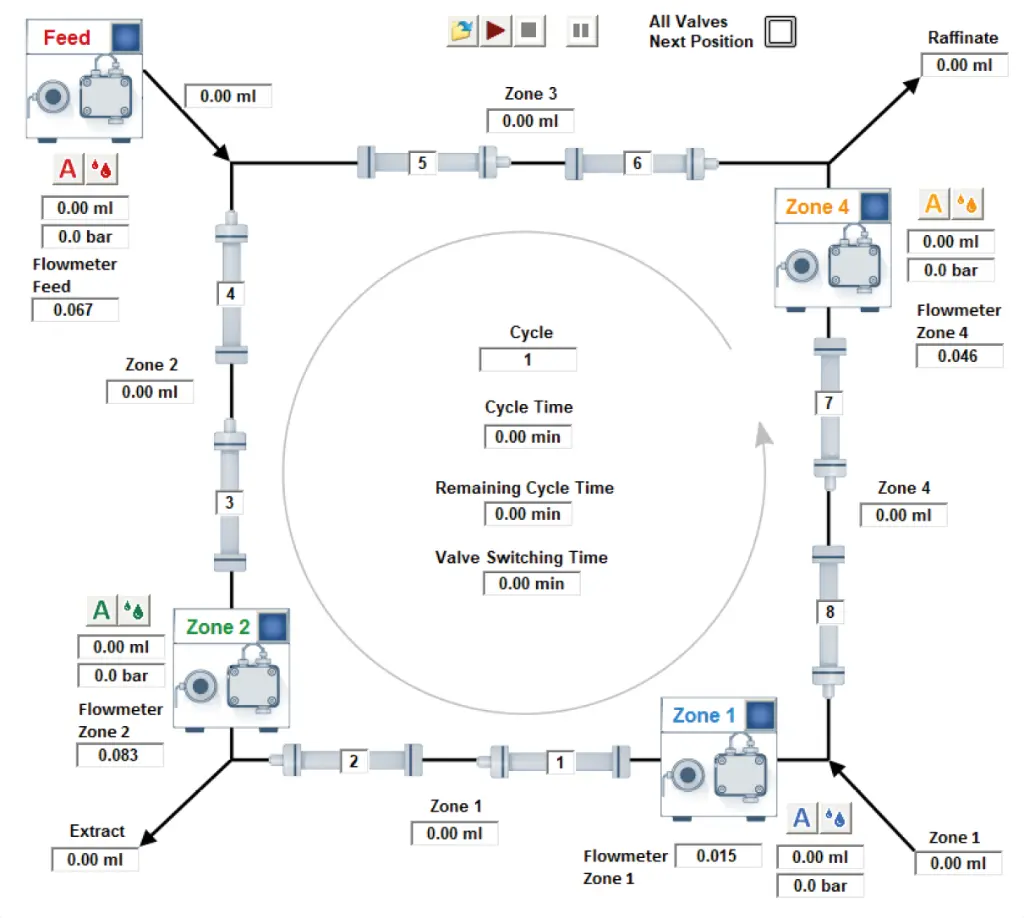
Fig. 3 Visualization and direct control panel of KNAUER SMB system in PurityChrom®MCC; column positions at cycle start
In-line tools for monitoring SMB processes
Pump/Zone pressure monitoring
Every pump of the SMB system has a pressure sensor which monitors the pressure of the zone after the pump, i.e. the zone 1 pump shows the pressure in zone 1. The pressures of the different zones differ to each other because of the different flow rates of the zones and the number of columns in each zone (Fig. 4). If the columns are all equally packed and the capillaries are not blocked the pressure in every zone should be the same over the whole SMB cycle for each zone. Variations of the pressure during the switches could indicate partially blocked capillaries or column(s).
Fig. 4 shows an overlay of the four different pump pressures. In the used SMB set-up, a flowmeter was placed in front of column no. 1. The column moves through the various zones of the system along with the flowmeter. If the classical SMB set-up with four zones and two columns per zone is used, the column will switch through eight positions before arriving at its start position. The number of switches is depending on the number of columns, once all position are passed one SMB cycle is closed. The flowmeter itself generates a back pressure which adds to the back pressure of column no.1. Therefore, the flowmeter will increase the pressure in every zone of the SMB system as soon as it is switched into that zone together with column no. 1. This effect is shown in Fig. 4. At the start position of the SMB cycle the column no. 1 is in position 1 just after the zone 1 pump. The pressure of zone 1 is at approx. 97 bar. With the next switch, column no.1 moves to position 8 which is in zone 4. This has two effects, the pressure in zone 1 reduces to approx. 82 bar (flowmeter not present) and the pressure in zone 4 increases (flowmeter present). This effect is monitored through the whole SMB cycle. The pressure of the zone 2 pump measures the combined pressure from zone 2 and zone 3. As column no. 1 will be for four switches in both zone 2 and zone 3 the pressure of the zone 2 pump is higher for these four switches.
A similar effect would be seen with a blocked column or a squeezed capillary. Additionally, changes in pressure can also indicate a change in the flow rate of the pumps.
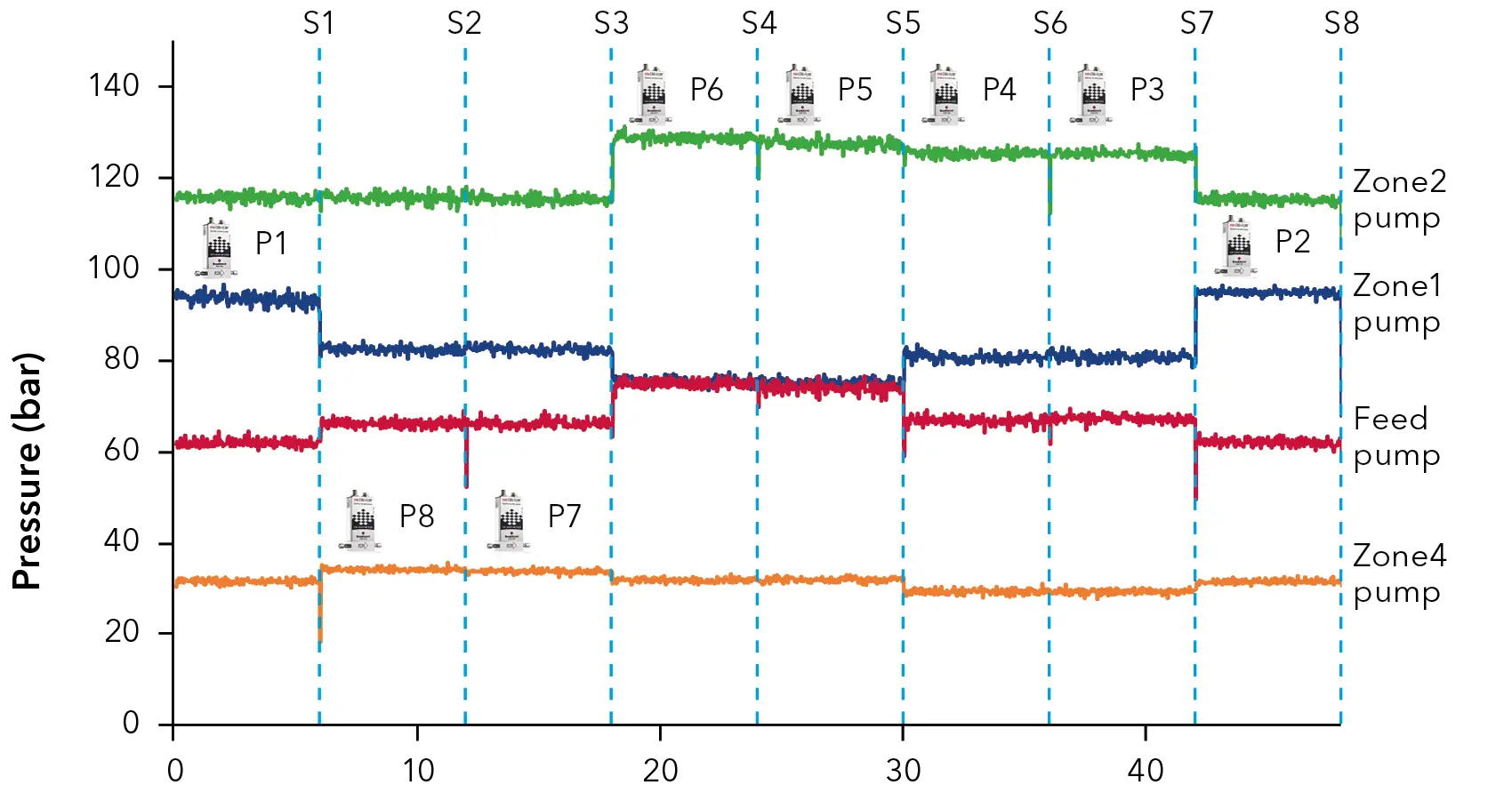
Fig. 4 Overlay of the pressure channels of the four SMB system pumps; blue – Zone 1 pump, green – Zone 2 pump, red – feed pump, orange – Zone 4 pump, the eight switches (S) of one cycle are highlighted; P – position column
Controlling flow rate of pumps and/or SMB zones
The success of an SMB process strongly depends on the stability of the different flow rates within the four zones of the SMB set-up. If the flow rates do not match the developed process, a sufficient separation and purification will most likely not be achieved. One of the main reasons for not reaching the proper zone flow rates and/or fluctuation of those are the incorrect functioning of one or more of the used pumps. Another reason could be leakage of one of the many capillaries or wrongly directed flow within in the system. Therefore, it is crucial to precisely monitor the flow rates. The most precise and efficient way to do so is the implementation of flowmeters into the system. Ideally, after every system pump one flowmeter is placed which monitors the flow of the corresponding pump (Fig. 5). Interruptions of the flow are directly monitored (Fig. 5, no. 1) and if necessary, can be fixed. Also changes in the flow rate due to process optimization during an SMB run are visible. If for example the feed flow is reduced and the zone 2 pump increased, these changes will be monitored (Fig. 5, no. 2).
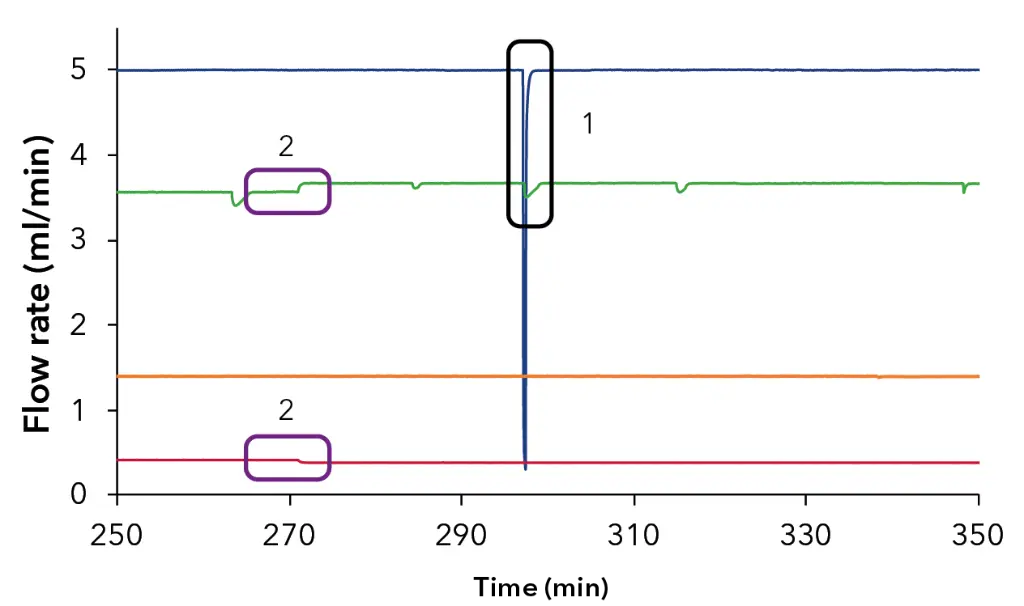
Fig. 5 Flow rate channels of the four flow meters connected behind the pressure sensors of the four SMB system pumps; blue – Zone1 pump, green – Zone 2 pump, red – feed pump, orange – Zone 4 pump
The usage of four flowmeters is ideal but as the investment in four flowmeters can be too high the solution is to integrate at least one flowmeter into the system. The flowmeter is integrated before i.e. column no 1. It will move together with the column through the four zones of the SMB system. During one cycle the column will pass all eight column positions, two in every of the four zones and thus the flow rate of all four zones will be monitored (Fig. 6 A, blue line). The pump flow rates can be determined from the zone flow rates. A second flowmeter could be used to monitor the feed flow rate (Fig. 6 A, red line). A correct feed flow is crucial for the separation and is compared to the pump flow rates, the lowest one (Fig. 6 B).
The outlet flow rates of the extract and raffinate could also be monitored by flowmeters. A practical and more cost-efficient way is to measure the actual volume at the outlets during one switch or cycle and compare the results to the theoretically estimated volumes.
The PurityChrom®MCC software allows flow rate adjustments during a running SMB process and changes will be adjusted with the next cycle. This enables the adjustment of pump flow rates if the pumps are over or under performing or the optimization of process parameters during the run.
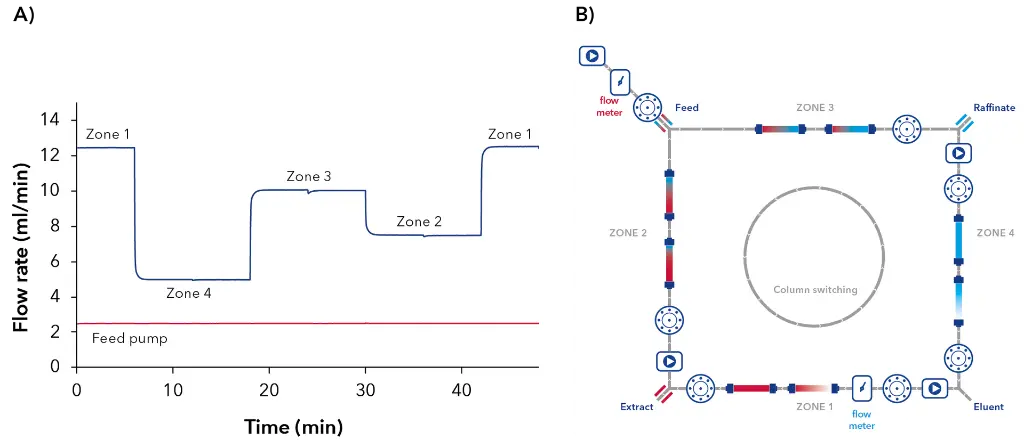
Fig. 6 A) Flow rate channels of the two flow meters, 1) connected in front of column 1, 2) behind feed pump, B) Location of the two flow meters, in front column no.1 and behind feed pump
Detection
Detectors play a crucial role in analytical and classical preparative batch chromatography by detecting sample components as they elute from the column.The results are shown in a chromatogram which is used for qualification and/or quantification.
Although most SMB systems are not equipped with detectors, they can still provide valuable information. The detectors in an SMB system will not show a classical separation, as SMB chromatography is a continuous process with a steady out flow at the raffinate and extract outlet. The detector signal reflects the concentration profile of all components together that elute during a switch and cycle (Fig. 7 A).
Detectors in an SMB system have three functions:
1) They show the increase in the concentrations of components leaving the outlets at the beginning of the process. (Fig. 7 A).
2) They monitor the steady state of the SMB process and any changes in concentration at the outlets can be seen. (Fig. 7 B)
3) After the SMB, process the cleaning of the columns is monitored by declining signals (Fig. 7 C)
RI and UV detectors are the two main detector types used in SMB systems. Normally the detectors are placed behind the two outlets (Fig. 2 no. 3). The more pressure resistant UV cells could also be placed into the SMB cycle in front of the two outlets.
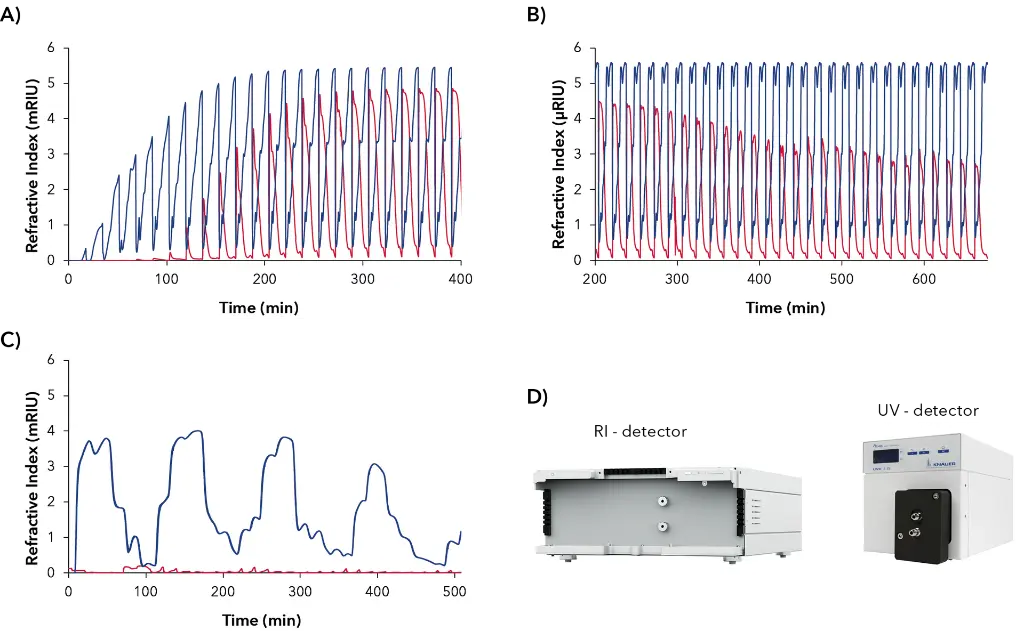
Fig. 7 Detector channels of two AZURA RI detectors at the raffinate and extract outlet; blue – raffinate outlet, red – extract outlet; A) beginning of the SMB process B) during the SMB process C) cleaning/washing of the columns, D) detector types for process monitoring
Off-line tools for the analysis of separation performance
Outlet sampling
The most important tool to control an SMB process is the collection of samples at the raffinate, extract and waste outlet. The samples are collected for either one full switch or one cycle. It is important to collect samples over a complete switch, as the concentration profiles change during the switch period. The sample is then analyzed using an analytical HPLC system and the results are compared to the initial feed chromatogram.
If the separation was succesfull, the sample from the raffinate only shows the fast-eluting component(s) and the sample from the extract only shows the late eluting component(s) (Fig. 8). At the beginning of the SMB process the extract and raffinate samples will show a steady increase of the component concentrations. Once a steady state is reached the concentration of the components will remain stable (Fig. 8). The analysis of the outlet samples should show any contamination between the two fractions. The process can then be adapted by changing the flow rates of the process. These changes should be visible after a few cycles in the chromatograms. To make fast adaptations, it is helpful to develop a fast analytical method for process control.
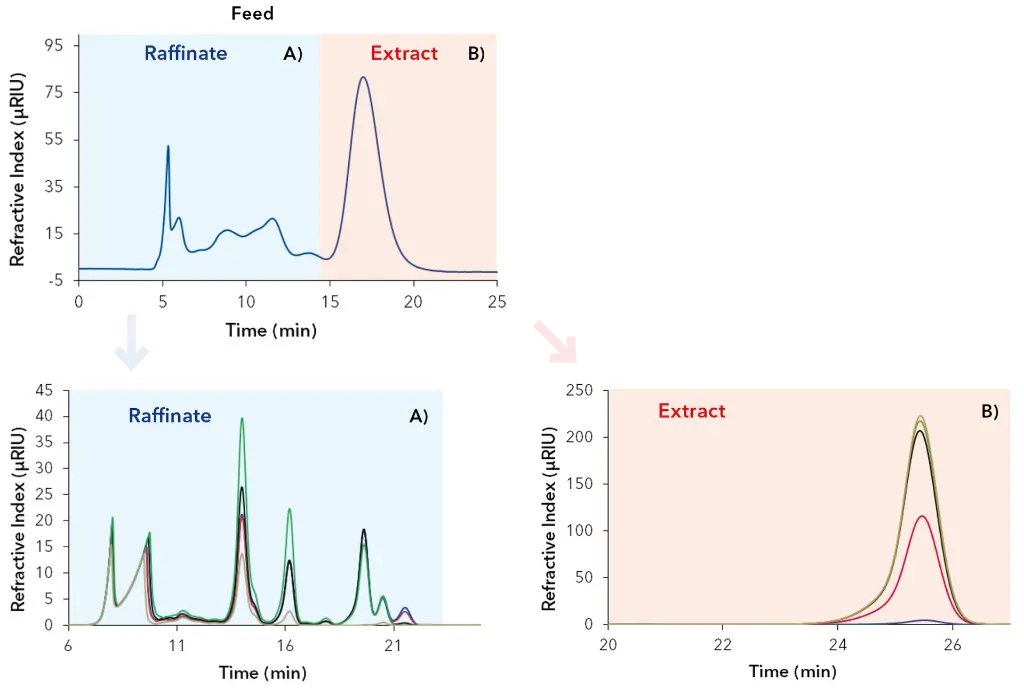
Fig. 8 Analysis of the raffinate and extract outlets over several cycles of the SMB process
The sample collection can be improved by implementing a sample valve [1]. Both outlet streams are connected to the valve. Depending on the valve position the stream can either flow into the sampling tube or into the collecting bottle (Fig. 9). This is especially helpful if only a switch is collected for analysis as the tubes do not have to be changed manually from sample tube to collecting bottles.
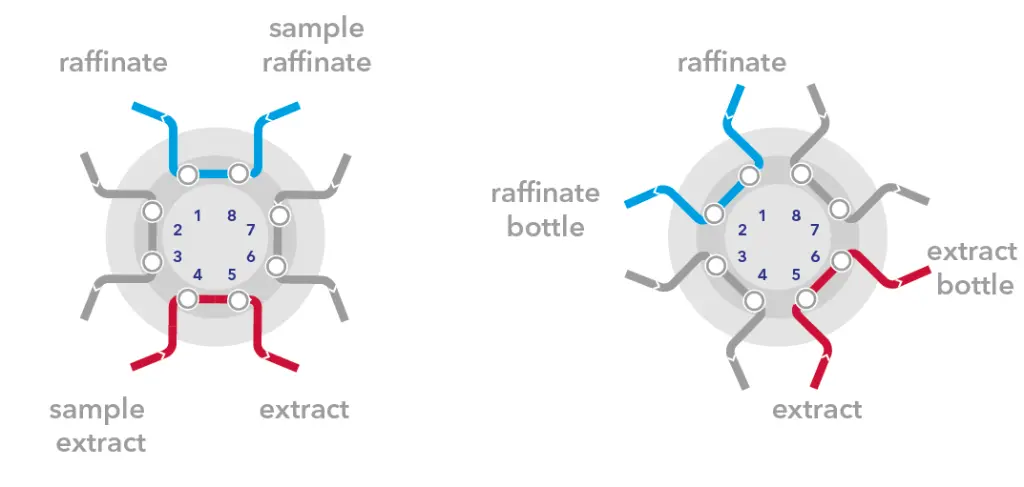
Fig. 9 Raffinate/extract collection valve
In-line sampling
In-line sampling is another way to monitor the separation process in an SMB system [2]. With this approach, the internal concentration profiles of the components are monitored during one SMB cycle. For that, a two-position valve with a sample loop is integrated into the system i.e. behind column no. 1 (Fig. 11). In position one, the system flow passes through the valve and fills the loop. At a distinct time-point during one switch the valve is manually moved to position two and the loop is by-passed. The sample trapped in the loop is collected and analyzed. This procedure is repeated at every switch, always at the same time point i.e. one minute after switching. At the end of one cycle, the concentrations of the components in the eight chromatograms are measured (Fig. 10). The results together with the time-points are used to create a concentration profile of the analyzed components during one SMB cycle (Fig. 12). This profile can help to evaluate if the separation of the two components is effective or if adjustments to the method must be made. Depending on the length of a switch, samples could be taken at different time-points during the switch. This would result in a more accurate representation of the concentration profile of the two components during the SMB cycle.
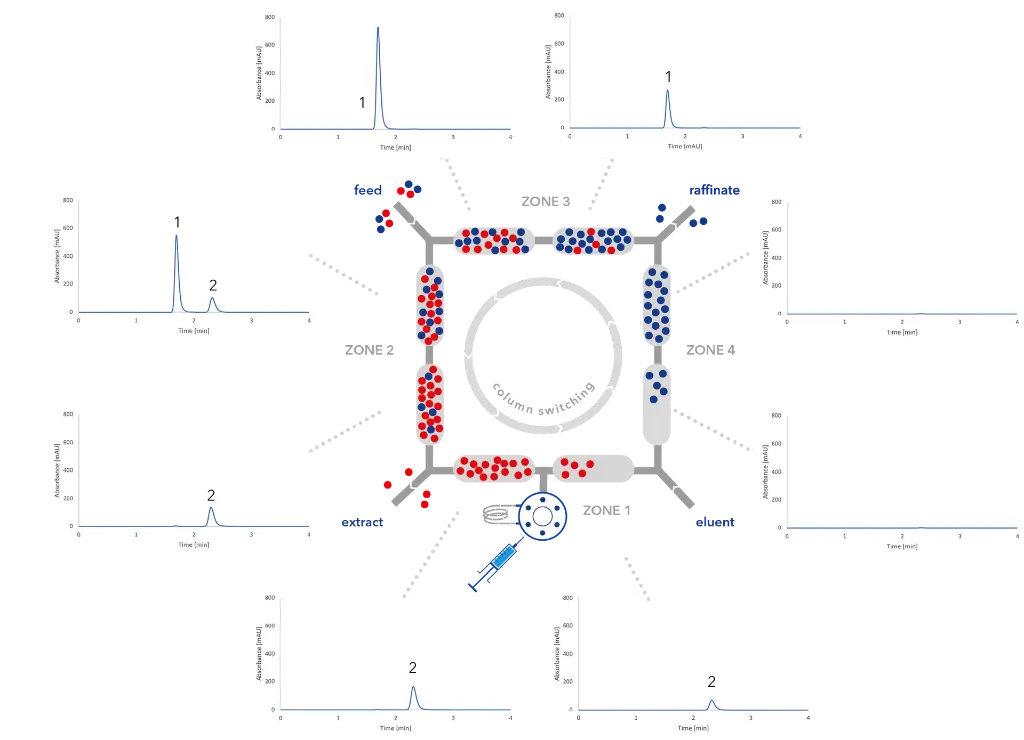
Fig. 10 Analysis of the raffinate and extract outlets over several cycles of the SMB process
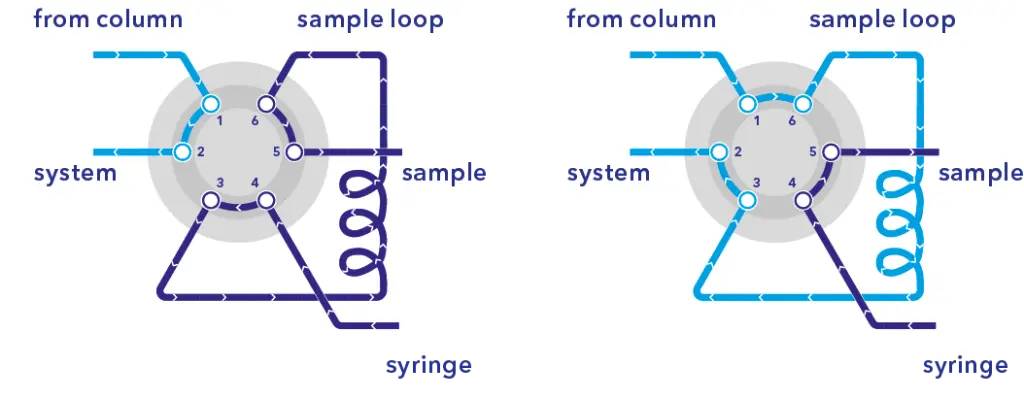
Fig. 11 In-line sampling
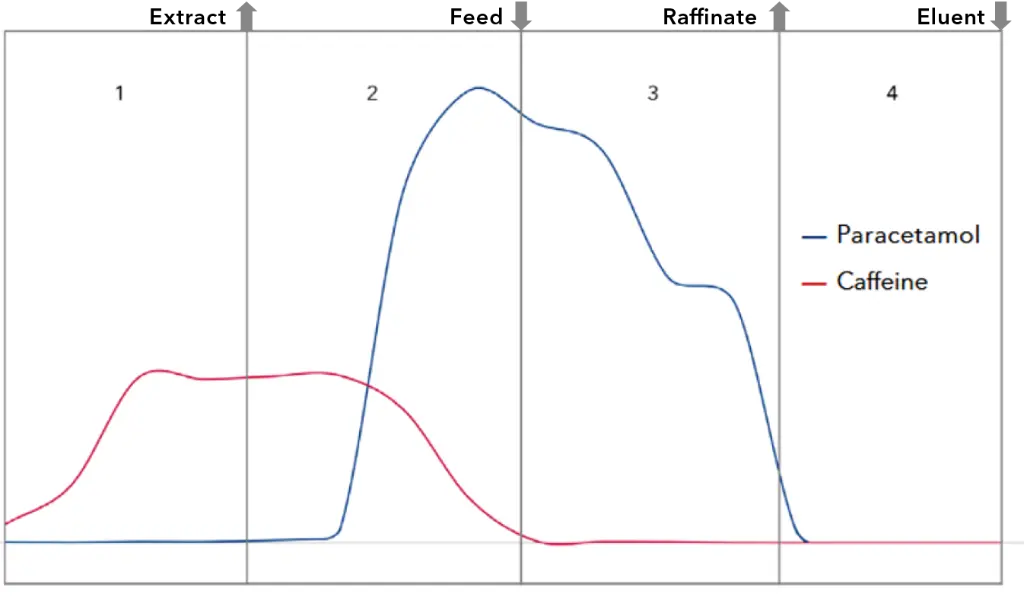
Fig. 12 Concentration profile of paracetamol and caffeine during one SMB cycle at tested conditions
Conclusion
SMB is a continuous separation process that can run for several hours or days without interruption. Therefore, it is important to monitor the process and to be able to adapt to changes during the run. Different tools are available that can be used for process monitoring and method development. These tools can be divided into two main categories: in-line and off-line tools. In-line tools monitor parameters such as pressure and flow rate directly during the run, whereas off-line tools take a sample, which is then analyzed by an HPLC system.
The tools described can be added to the KNAUER SMB systems depending on the customer’s needs. The more parameters that are measured, the better the process can be monitored. This is especially helpful during SMB method development.
Material and Methods
References
[1] Stephan S., et al. Simultaneous sampling of two product streams, KNAUER Application No.: VTN0012
[2] Stephan S., et al. Simulated Moving Bed (SMB) inline sampling, KNAUER Application No.: VTN0011
Application details