
Science with Passion

Application No.: VBS0071
Version 1 11/2018
Comparison of two column sets for antibody purification in an automated two step purification process
Ulrike Krop, Kate Monks; applications@knauer.net
KNAUER Wissenschaftliche Geräte GmbH, Hegauer Weg 38, 14163 Berlin

Summary
This application compares the automated purification of antibodies with the AZURA® Bio purification 50 – Two Step Purification System with different columns. Capacity and yield of the purified proteins were compared and revealed no significant differences in the performances of the two investigated column sets.
Introduction
Antibodies play an important role in the biotechnology and pharmaceutical industry. They are used in a variety of applications where quality and purity of the antibodies is crucial. The most widely used technique for antibody purification is protein A affinity chromatography. It is a very efficient capture step and delivers highly clean protein. The antibodies are eluted under acidic conditions requiring an additional buffer exchange step. This desalting step requires in many cases manual interaction. The AZURA Bio purification 50 – Two Step Purification System allows an automated purification without manual interaction. Various resins from different vendors are available for protein A affinity and desalting purification. The aim of this application was to compare different column sets for the affinity and desalting phase for this specific two step approach.
Results
Antibodies were purified from 100 µL reconstituted human plasma by protein A affinity chromatography and a subsequent buffer exchange step. The chromatogram of the whole purification process is divided in two steps (Fig. 1) During the first step, the sample is injected. All non-binding proteins flow through the column (Peak A). Next, all remaining impurities are washed from the affinity column. Elution takes place under low pH conditions (Peak B1). The eluted sample was stored in a sample loop and reinjected in step two on a desalting column. Finally, the elution peak (Peak B2) was collected. In the chromatogram two example purifications with different column sets are depicted. The antibodies purified with the vendor X Protein A FF and Desalting columns (red signal) and Sepapure Protein A FF and Sepapure Desalting columns (blue signal) are comparable. An average of 0.37 ± 0.05 mg proteins was purified with the vendor X Protein A FF and Desalting column in comparison to an average yield of 0.41 ± 0.1 mg protein with Sepapure Protein A FF and Sepapure Desalting columns (Tab. 1 suppl. Material). Finally, SDS-PAGE was performed to analyze the purity of the samples (Fig. 2).
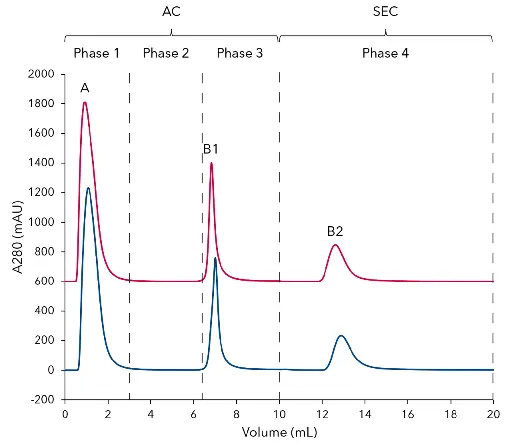
Fig. 1 Overlay of chromatograms of the two step antibody purification; Step 1 - Affinity chromatography (AC): Phase 1) Sample injection; Phase 2) Column washing; Phase 3) Elution of antibodies and parking in sample loop; Step 2 - Buffer exchange with desalting column: Phase 4) Elution of antibody; A – flow through of unbound protein; B1 – elution peak of antibodies from Protein A column; B2 - elution peak of antibodies from desalting column; Red signal : Purification with vendor X Protein A FF 1 mL and Desalting 5 mL column Blue signal: Purification with Sepapure Protein A FF 1 mL and Sepapure Desalting 5mL column
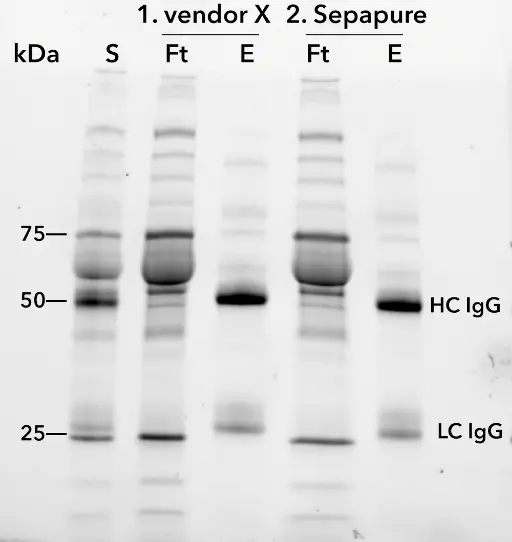
Fig. 2 SDS-PAGE at different purification steps; 1. Purification with vendor X Protein A FF 1 mL and Desalting 5 mL column, 2. Purification with Sepapure Protein A FF 1 mL and Sepapure Desalting 5 mL column, S) serum before purification; FT) flow through, E) eluted antibodies (IgG) heavy chain (HC) and light chain (LC) after two step purification
Materials and Methods
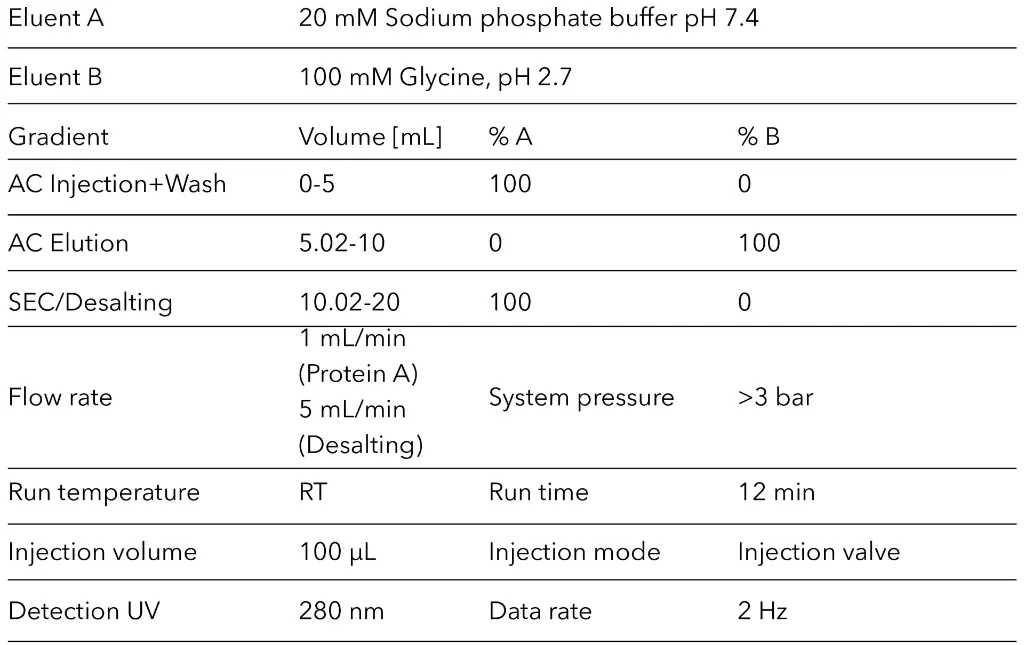
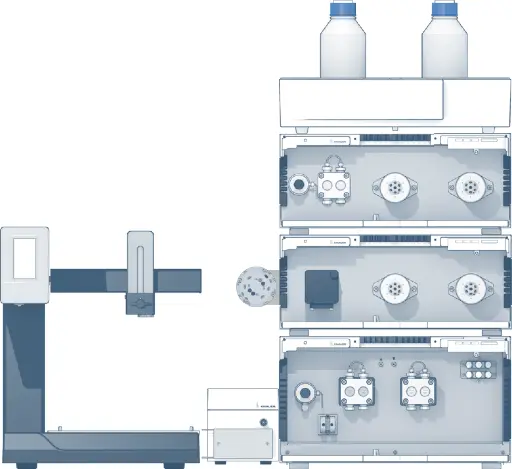
In this application an AZURA Bio purification 50 - Two Step Purification System was used. It consisted of an AZURA P 6.1L 50 mL HPG metal-free pump,1st AZURA ASM 2.1L assistant module with 50 mL feed pump and two 6 port/2 position valves,2nd AZURA ASM 2.1L with UVD 2.1S and two 6 port/2 position valves, column switching valve; conductivity monitor and a fraction collector. The protein A and Desalting columns were equilibrated with buffer A (20 mM Sodium Phosphate Buffer, pH 7.4). The flowrate for the 1mL protein A columns was 1ml/min and for the 5mL Desalting columns was 5 mL/min. 100 µL of reconstituted human plasma was injected on to the protein A column. The column was washed with buffer A. Antibodies were eluted with buffer B (0.1 M Glycin-HCL, pH 2.7). Via a threshold function the elution peak was parked in a 5 mL sample loop. Subsequently, the eluted protein was re-injected on to the desalting column for buffer exchange with buffer A. The eluted antibodies were collected with the fraction collector. The UV signal was measured at 280 nm and conductivity signal was recorded. Each purification was done with two column sets from each vendor in triplicates. The concentrations of the eluted protein from each individual run were determined with a NANODROP 2000 and analyzed by SDS-PAGE.
Conclusion
The AZURA Bio purification 50 - Two Step Purification System was used to analyze the automatic purification of human antibodies with two different sets of columns from different vendors. The yield and purity of the eluted antibodies was for both column sets comparable. With the two step purification system, no manual interaction was necessary between the first protein A affinity chromatography step and the second buffer exchange/desalting step. This setup can be adapted to other purification protocols and can be used for a variety of materials. In conclusion, the purification is quantitatively and qualitatively identical for both tested column materials in the two step system setup. The tested column column materials are suitable for two step purification.
Additional Results
Tab. A1 Yield of the purified antibodies

Additional Materials and Methods
Tab. A2 Method parameters
Tab. A3 System configuration & data
Instrument | Description | Article No. |
Pump | AZURA P6.1L, HPG 50 mL pump head, ceramic | |
Assistant 1 | AZURA ASM 2.1 L Right: 6 Port 2 Pos valve 1/16”, PEEK Middle: 6 Port 2 Pos valve 1/16”, PEEK Left: P 4.1S, 50 mL pump head, ceramic | |
Assistant 2 | AZURA ASM 2.1 L Right: 6 Port2Pos valve 1/16”, PEEK Middle: 6 Port2Pos valve 1/16”, PEEK Left: UVD2.1S | |
Flow cell | 3 mm path length, 1/16", 2 µL volume, 300 bar, biocompatible | |
Conductivity monitor | AZURA CM 2.1S | |
Flow cell | Preparative up to 100 mL/min | |
Column | Sepapure Protein A FF 1ml Sepapure Desalting 5 ml vendor X Protein A FF, 1ml vendor X Desalting, 5 ml | |
Fraction collector | Foxy R1, microplates rack | |
Software | Purity Chrom Basic |
Application details
|
Method |
FPLC |
|
Mode |
Affinity |
|
Substances |
human Plasma |
|
CAS number |
n/a |
|
Version |
Application No.: VBS0071 | Version 1 11/2018 | ©KNAUER Wissenschaftliche Geräte GmbH |