Girls Just Wanna Have Fun With KNAUER – A Girls' Day Full of Rainbows
What do cats and rainbows have to do with HPLC? At the 26th nationwide Girls’ Future Day—”Girls’ Day”,15 girls from various Berlin schools asked themselves these questions. Through five interactive stations covering everything from development to production, they explored a variety of apprenticeship and professional careers at KNAUER and discussed a whole range of other questions along the way.
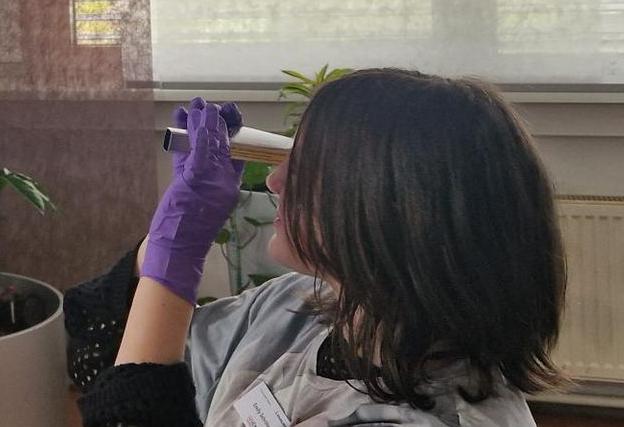
Figure 1: A student observes the rainbow spectrum of white light. (Photo by KNAUER)
What is a Girls Day?
Girls' Future Day is very popular because it gives girls a chance to step out of the classroom and into the adult world. Across the country, girls can get a taste of traditionally male-dominated professions and get a sense of whether this career path might be right for them. All it takes is curiosity and an openness to the unknown. KNAUER has been offering Girls' Future Day for 17 years, and it has become highly sought-after. Spots fill up almost as fast as Taylor Swift’s concerts. But why is that?
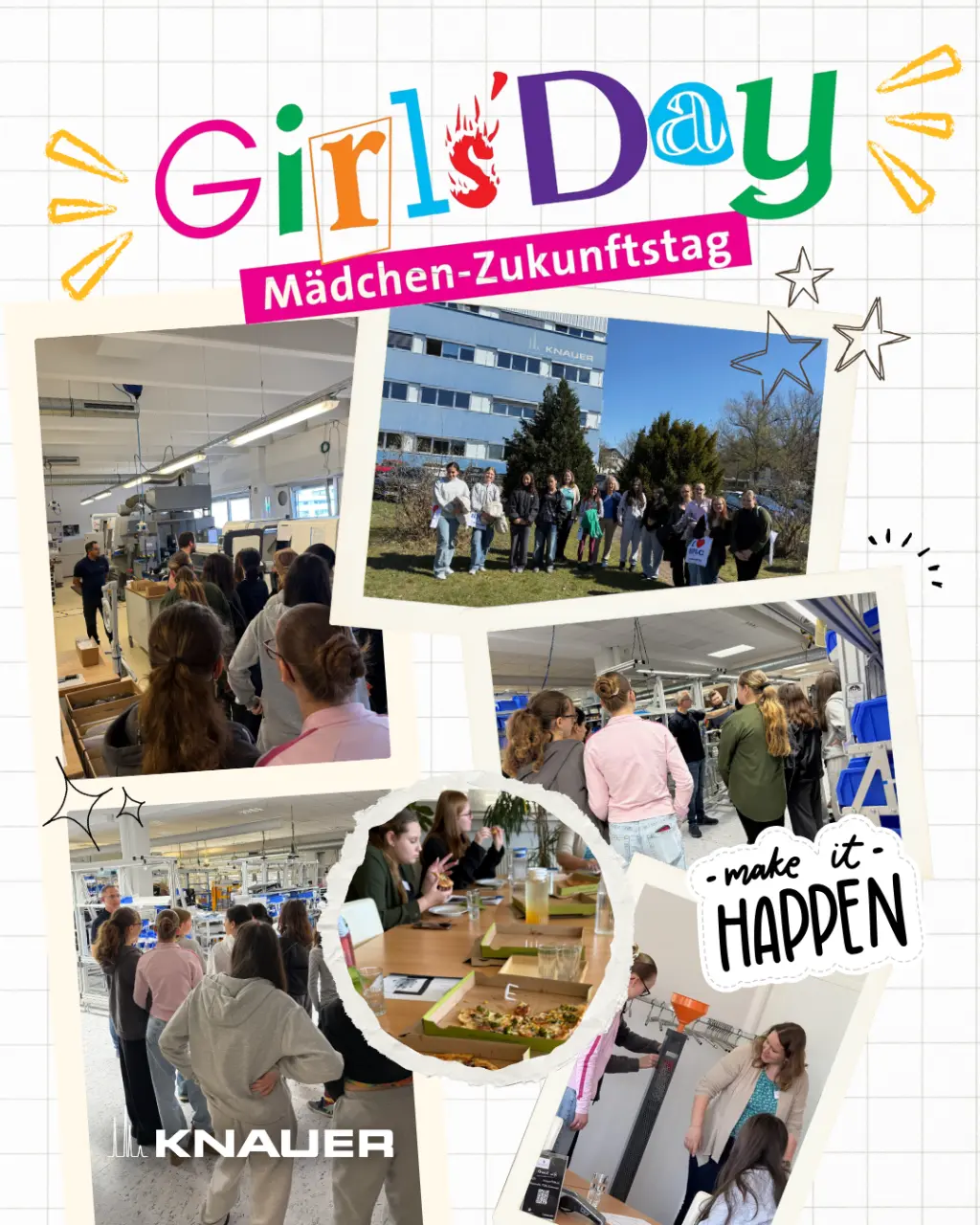
Image 2: Hands-on experience and wonder at Girls’ Day 2025: 13 interested girls assembled pump heads, learned what HPLC is, and how such equipment is developed. (Picture by KNAUER)
"That moment when the girls realize, with sparkling eyes, just how cool science can be—that’s exactly why I love Girls’ Day. It’s worth every bit of the effort!” – Dr. Kristin Folmert, chemist and product manager at KNAUER
Why Do so Many Berlin Schoolgirls Want to Spend Girls' Day at KNAUER?
At KNAUER wissenschaftliche Geräte GmbH, the name says it all. We design, engineer, develop, manufacture, market, and sell laboratory equipment—100% from Berlin into the whole world. In addition, we have a large laboratory department that tests the equipment and develops methods using it. This means that from mechanics, warehouse logisticians, media designers, and mechatronics engineers to software developers, scientists, and managing directors, there are many strong female characters at KNAUER who can serve as role models for young girls.
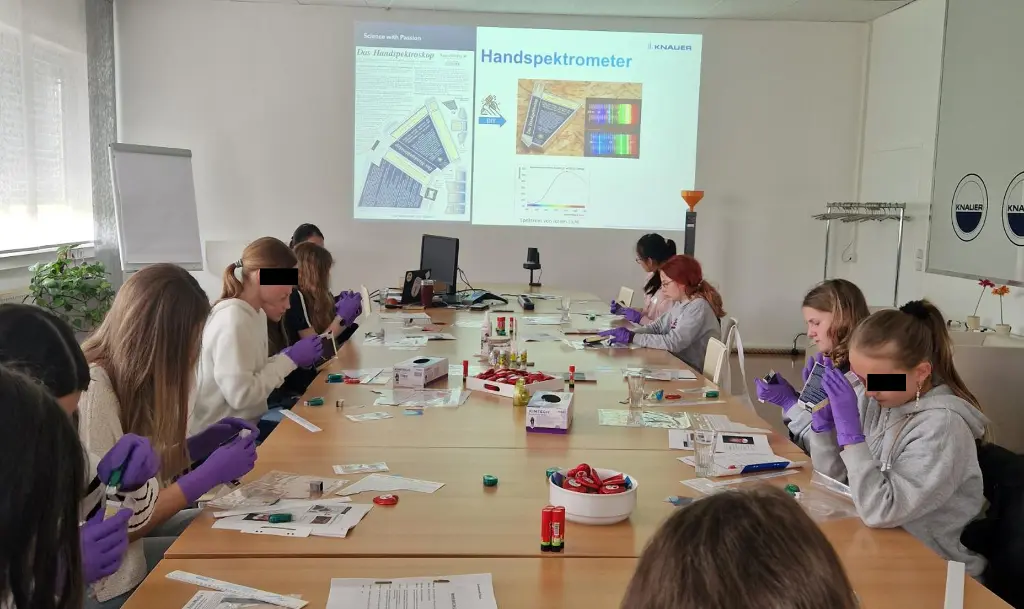
Figure 3: The girls learned what chromatography and HPLC are, what they are used for, and how a UV/Vis detector works. They then built their own handheld spectroscope and experimented with white light and various color filters. (Photo by KNAUER)
KNAUER Stands Up for Girl Power
Even former Chancellor Angela Merkel expressed her surprise during a visit to KNAUER at the end of the COVID-19 pandemic, noting that she had observed an unusually high number of women across all departments. KNAUER is a science-driven high-tech company and, as such, employs an unusually high proportion of women—37 %—particularly in its scientific and management departments. This could be due to the female leadership under Alexandra Knauer, or to the low gender pay gap of 1.84 % (2026). According to the Federal Statistical Office, the unadjusted gender pay gap in Germany in 2025 stands at 16 %. KNAUER is also one of the few high-tech companies that enables young female university graduates to enter the workforce in highly qualified positions. 44 % of leadership positions at KNAUER are held by women, and several leaders work part-time. This enables a positive work-life balance and the compatibility of career and family. Diversity and equality are practiced in all areas at KNAUER. For example, in departments where heavy loads must be carried, modern indoor cranes are used to lighten the load on employees. The usual discrimination against women based on body size is therefore eliminated in these areas. Instead of the typical career setback, new parents receive a bonus and a KNAUER baby onesie, as well as financial support for childcare.
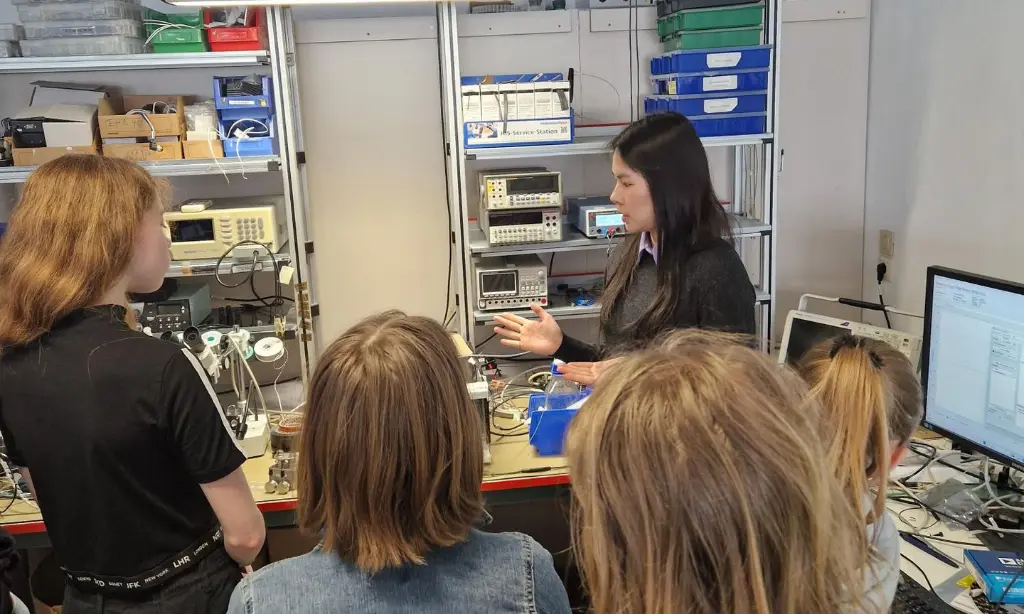
Image 4: During a visit to the equipment development department, scientist Thy Vu talks about her career at KNAUER. She wrote her bachelor’s thesis here and then worked as a student assistant in development during her master’s program. Subsequent to completing her master’s degree, she accepted a permanent position at KNAUER in the development department. Today, she is developing the pump drive of the future and tells the fascinated girls which gemstones are used in such a pump (sapphires and rubies). (Photo by KNAUER)
For the girls participating in Girls’ Day, these are all questions for the future. Many are nevertheless surprised when they realize how few barriers there are for women today thanks to modern technology and modern corporate management. The positive atmosphere and warm cooperation within the KNAUER team help even the shyest girls overcome their fear of asking questions. We always get the impression that Girls’ Day is an eye-opener for the girls. Because there is a life after school, and it can be exciting, diverse, and fulfilling.
What Do the Girls Learn at Girls' Day at KNAUER?
Several female employees at KNAUER are members of “International Women in Chromatography”, a group of women passionate about chromatography where women and non-binary individuals network and support one another. Our enthusiasm for the natural sciences, innovation, and technology is something everyone at KNAUER can easily see, and we’ve tried to pass some of that on to the girls. On this day, they met many strong women who are passionate about their careers. One of them was a student nearing the end of her studies; they met mothers working in product management or scientific roles, and a developer who had already worked as a student assistant at KNAUER during her studies and is now developing the pumps of the future at KNAUER. There was also a lively exchange with Managing Director Alexandra Knauer, who, for her part, had many questions for the girls. We encouraged the girls to believe in themselves and their path. If you’re enthusiastic and motivated, you can achieve any position as a young woman in Germany. Networking and a proactive approach to challenges play an important role in this.
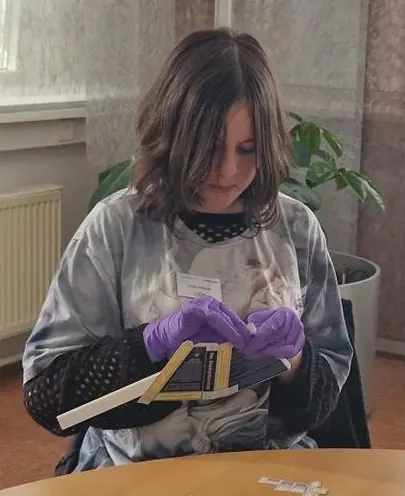
Image 5: A girl works intently and with great care on her spectroscope. None of the girls glance at their phones; they are all polite, and many feel comfortable asking questions openly. We are very excited about this generation of bright young talents. (Photo by KNAUER)
What did the Girls Learn about HPLC?
The girls learned the basic principles of HPLC. To do this, we conducted a noisy experiment using light and heavy balls in a human-sized glass column. We did it twice, because it was so much fun. After that, we moved on to the setup of an HPLC system. Have you ever thought about how the parts of an HPLC are essentially analogous to human organs? The pump pumps like the heart with a soft thump-thump-thump, the molecules are separated in the column just like nutrients in our intestines, and the detector processes light, very similar to our eyes.
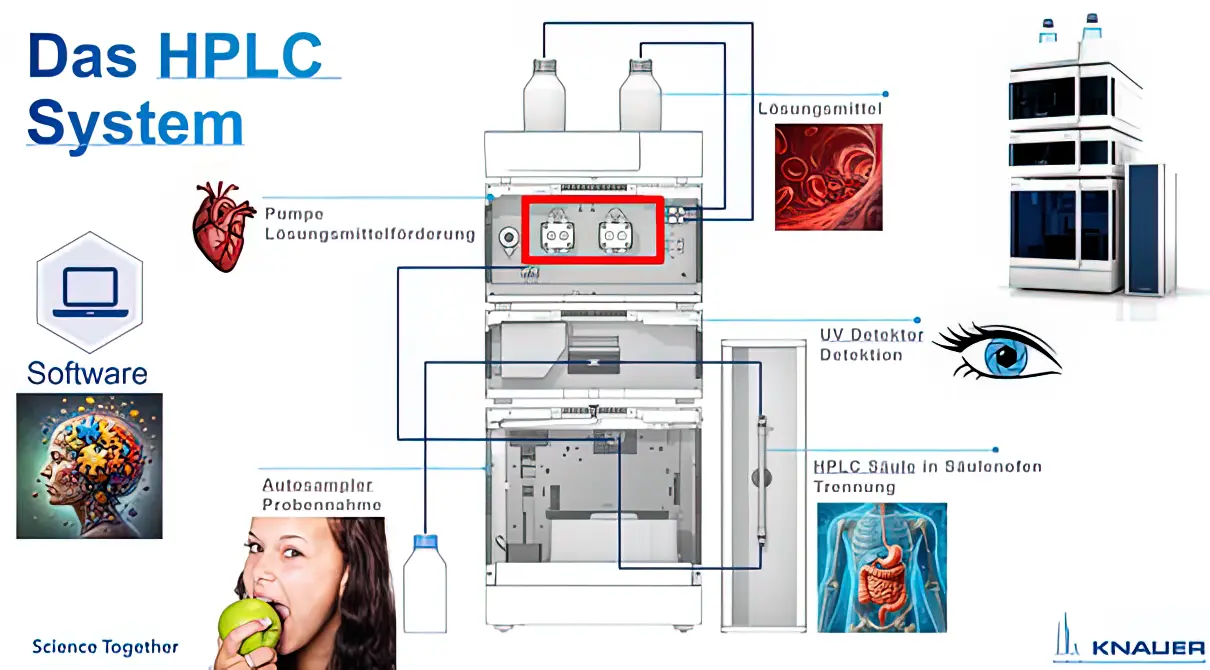
Figure 6: The HPLC and its various modules, depicted as human organs. (Picture by KNAUER)
Next, they built a handheld spectroscope, which required careful reading and dexterity. The girls helped each other attach the fragile lens. Together, they quickly found the best way to do it. That’s exactly how “real project development” works: You work as a team, continuously refine the instructions, and every subsequent step benefits from it. That was one of those “Oh, I see” moments that Girls’ Day is all about. Things got really exciting when we had a look into the light with our finished spectroscopes. You see a colorful rainbow and even spectral lines against a wavelength scale. If you now hold a color filter between the light source and the spectroscope, the spectrum changes. Earlier that day, they learned in a lecture what light and absorption are from a physical perspective, which light can you see and how a spectrum becomes a peak in HPLC.
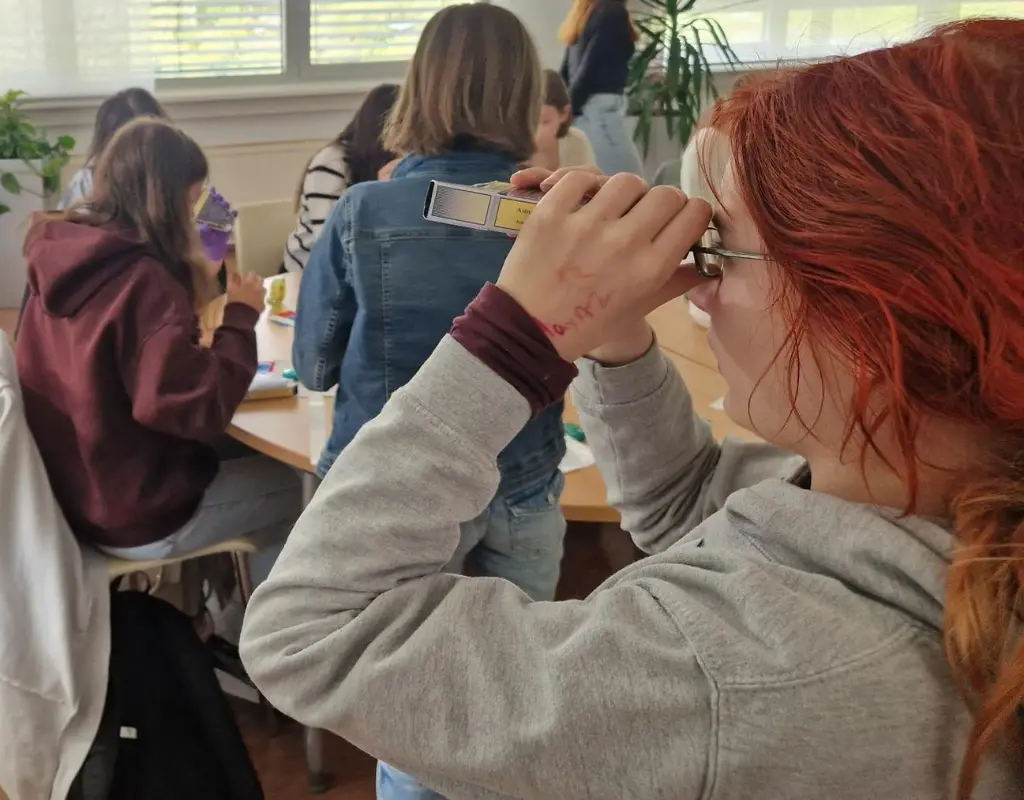
Figure 7: A 11-year-old girl gazes fascinated at her rainbow and notices that while all the colors are visible, some areas are brighter while others are quite dark. “Is the spotlight not pure white, or is my spectroscope absorbing light?” Such clever questions arise when girls are encouraged to explore things for themselves. (Photo by KNAUER)
Visit to the Development, Production, and Mechanical Manufacturing Departments
While the girls are still proudly comparing their homemade spectroscopes, we walk into the large production hall. It’s very loud in here; the pounding of the machines and the whirring of the many modern CNC machines momentarily silence our conversation. The girls watch the gripper robots at work in awe.
“This is like science fiction!” – Mariko Stahr, a schoolgirl visiting for Girls’ Day
They watch as parts of a pump head take shape right before their eyes. This is “Made in Germany”—live and loud. We take these impressions with us into the development department. Cables hang everywhere here, and complicated-looking sketches fill the screens. Thy Vu, a young developer, explains to the girls how she’s researching the optimal torque for a pump motor. The girls also get to handle various materials used in a pump. The fact that real gemstones are built into an HPLC pump is particularly fascinating. “Why do you do that?” asks one of the younger girls, sparking an interesting conversation about crystal structures and why, as a developer, you should also have a basic understanding of chemistry. Then they discuss together how much such a pump might cost.
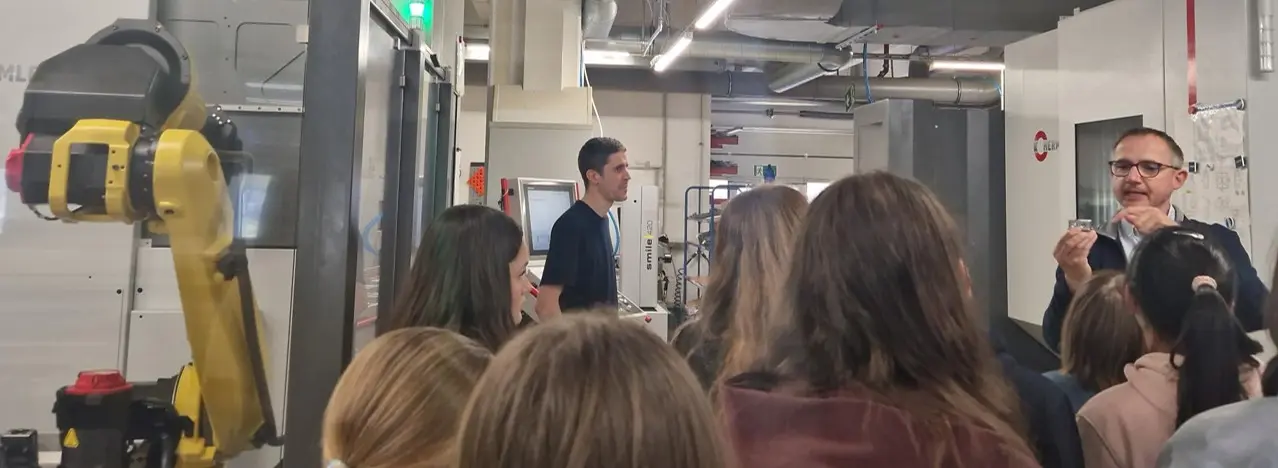
Figure 8: Thomas Müller explains to the girls how CNC machines mill the housing for a pump head from a block of metal and why precision is crucial in this process. On the left is one of the robotic arms that continues working even at night, allowing employees to focus solely on daytime work and more demanding tasks. (Photo by KNAUER)
Our final stop is the equipment assembly area. Here, each girl gets to assemble a pump head on her own. It turns out to be quite tricky, since you have to coordinate both hands at the same time. Thanks to the patient guidance of our training supervisor, Ronald Berger, everyone succeeds and ends up proudly holding their heavy pump head in their hands. Of course, an expert check is also performed to ensure that the pistons move properly.
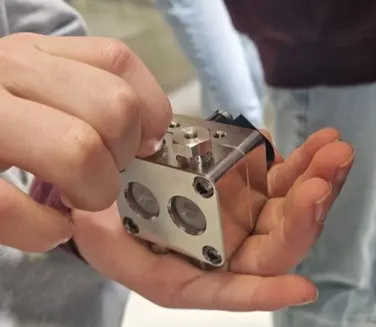
Figure 9: A girl is screwing the check valve with the check valve holder into the pump head. Everything is then tightened using a torque wrench. (Photo by KNAUER)
With our minds full of new impressions, we head off for lunch. We have pizza, and Managing Director Alexandra Knauer joins us again to answer the girls’ questions. Girls’ Day is a cause close to her heart. Since becoming managing director of her parents’ company, Alexandra Knauer has been committed to increasing the visibility of women and inspiring them to pursue STEM careers. Finally, certificates and “I love HPLC" bags filled with small gifts are handed out. As we say goodbye, we invite all the girls to apply to us later when they’re ready to start their careers. Fourteen smiling girls leave the premises and wave goodbye.
So What Do Cats and Rainbows Have to Do With HPLC?
When white light is diffracted through a prism, as in our handheld spectroscope, you see a beautiful rainbow. If part of the light is absorbed, only part of the rainbow appears. This is because absorption is the swallowing up of light. You only see what’s left, and that can tell you a lot about a molecule—or even a cat—if it sits directly in the beam of light and swallows up almost all of it. Similarly, in Figure 10, you can see that in the evening sun, a particularly large amount of blue light was absorbed by the particles in the air. When sunlight strikes the Earth at an acute angle, the light must travel a particularly long distance to reach the eye. In the process, more short-wavelength blue light is absorbed by the particles in the Earth’s atmosphere. What remains is the long-wavelength evening glow.
![Figure 10: The cat actually absorbs all the light, but its outline still lets us know that there’s a fluffy cat sitting there. In HPLC, a[SD5.1] molecule’s light absorption also tells us a great deal about its identity.](/web/image/273603-2cf30374/Cat.webp?access_token=7bfa0a63-fc81-4f21-937d-236639e00f7f "Figure 10: The cat actually absorbs all the light, but its outline still lets us know that there’s a fluffy cat sitting there. In HPLC, a[SD5.1] molecule’s light absorption also tells us a great deal about its identity.")
Figure 10: The cat actually absorbs all the light, but its outline still lets us know that there’s a fluffy cat sitting there. In HPLC, a[SD5.1] molecule’s light absorption also tells us a great deal about its identity. (Picture by KNAUER)
Here you can find more information about the KNAUER systems: https://www.knauer.net/de
For further information on this topic, please contact our author: folmert@knauer.net
