
Science with Passion

Application No.: VFD0160 Version 1 11/2017
Determination of sugars and natural sugar substitutes in different matrices
Juliane Böttcher, Hagen Schlicke, Kate Monks; applications@knauer.net
KNAUER Wissenschaftliche Geräte GmbH, Hegauer Weg 38, 14163 Berlin
Summary
Nowadays sugar substitutes are used in many products, not only for diabetic purposes but to make products more attractive for customers. Furthermore, people are interested in a healthier lifestyle which includes consuming less sugar. Therefore, a quality control of sugar and sugar substitutes in food and beverages needs to be compulsory, to assure the correct composition of ingredients.
Introduction
Sweet taste is favored by human beings. People instinctively desire the pleasure of sweetness, which resulted in a preference for sweet foods and beverages [1]. But sugar is a rich in calories and that is why a lot of people are switching to light products containing sugar substitutes. These products contain less calories and are often obtained from natural crude materials. e.g. wood fibers of the birch. This application will focus on the determination of commonly used sugars and natural sugar substitutes. Sucralose (E 955) is a high -intensity sweetener, about 600 times higher than saccharose. Mannitol (E 421) and sorbitol (E 420) have about half the intensity of saccharose and xylitol (E 967) has a quite equal intensity as commonly used sugar [2].
Results
A mixed standard of saccharose, sucralose, glucose, fructose, mannitol, xylitol, and sorbitol was used for calibration in a range from 0.25 mg/mL up to 2.0 mg/mL. Five different samples of caffeinated soft drinks as well as one sample of chewing gum and one sample of tooth paste were analyzed. Various compositions and contents of the analytes in the samples were determined (Tab A1, additional results).
Fig 1 shows a chromatogram of sample 5 compared to the standard mix. It reveals that this sample contains saccharose, glucose, and fructose exclusively. The analyzed chewing gum and tooth paste contain only mannitol, xylitol, and sorbitol. Additional peaks were observed in both chromatograms but are not related to the substances in the standard mix (Fig 2 & 3).
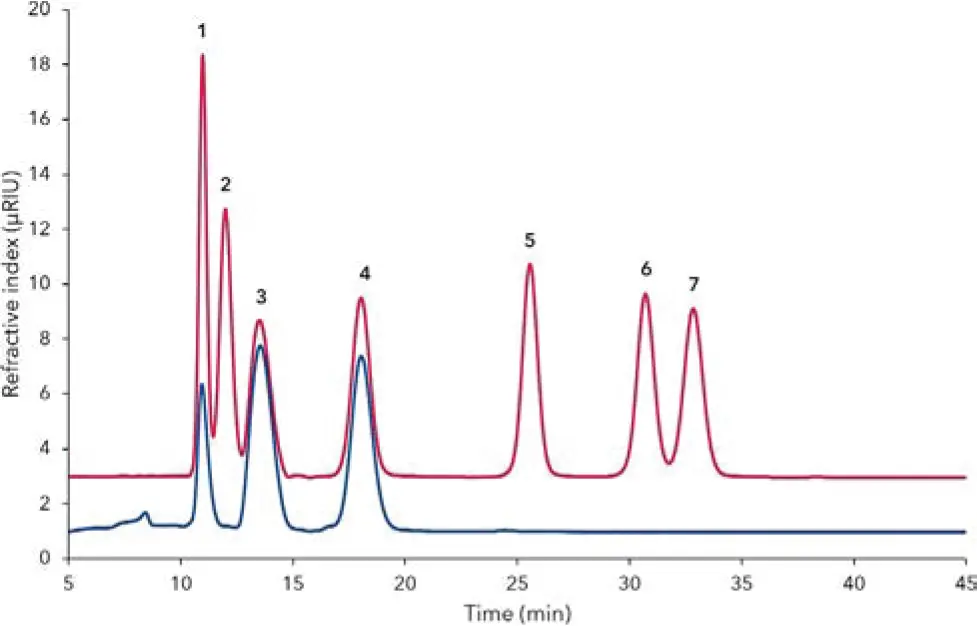
Fig. 1 Overlay of mixed standard (red) and Guarana soft drink with sugar (dilution 1:30, blue), 1) saccharose, 2) sucralose, 3) glucose, 4) fructose, 5) mannitol, 6) xylitol, 7) sorbitol
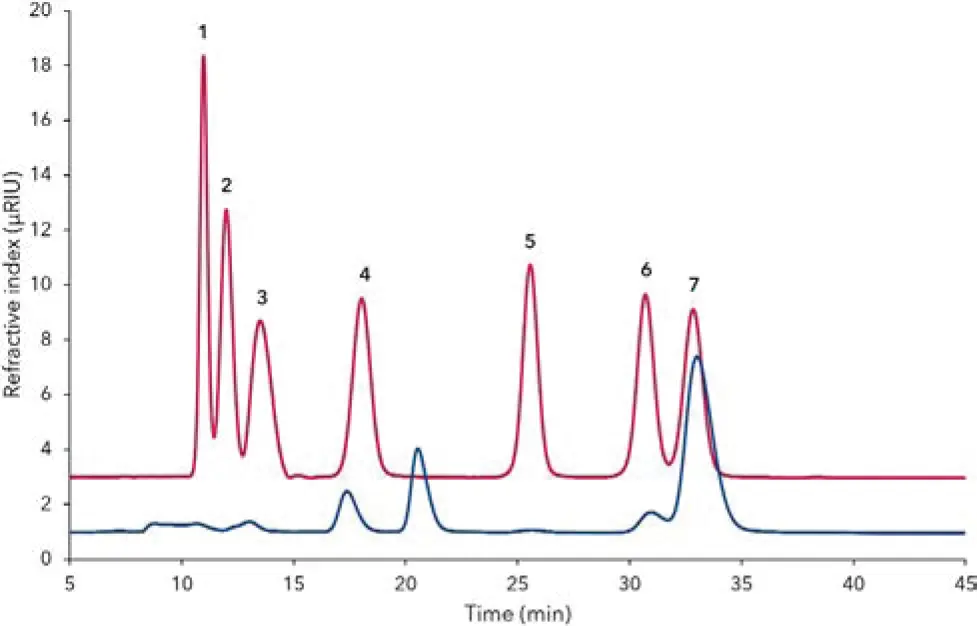
Fig. 2 Overlay of mixed standard (red) and extracted tooth paste (blue), 1) saccharose, 2) sucralose, 3) glucose, 4) fructose, 5) mannitol, 6) xylitol, 7) sorbitol
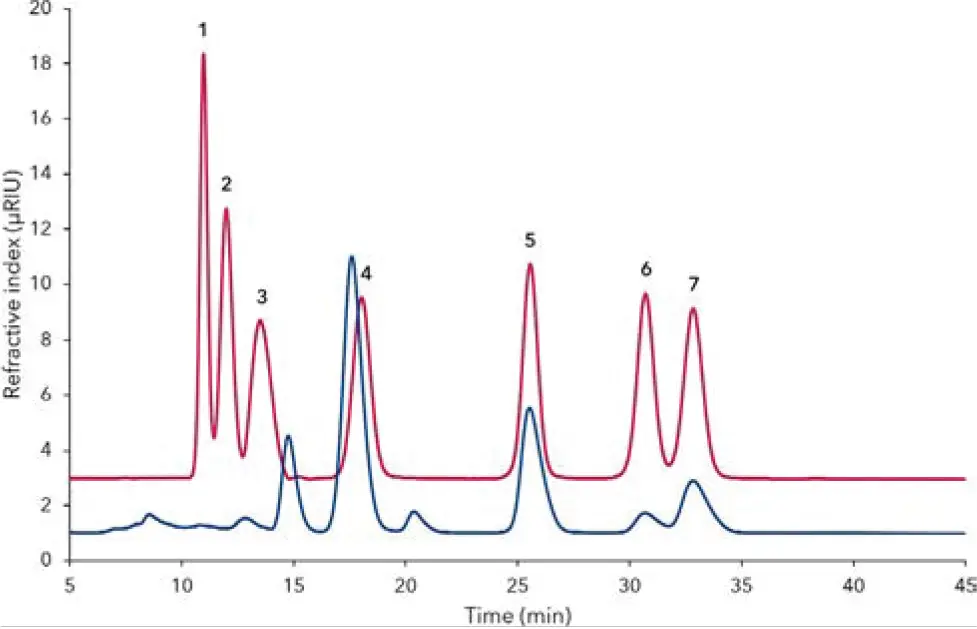
Fig. 3 Overlay of mixed standard (red) and extracted chewing gum (blue), 1) saccharose, 2) sucralose, 3) glucose, 4) fructose, 5) mannitol, 6) xylitol, 7) sorbitol
Materials and Methods
The AZURA® dedicated system for sugar analytics with an additional autosampler was used for this application. The system consisted of an isocratic AZURA P 6. 1L pump, an AZURA autosampler AS 6.1L, an AZURA CT 2.1 column thermostat, an AZURA RID 2.1L refractive index detector and an Eurokat Ca column in a dimension 300 x 8 mm ID with precolumn 30 x 8 mm ID filled with the same material. Eurokat Ca is a sulfonated cross-linked styrene-divinylbenzene copolymer. The isocratic method ran 45 minutes at a flow rate of 0.5 mL/min with 100 % aqueous eluent. The column thermostat was set to 60 °C and the data rate of the detector to 20 Hz. 20 μL of samples and standards were injected.
Conclusion
The presence of natural sugar substitutes besides sugars in the same sample matrix is not prevalent but quite feasible. It can be seen, that the caffeinated soft drinks only contained sugar and no sugar substitutes. As expected the soft drinks which were declared to be “light” had no measurable amount of sugars. The extracted tooth paste and chewing gum were specified to be sugar-free but contain sugar substitutes. The detection of mannitol, xylitol or sorbitol was as expected. With the described method it is possible to identify the most commonly used sugars and natural sugar substitutes in one run. With little effort in sample preparation it is even contingent to determine these substances from solid samples such as chewing gum or tooth paste.
Additional Results
Tab. A1 Results of sample measurements (n.d. = not detectable)
Additional Materials and Methods
Tab. A2 Method parameters
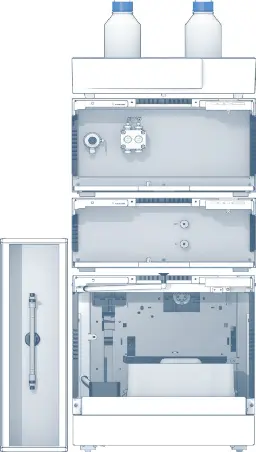
Tab. A3 System configuration
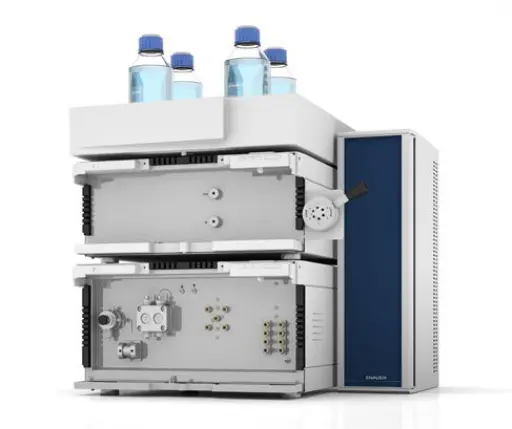
Dedicated AZURA® Sugar Analytical System
Related KNAUER Applications
VFD0161 – Determination of sugars in honey using HILIC separation and RI detection
VFD0155 – Semi preparative xylitol purification with dedicated sugar purification system
VFD0150 – Alternative xylitol extraction via hplc purification from fermented biomass
VSP0013 – Simplified scale up for sugars with the AZURA RID 2.1L extended dynamic range option
References
- https://pmc.ncbi.nlm.nih.gov/articles/PMC3098376/
- https://www.bzfe.de/inhalt/kennzeichnung-von-zusatzstoffen-1881.html
Application details