
Science with Passion

Application No.: VFD0156 Version 1 05/2017
Determination of osmolality of isotonic and non-isotonic beverages
Juliane Böttcher, Till Myrach, Kate Monks; applications@knauer.net
KNAUER Wissenschaftliche Geräte GmbH, Hegauer Weg 38, 14163 Berlin
Summary
In the last years isotonic beverages have become more and more popular. Almost every drink is available in an isotonic version. But what does isotonic mean and what are its benefits? How can be checked that beverages are really isotonic? And have you ever heard of osmolality?
Introduction
Every liquid containing substances such as minerals, carbohydrates, or proteins has an osmotic pressure. Isotonic or iso-osmotic means that the liquid has the same osmotic pressure as human blood. This feature allows an accelerated ingestion of salt and sugars from the drink which results in a faster recovery after sporting activity. A fast and easy way to check how many osmotically active molecules are solved in a liquid is to determine its osmolality. The osmolality is a general measure for the number of molecules and is commonly given in mOsmol/kg solvent. An isotonic drink Fig 1) is defined to have an osmolality of 300±10 % mOsmol/kg. These limit values are for example fixed by the European Food Safety Authority, short EFSA [1].
Results
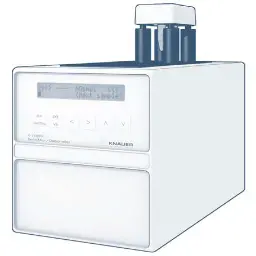
Six different samples of isotonic and non-isotonic drinks were measured, the osmolality was determined using the K-7400S osmometer which correlates freezing point depression with osmolality. The osmometer was calibrated in a range of 0-850 mOsmol/kg for isotonic samples and in a range from 0-2000 mOsmol/kg for non-isotonic drinks, respectively. Ten replicates were measured for each sample using a sample volume of 150 µL. The diagram in Fig 2 shows the average values of osmolality for the isotonic samples together with the EFSA limits. The non-isotonic beverages have a much higher osmolality. For samples of caffeine containing soft drink and beer osmolalities of 644 mOsmol/kg and 1008 mOsmol/kg, respectively, were determined. As alcohol is also depressing the freezing point, the osmolality.
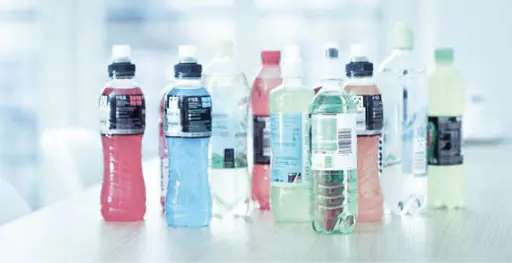
Fig. 1 Isotonic beverages
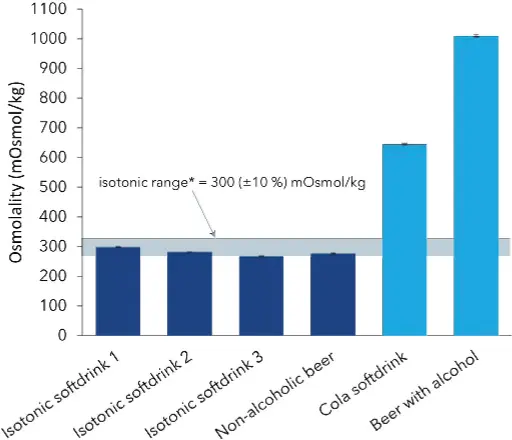
Fig. 2 Measured osmolalities of four different as isotonic declared as well as two non-isotonic beverages. Graph shows average values and standard deviations of 10 replicates
Materials and Method
All measurements were made with the KNAUER K-7400S Semi-Micro Osmometer. The used calibration standards had osmolality values of 300, 850 and 2000 mOsmol/kg. The system parameters were set to -8 °C for freeze and -16 °C for cooling limit. The samples of soft drinks and beer were degassed using an ultrasonic bath to remove the carbon dioxide. Then 150 µL of the samples were transferred to a plastic sample tube.
Conclusion
The osmolalities of all analyzed isotonic samples were within the EFSA defined range. In general, the values were below 300 mOsmol/kg, which could be due to the sample preparation (degassing) and a subsequent reduction of carbon dioxide. Due a higher content of solved compounds like sugars or alcohol, in the case of beer, non-isotonic beverages showed significantly higher osmolalities.
Additional Results
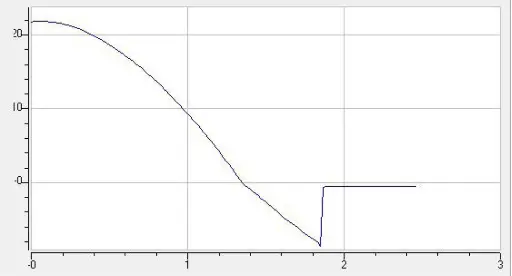
Fig. A1 Temperature-time-curve
Tab. A1 Average osmolalities of isotonic and non-isotonic beverages
Additional Materials and Methods
Tab. A2 Method parameters
Tab. A3 System configuration
References
[1] Scientific Opinion on the substantiation of health claims related to carbohydrate-electrolyte solutions and reduction in rated perceived exertion/effort during exercise (ID 460, 466, 467, 468), enhancement of water absorption during exercise (ID 314, 315, 316, 317, 319, 322, 325, 332, 408, 465, 473, 1168, 1574, 1593, 1618, 4302, 4309), and maintenance of endurance performance (ID 466, 469) pursuant to Article 13(1) of Regulation (EC) No 1924/20061 EFSA Panel on Dietetic Products, Nutrition and Allergies (NDA);
http://onlinelibrary.wiley.com/
Related KNAUER Applications
VPH0064 – Quality control of pharmaceutical solutions by determination of osmolality
Application details