
Science with Passion

Application No.: VCH0017
Version 2 08/2020
Molecular weight distribution of a broad polystyrene standard
Juliane Böttcher, Lisa Loxterkamp, Jan Wendrich, Kate Monks; applications@knauer.net
KNAUER Wissenschaftliche Geräte GmbH, Hegauer Weg 38, 14163 Berlin
Photo: Pixabay
Summary
Gel permeation chromatography (GPC) and size exclusion chromatography (SEC) describe the separation of molecules based only on their molecular size. Using an AZURA® GPC it is possible to run GPC/SEC applications with aqueous as well as organic solvents, when changing the system modules with the suitable compatibility.
Introduction
GPC and SEC are based on the same separation principle, size exclusion. GPC can characterize polymers with determining the molecular weight distribution and the refractive index. In former times the term SEC was used for aqueous applications with stationary phases, e.g. dextran. GPC on the other side was applied with organic solvents and for instance polystyrene stationary phases. Nowadays both definitions are used side by side for the same separation. The peculiarity of GPC and SEC is that analysis is performed over one column volume, which results in a negative partition coefficient (k) for the analytes. The complete separation is therefore taking place over the selective permeation range which depends on the pore and exclusion volume [1]. The analyte needs to be dissolved in the eluent during separation to determine the exact molecular weight distribution. Sorption or chemical interactions with the stationary phase or wetted parts are objectionable. GPC is a relative molecular weight determination, where the best alternative is using the direct standard calibration in which case the standard is the same polymer type as the sample [2]. This application gives an example of the mentioned appliance. A calibration with narrow polystyrene standards on a polystyrene stationary phase was performed. With this calibration a broad polystyrene standard was analyzed. The obtained results are compared to the given values of the certificate of the broad standard to illustrate that KNAUER AZURA devices are suitable for GPC/SEC implementation.
Results
The elugram in Fig. 1 shows an overlay of the RID trace of the broad standard and the determined calibration curve. Here it can be seen that the elution volume or the peak maximum of the broad standard lies within the calibration range. By using the ClarityChrom GPC/SEC extension it is easy to obtain the desired information about the molecular weight distribution of the analyzed samples. Fig. 2 exemplarily shows the distribution of the broad standard. The certificate of the broad standard provides the following values: Mw=248000 Da and Mn=143000 Da. The polydispersity is given with a value of PD=1.73 [Mw/Mn]. In comparison the calculated result with ClarityChrom are Mw=247163 Da, Mn=126765 Da and PD=1.95 [Mw/Mn]. The deviation of the calculated values compared to the certificate might be a result of the used column with mixed porosities resulting in a broader weight distribution. This column normally is used for screening purposes and did not provide the best resolution. In addition, the broad standard signal is not completely within the calibration range, which makes the deviation of Mn and PD plausible. Another effect could be the approximated K and α coefficients which are not exactly according the measurement conditions due to the different temperature. For exact coefficient determination a viscosity detector should be used.

Fig. 1 Polystyrene broad standard elugram (blue) with the calibration curve (black) in the background.
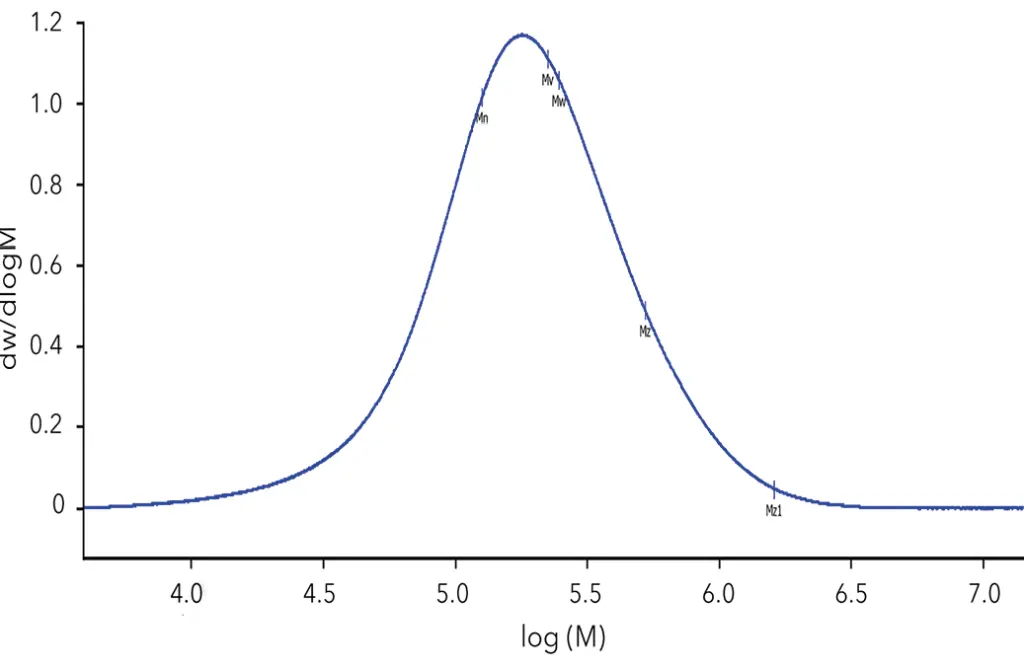
Fig. 2 Molecular weight distribution of the polystyrene broad standard.
Sample Preparations
A calibration in a range from 580 Da to 364 kDa using the EasiCal PS-2 calibration kit was prepared. Standards were prepared directly in the vial and dissolved in approximately 1.5 ml THF. 30 mg of the broad standard polystyrene were weighed in a volumentric flask and dissolved in 10 ml THF overnight. The used K and α Houwink coefficient were provided by the ClarityChrom software with K=14.1 [dl/g*105] and α=0.7 at 25 °C. The elugrams of the measured calibration standards are shown in Fig. 3 and Fig. 4.
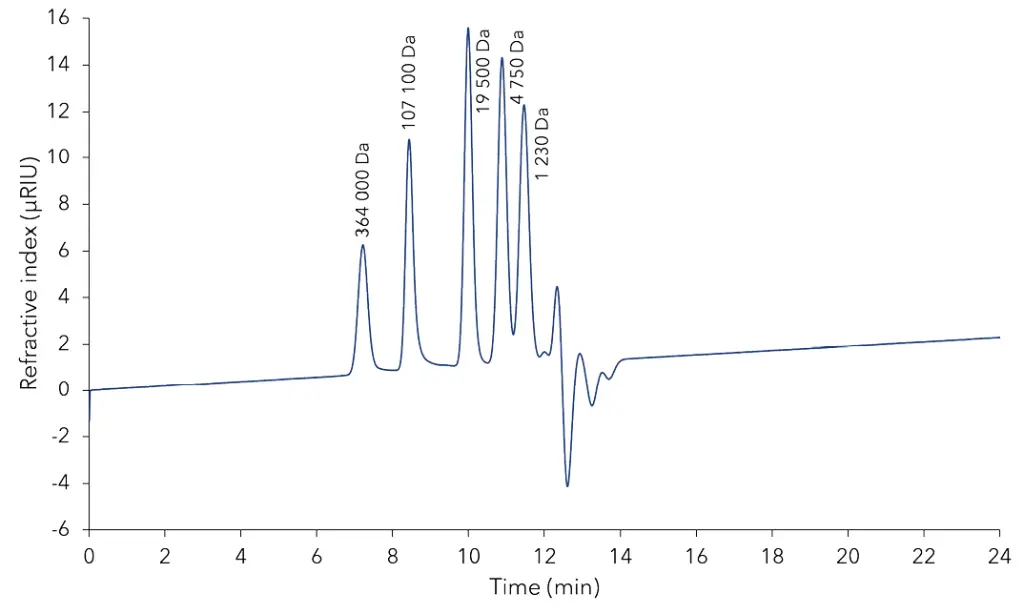
Fig. 3 Polystyrene Standard PS-2 A.
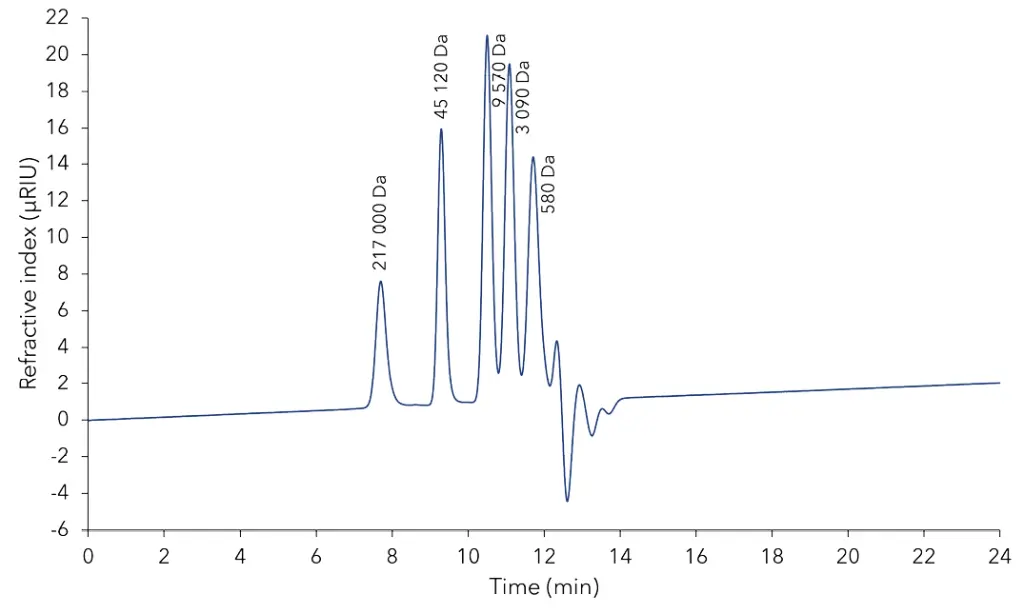
Fig. 4 Polystyrene Standard PS-2 B.
Conclusion
As pumps are available for normal phase operation, aqueous/organic and aqueous mode KNAUER devices are perfectly suitable for this application.
Materials and Methods
Tab. 1 Method parameters
Column temperature | 23 °C |
Injection volume | 20 µl |
Injection mode | Partial loop |
Detection | RI |
Data rate, Time constant | 20 Hz, 0.05 s |
Temperatur of RID | 35 °C |
Tab. 2 Pump parameters
Eluent | Tetrahydrofuran stabilized with BHT |
Compressibility | 0.97 |
Flow rate | 1 ml/min |
Pressure | ~ 35 bar |
Pump program | isocratic |
Tab. 3 System configuration
Instrument | Description | Article No. |
Pump | AZURA P6.1L HPG | |
Degasser | 2 channel GPC degasser | |
Autosampler | AZURA AS 6.1L | |
Detector | AZURA RID 2.1L | |
Thermostat | AZURA CT 2.1 | |
Column | AppliChrom® ABOA StyDiViBe-P-10E5A-BPT, 5 µm, GPC column 300 x 8 mm | |
Software | ClarityChrom 8.2.2 | |
Software | ClarityChrom GPC Extension |
Tab. 4 Standards and samples
Name | Molecular weight data |
Polystyrene Standard EasiCal PS-2, Agilent Standard A Standard B |
217 000, 45 120, 9 570, 3 090, 580 Da |
Polystyrene PSS-psb250k | Mw: 248 000 Da Mn: 143 000 Da PDI: 1.73 |
References
[1] Wu, C. Handbook of size exclusion chromatography. Marcel Dekker (1995).
[2] Teraoka, I. Polymer Solutions: An introduction to physical properties. John Wiley & Sons, Inc. (2002).
Related KNAUER Applications
VFD0153 – GPC cleanup of olive oil samples
VFD0166 – LC-FLD of 4 PAHs in olive oil samples using AZURA® GPC Cleanup System
VFD0172 – A D E K - Easy separation of fat-soluble vitamins using GPC/SEC
Application details
Method | HPLC |
Mode | GPC/SEC |
Substances | Polystyrene |
CAS number | CAS 9003-53-6 |
Version | Application No.: VCH0017 | Version 2 08/2020 | ©KNAUER Wissenschaftliche Geräte GmbH |