
Science with Passion

Application No.: VFD0155 Version 1 05/2017
Semi preparative xylitol purification with dedicated sugar purification system
Yannick Krauke, Matthias Lübbert, Kate Monks; applications@knauer.net
KNAUER Wissenschaftliche Geräte GmbH, Hegauer Weg 38, 14163 Berlin

Summary
Xylitol is used as sweetener in the food industry and is generated by chemical conversion of xylose. Here, xylitol was purified from fermentation mash by microbial xylose conversion. The AZURA® Sugar purification system with the AZURA RID 2.1L refractive index detector was used for this semi-preparative purification in combination with polymer-based Eurokat Ca column.
Introduction
The second generation of bio refinery is using biomass with low contents of C6 sugars such as wheat straw. This biomass is often rich in the C5 sugar xylose which is normally not used as a carbon source by microorganisms for ethanol production. Xylose is chemically converted to xylitol which is a five-carbon sugar alcohol occurring in nature mostly in low concentrations and its extraction is too unproductive. It has found its application i.e. food industry as an artificial sweetener in chewing gums. It has been shown that xylose can be converted to xylitol by different yeast and bacteria species [1, 2]. The microbial conversion of xylose to xylitol, followed by a simple purification process, presents an economical and environmentally-friendly alternative [3]. A previous study already revealed the feasibility of semi-preparative xylitol purification from fermentation mash (VFD0150). In this study, method optimization for xylitol purification was performed with the same stationary phase material. The AZURA RID 2.1L detector could be used for this task due to its ability to sustain flow rates up to 10 mL/min and 5 bar back pressure.
Results
The separation profile of the semi–preparative Eurokat Ca 150 × 20 mm column was tested by injection of 0.5 mL fermentation mash (FM; 1:2 dilution). Overlay of the resulting chromatogram with chromatograms of standard solution and retention time comparison identified xylitol, mannitol, glycerol and xylose in the sample (see add. results Fig. A1). Also at larger injection volumes (1 mL, 2 mL) xylitol could still be baseline separated from mannitol (Fig. 1). Due to the shorter column length (150 × 20 mm) and faster flow rate (4 mL/min) the xylitol peak eluted earlier (approx. 13 min) compared to previous study where it eluted at 19 min using a longer column (250 × 16 mm) and lower flow rate (2.5 mL/min) (VFD0150). After injection of 2 mL FM a 12 mL fraction of xylitol was recovered (Fig. 1, blue bracket). The analysis of the 12 mL xylitol fraction and subsequent comparison with chromatograms of a xylitol standard (1 mg/mL) and FM revealed no contaminations in the xylitol fraction (Fig. 2, red line). Measurements of xylitol concentration in the FM showed an initial concentration of approx. 60 mg/mL xylitol and a concentration of approx. 5.6 mg /mL xylitol in the fraction, revealing an about 11 fold dilution of xylitol by batch purification.
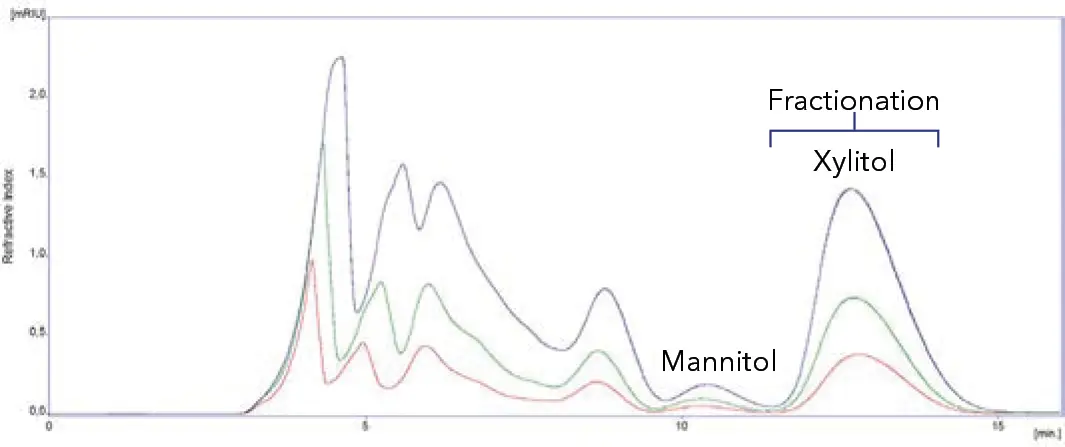
Fig. 1 Chromatogram overlay of different injection volumes from fermentation mash (1:2 dilution); red - 0.5 mL, green - 1 mL, blue - 2 mL; blue brackets-fractionation area 2 mL injection; EK Ca 150 x 20 mm; 4 mL/min; 60 °C
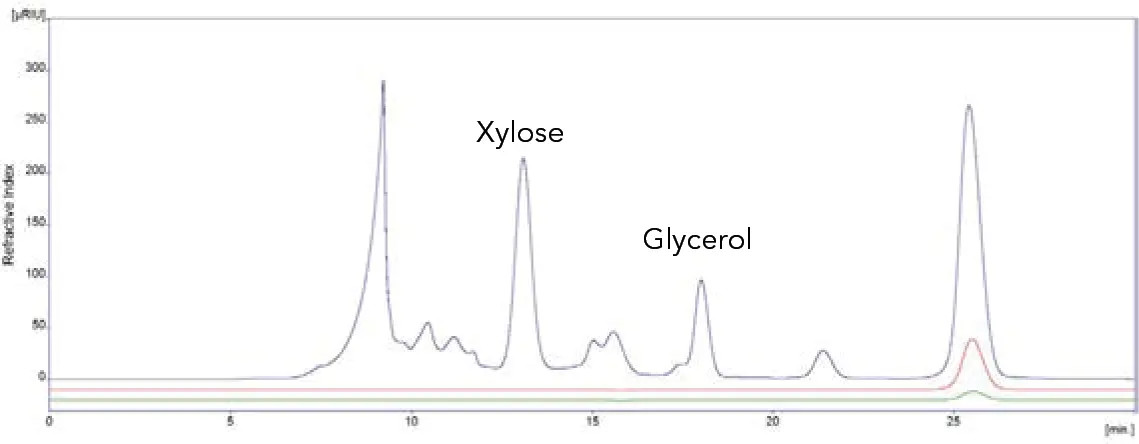
Fig.2 Overlay of analytical chromatograms; blue - fermantation mash (1:2 dilution); red - fractionation sample from Fig. 1; green - xylitol standard 1 mg/mL; 10 µl each; EK Ca 300 x 8 mm; 75 °C
Acknowledgement: This project has received funding from the European Union‘s Seventh Framework Program for research, technological development and demonstration under grant agreement no FP7-KBBE-2013-7-613802.

Materials and Method
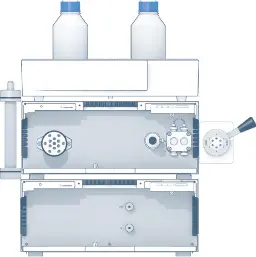
The AZURA sugar purification system consists of an assistant AZURA ASM 2.1L with a 12 port multi position valve (for fractionation) and 50 mL pump and an AZURA RID 2.1L refractive index detector. Eurokat Ca 150×20 mm column (sulfonated cross-linked styrene-divinylbenzene copolymer) with 25–56 µm particles was used for purification. The column was heated with a heating jacket to 60 °C. Purification run was in isocratic mode for 16 min at 4 mL/min. Different injection volumes were tested. The data rate was set to 5 Hz, time constant 0.02 sec.
Conclusion
Two main results were achieved with this study: 1. Optimization of the batch xylitol purification process and 2. Application of the AZURA RID 2.1L refractive index detector for semi-preparative sugar purification at higher flow rates. Xylitol was purified with a purity of >99 % and recovery of >99 % from fermentation mash of microbial xylose to xylitol conversion. Elution time (13 min) and temperature (60 °C) was reduced and injection volume (2 mL) increased when compared to early study (VFD0150).
Additional Results
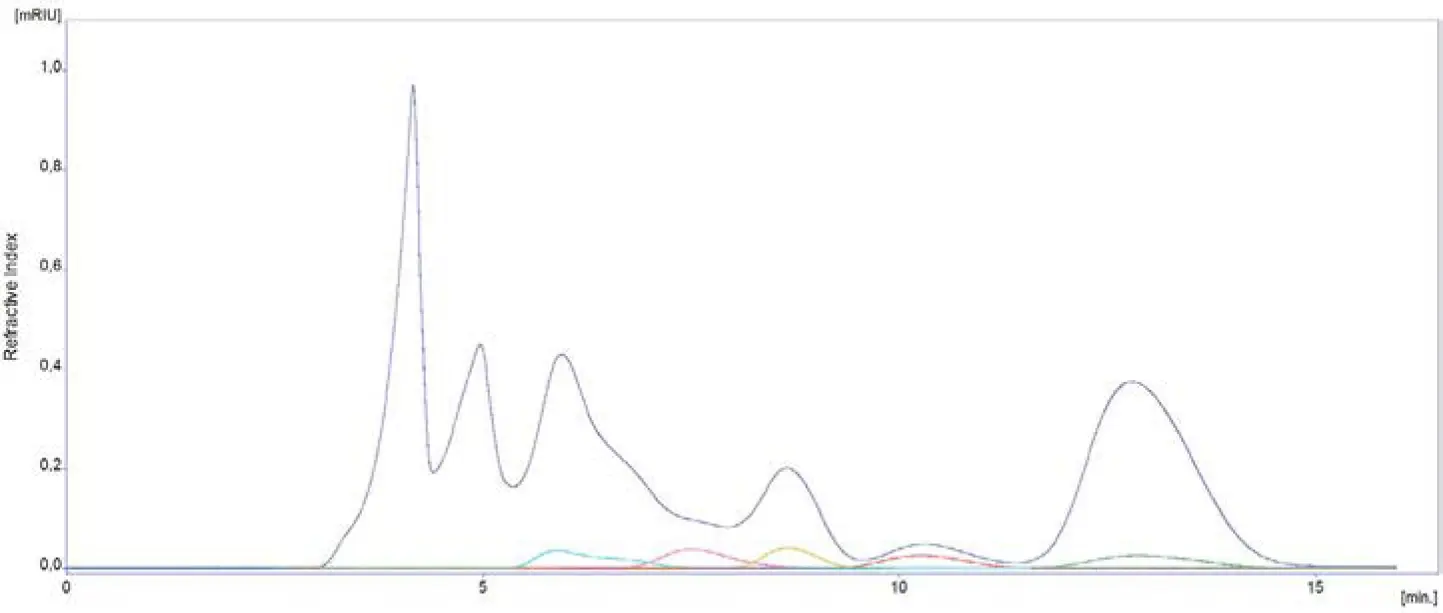
Fig. A1 Chromatograms of 0.5 mL injection of fermentation mash (1:2 dilution) and standards (2 mg/mL each); blue - FM; EK Ca 150 x 20 mm; 60 °C; 4 mL/min
Additional Materials and Methods
Tab. A1 Method parameters (preparative purification)
Tab. A2 Method parameters (fraction analysis)
Tab. A3 System configuration
References
Tamburini E.; Costa S., Gabriella Marchetti M., Pedrini P. Biomolecules 5: 1979–1989 (2015)
Hernandez-Perez A.F., Vaz de Arruda p., Gracas de Almeidan Felipe M.d.FTI 20037. Brazilian Journal of microbiology 47: 489-496 (2016)
Chen X., Jian Z.-H., Chen S., Qin W. Int. J. Biol. Sci. 6(7): 834–844 (2010)
Related KNAUER Applications
VFD0160 – Determination of sugars and natural sugar substitutes in different matrices
VFD0161 – Determination of sugars in honey using HILIC separation and RI detection
VSP0013 – Simplified scale up for sugars with the AZURA RID 2.1L extended dynamic range option
VFD0150 – Alternative xylitol extraction via hplc purification from fermented biomass
Application details