
Science with Passion

Application No.: VPH0084 Version 1 06/2026
Scaling up LNP formulation using a Reynolds number-based methodology
S. Stephan, I. Regeler, P. Pietsch; s.stephan@knauer.net
KNAUER Wissenschaftliche Geräte GmbH, Hegauer Weg 38, 14163 Berlin
Summary
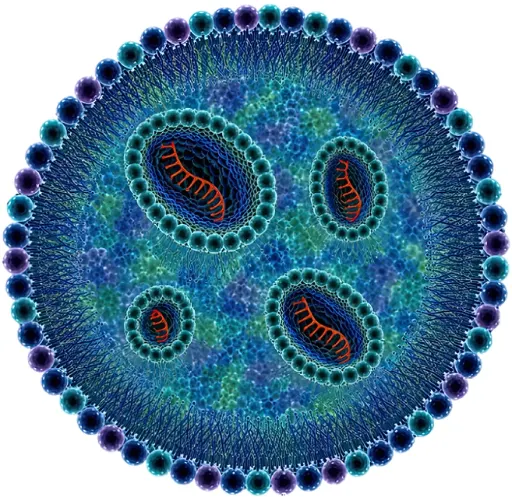
The growing importance of lipid nanoparticles (LNPs) in pharmaceutical applications and personalized medicine is driving the need for scalable manufacturing strategies that maintain consistent product quality from development through to large-scale production. In Impingement Jets Mixing (IJM) technology, nanoparticle formation is highly sensitive to the way fluids move and interact during mixing, making precise control of the mixing process a critical factor during scale-up.
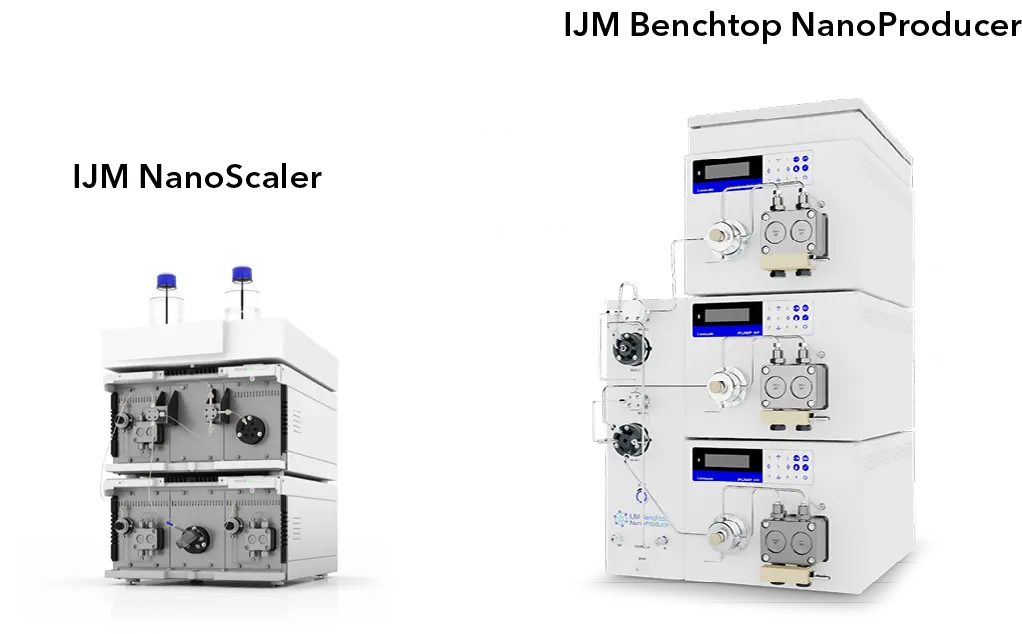
This application note presents a Reynolds number-based strategy to transfer LNP production from the R&D-scale IJM NanoScaler to the production-scale IJM Benchtop NanoProducer. A critical Reynolds number defining stable particle size and polydispersity index (PDI) was identified and subsequently applied across platforms. The results demonstrate that maintaining comparable flow conditions enables reliable scale-up while significantly increasing throughput ensuring consistent quality attributes.
Introduction
LNPs have become an essential enabling technology for RNA-based therapeutics and next-generation drug delivery systems. As these applications progress from laboratory research [1,2] to commercial manufacturing, process robustness and scalability become increasingly important. Beyond scalability, consistent product quality is critical. In pharmaceutical development, predefined critical quality attributes (CQAs) such as particle size, PDI, encapsulation efficiency and active pharmaceutical ingredient (API) integrity define whether a formulation meets its intended performance and regulatory requirements. These CQAs are established during early formulation development and must be maintained throughout scale-up to ensure product consistency, pharmaceutical efficacy and reproducibility.
LNPs are typically generated by controlled mixing of a lipid phase in ethanol with an aqueous buffer containing the nucleic acid payload. The rapid solvent exchange initiates lipid self-assembly and determines the resulting nanoparticle characteristics. Because particle formation occurs on timescales comparable to the mixing process, the interplay between hydrodynamics and nanoparticle assembly is a key determinant of final product quality. Even minor variations in mixing conditions can influence particle size distribution, encapsulation efficiency, and overall formulation consistency.
To establish robust and scalable manufacturing processes, the underlying transport phenomena must be described independently of an operating scale. Dimensionless numbers provide a powerful framework for this purpose. The Reynolds number (Re) characterizes the flow regime and mixing intensity by relating inertial and viscous forces, while the Damköhler number (Da) describes the relationship between the characteristic timescales of mixing and nanoparticle formation. Together, these parameters provide a quantitative basis for understanding and controlling LNP self-assembly.
For LNP manufacturing, the Damköhler number is defined as the ratio between characteristic mixing and self-assembly timescales. This application extends the classical reaction-engineering concept and serves as a practical parameter for describing nanoparticle formation during rapid mixing. The Damköhler number is a dimensionless number used in chemical engineering and reaction engineering to compare the rate of a chemical reaction to the rate of transport processes such as mixing, diffusion or flow. From a mechanistic perspective, LNP formation in Impingement Jets Mixing systems is characterized by Da > > 1 [3]:
tmix: mixing time [s]
tassembly: reaction time [s]
In LNP systems, nucleation and structural rearrangement occur on the microsecond timescale once supersaturation is reached, whereas macroscopic mixing proceeds on the millisecond timescale. Consequently, nanoparticle self-assembly is substantially faster than complete solvent homogenization, indicating that the process is mixing-controlled. Under these conditions, local hydrodynamic and mass transfer phenomena directly determine supersaturation profiles and nucleation kinetics. Even minor variations in mixing intensity or flow regime can therefore influence particle size and PDI.
The Reynolds number, defined as
ρ: density [kg/m3]
ν: flow velocity [ml/min] = 1.67 · 10-8 [m3/s]
d: inner diameter [mm] = 10-3 [m]
η: dynamic viscosity [kg/m·s]
was selected as the governing parameter to describe and control the mixing regime.
Maintaining comparable Reynolds and Damköhler numbers across different mixer sizes and operating conditions enables the preservation of key hydrodynamic and physicochemical conditions that govern particle formation. As a result, dimensionless analysis offers a rational strategy for scale-up, helping to ensure that predefined CQAs remain consistent across development and manufacturing scales. The following section demonstrates how Re- and Da-based scaling can facilitate process transfer between different Impingement Jets Mixer platforms.
Results
R&D Evaluation and Hydrodynamic Characterization
The experimental study was initiated on KNAUERs IJM NanoScaler, where multiple LNP formulations were developed and characterized under defined process conditions. During this phase, formulation parameters such as lipid composition, flow rate ratio (FRR), and total flow rate (TFR) were systematically varied to establish target CQAs, particularly particle size and PDI. In addition to recording volumetric flow parameters, the corresponding hydrodynamic conditions were quantified by calculating Re for each experimental setting, thereby the prevailing flow regime within the impingement zone.
Determination of a Critical Reynolds Number
Particle size was evaluated to depend on the Re using the IJM NanoScaler (Fig. 1). At Re below 500 particle sizes of 100 nm and larger were observed, indicating insufficient mixing and heterogeneous supersaturation conditions. With increasing Re, particle size decreased until reaching a plateau region at around 52 nm. Above a critical Reynolds number of ~ 750, further increases in flow rates did not significantly affect particle size. This plateau defines the hydrodynamic condition required to achieve minimal particle size for the given formulation.
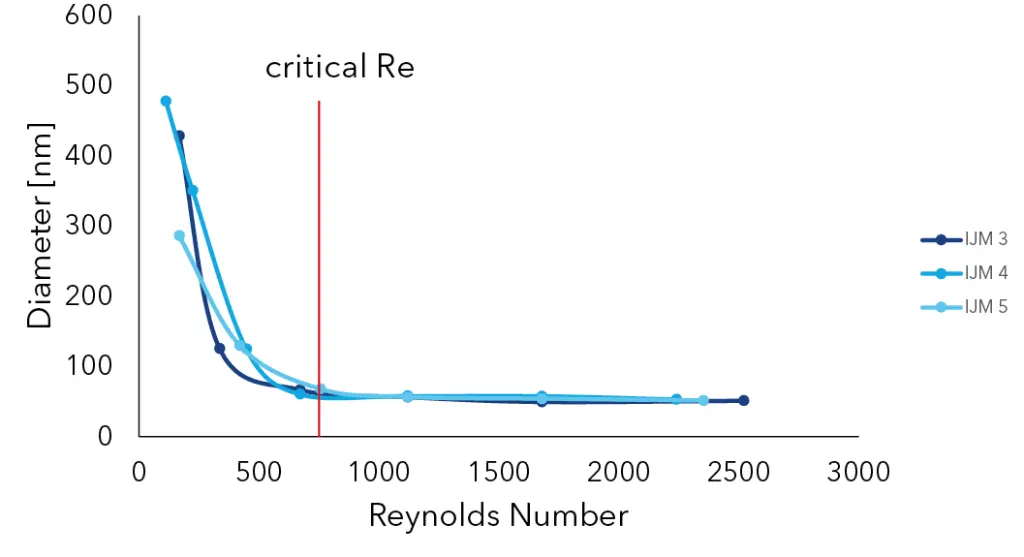
Fig. 1 Average particle size of lipid nanoparticles against the Reynolds number. Test parameters: IJM# 3-5, FRR = 1:3 (lipid phase : citrate buffer), TFR = 2-56 ml/min, n = 3. Results obtained using the IJM NanoScaler.
Subsequently, LNPs were formulated using the IJM NanoScaler and five different sized IJMs. Flow conditions were adapted to individual mixer sizes resulting in a constant Re of 1120 for each case. This value for Re was chosen slightly above the critical Reynolds number to ensure results within the plateau region. The resulting particle sizes and PDIs are in the same range for all IJMs (Fig. 2).
These results confirm the presence of a critical Re threshold above which mixing is no longer the limiting factor for nanoparticle formation.
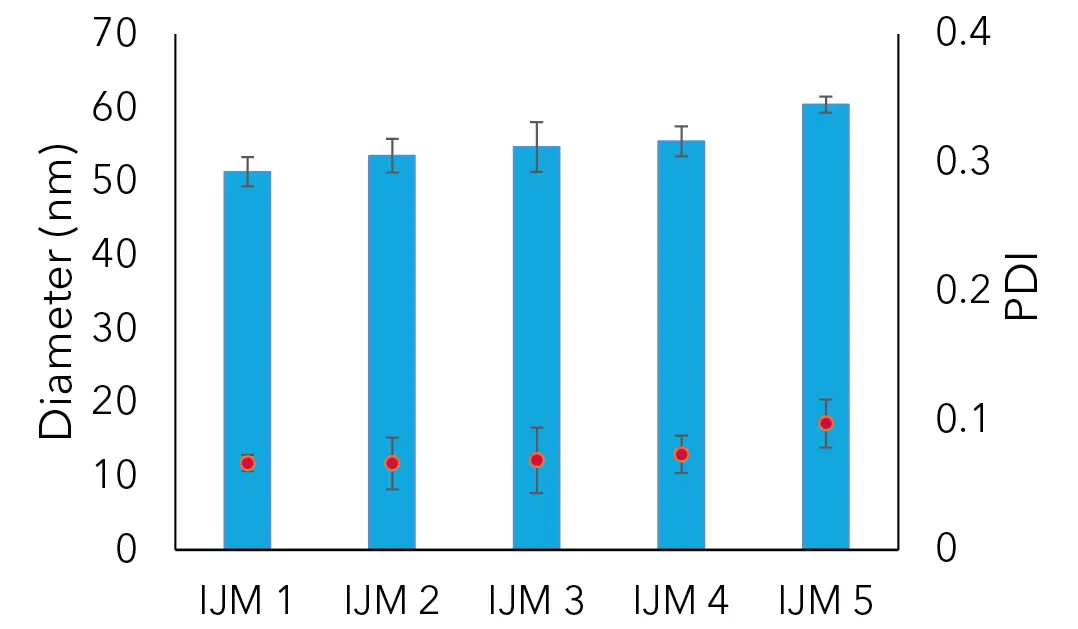
Fig. 2 Particle size (blue bar) and PDI (red dot) of lipid nanoparticles at a constant Re number = 1120. Test parameters: IJM# 1-5, FRR = 1:3 (lipid phase : citrate buffer), TFR = 5-27 ml/min, n = 3. Results obtained using the IJM NanoScaler.
Reynolds based LNP formulation transfer from R&D to Benchtop Scale
Based on the identification of optimal flow regimes on the NanoScaler, scale-up experiments were performed on the IJM Benchtop NanoProducer (Fig. 3). Operating parameters were adjusted to achieve equivalent Re numbers on the larger system. By preserving hydrodynamic similarity, comparable mixing-controlled self-assembly conditions were targeted. The resulting data demonstrate that matching Reynolds numbers between R&D and production scale enables the maintenance of CQAs, yielding comparable particle diameters of appr. 50 nm and PDIs below 0.05 across both systems.

Fig. 3 Particle size (blue bar) and PDI (red dot) of lipid nanoparticles at a constant Re number = 1120. Test parameters: IJM# 3-7, FRR = 1:3 (lipid phase : citrate buffer), TFR = 13-40 ml/min, n = 3. Results obtained using the IJM Benchtop Producer
Throughput Expansion Within the Established Operating Window
To further validate the robustness of the scale-up strategy, throughput was increased on the benchtop system using IJM 5 (Fig. 4). Even at substantially higher Re numbers and production rates, particle size and PDI remained within the previously identified plateau region. This confirms that equivalent shear and mixing kinetics - rather than absolute flow rate – is the decisive parameter governing LNP formation and scalable manufacturing.

Fig. 4 Particle size (blue bar) and PDI (red dot) of lipid nanoparticles, formulated at Re numbers from 252 to 8400. Test parameters: IJM# 5, FRR = 1:3 (lipid phase: citrate buffer), TFR = 6-200 ml/min, n = 3. Results obtained using the IJM Benchtop Producer.
Conclusion
A critical Reynolds number defining stable particle size and PDI was successfully identified on the R&D-scale IJM NanoScaler. Operating above this threshold ensured consistent nanoparticle characteristics within a defined plateau region. By transferring these hydrodynamic conditions to the benchtop system, predefined CQAs were reliably maintained across scales. The data demonstrate reproducible particle size and PDI during scale-up while enabling a substantial increase in throughput. These findings highlight that a Reynolds number driven approach provides a robust and scalable framework for predictable LNP manufacturing using IJM technology.
Material and Methods
Northern Lipids Compass Kit 1 and corresponding protocol were kindly provided by Evonik.
LNPs were measured directly after formulation
Dynamic Light Scattering (DLS):
DynaPro ZetaStar from Wyatt Technology
Tab. 1 System configuration.
References
[1] Zhou, W., Jiang, L., Liao, S., Wu, F., Yang, G., Hou, L., Liu, L., Pan, X., Jia, W. & Zhang, Y. (2023). Vaccines’ New Era-RNA Vaccine. Viruses, 15.
[2] Hou, X., Zaks, T., Langer, R. et al. Lipid nanoparticles for mRNA delivery. Nat Rev Mater 6, 1078–1094 (2021). https://doi.org/10.1038/s41578-021-00358-0
[3] Devos C, Mukherjee S, Inguva P, et al.Impinging jet mixers: A review of their mixing characteristics, performance considerations, and applications. AIChE J. 2025; 71(1):e18595. doi:10.1002/aic.18595
Application details