
Science with Passion

Application No.: VPH0067
Version 1 01/2021
Easy and fast isolation of rosmarinic acid from lemon balm with mass-directed purification
Jan Wendrich, Yannick Krauke, Lilit Avagyan, Kate Monks; applications@knauer.net
KNAUER Wissenschaftliche Geräte GmbH, Hegauer Weg 38, 14163 Berlin

Summary
Rosmarinic acid is a natural product widely spread over different plant families. Preparative reversed-phase chromatography was used for the mass-directed purification of rosmarinic acid from a lemon balm extract. The AZURA® Prep HPLC system together with the 4000 MiD mass spectrometer was showed to be well suited for this application.
Introduction
The ubiquitous natural product rosmarinic acid shows antiviral, antimicrobial and anti-inflammatory characteristics. It is used in different kinds of medicinal products for example in ointments for sports injuries. Leaves of lemon balm contain a high concentration of rosmarinic acid and are therefore an interesting source for the isolation of this compound. Here, we present an effective and time-saving method for the isolation of rosmarinic acid from a lemon balm extract based on the technique of mass-directed purification.
Results
A method for the isolation of rosmarinic acid from a lemon balm extract was developed on an analytical scale using an AZURA Analytical System and a Eurospher II C18 column (Fig 1). The UV spectra from the analysis showed the presence of many compounds with the structural motif of a phenyl acrylic acids. For a time-saving isolation of the target compound, the developed method was then transferred directly to the AZURA Preparative System with the ability to fractionate via molecular mass. One fraction with a compound of the desired mass (m/z 359.2; [M-H]-) was collected (Fig 2 & Fig 3). The following analysis of this fraction with the AZURA Analytical System showed that is was possible to isolate the target compound rosmarinic acid with the technique of mass-directed purification in a purity of >95 % (Fig 4).
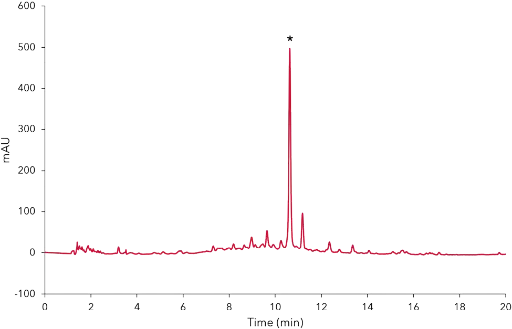
Fig. 1 Analytical chromatogram of the crude lemon balm extract at 280 nm; gradient separation 20 %-100 % acetonitrile, *rosmarinic acid peak
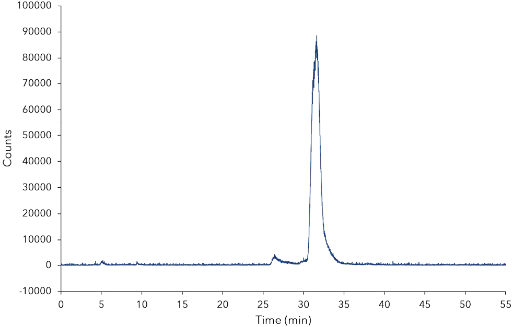
Fig. 2 SIM (single ion monitoring) chromatogram of a purification run for the target mass of m/z 359.2
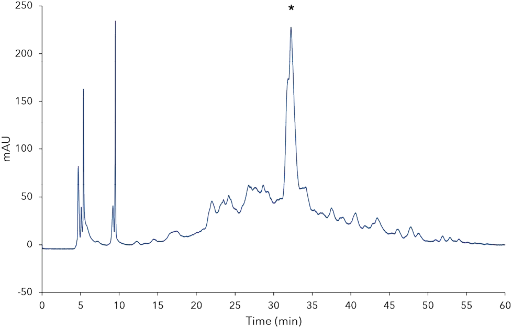
Fig. 3 UV-Chromatogram of a purification run for the crude lemon balm extract at 280 nm, *rosmarinic acid peak
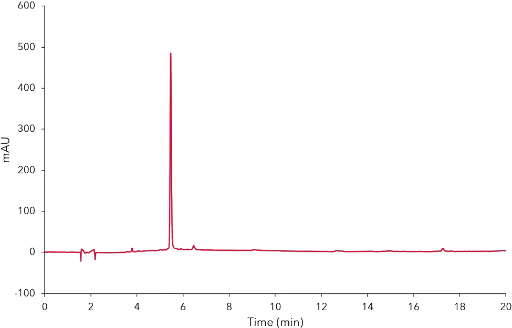
Fig. 4 Analytical chromatogram of the fraction containing rosmarinic acid at 280 nm, isocratic separation 50/50 water/acetonitrile
Materials and Methods
AZURA Analytical HPLC System was used for the method development consisting of a low-pressure gradient AZURA P6.1L pump, an AZURA AS 6.1L autosampler, an AZURA DAD 2.1L diode array detector equipped with a 10 mm PressureProof flow cell and an Eurosphere II 100-5 C18 150 x 4.6 mm column.
The gradient method was run for 20 min at a flow rate of 1 mL/min starting with 80/20 % water/acetonitrile increasing to 100 % acetonitrile over 20 min. Both eluents contained 0.1 % formic acid as an additive. The wavelength of the detector was set to 280 nm at a data rate of 20 Hz. 10 µL of the sample was injected.
AZURA Preparative HPLC System was used for the mass-directed purification of rosmarinic acid. The system consisted of an AZURA P 2.1L pump equipped with a 250 mL pump head and a three channel low pressure gradient (LPG) ternary module, a manual injection valve (1/8’’, 6 port 2 kanal) equipped with a 5 mL sample loop, an AZURA DAD 6.1L diode array detector equipped with a 3 mm PressureProof flow cell, a 4000 MiD mass spectrometer with the MiDas sampling unit, a AZURA V 2.1S equipped with a 6 port multi position valve for fractionation and an Eurospher II 100-10 C18 250 x 30 mm column. The gradient method run for 67 min at a flow rate of 21.3 mL/min under the same conditions as the analytical method described above. The wavelength of the DAD was set to 280 nm at a data rate of 10 Hz, while the mass selective detector was set to SIM mode monitoring the relevant mass of m/z 359.2. The data trace of the mass selective detector was used for fractionation via the multi-position valve. 5 mL of the crude extract obtained under sonication from dried leave material with 30 % isopropanol was injected.
Conclusion
Rosmarinic acid was the main metabolite of the extracted lemon balm material. This target molecule was isolated in a short time with an AZURA Preparative HPLC system using the technique of mass-directed purification. By this, the number of fractions was reduced to one leading to a significant decrease of past analysis time.
Additional Results
![Fig. A1 Mass spectrum of rosmarinic acid ([M-H]-).](/web/image/272060-8e142710/VPH0067_Fig-A01.webp "Fig. A1 Mass spectrum of rosmarinic acid ([M-H]-).")
Fig. A1 Mass spectrum of rosmarinic acid ([M-H]-).
Additional Materials and Methods
Tab. A1 Method parameters (preparative)
Tab. A2 Method parameters (mass spectrometer analysis)
Tab. A3 System configuration & data (analytical system)
Tab. A4 System configuration & data (preparative system)
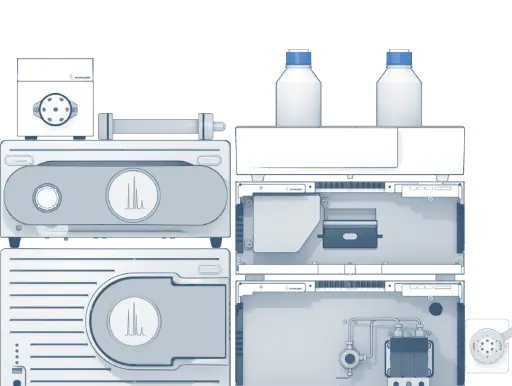
KNAUER AZURA® Preparative HPLC system using the technique of mass-directed purification
Application details