
Science with Passion

Application No.: VFD0159 Version 1 09/2017
Alternaria alternata – determination of main metabolites
Juliane Böttcher, Marina Müller1, Kate Monks; applications@knauer.net
KNAUER Wissenschaftliche Geräte GmbH, Hegauer Weg 38, 14163 Berlin
1Leibniz-Zentrum für Agrarlandschaftsforschung e.V., Müncheberg, Germany
Summary
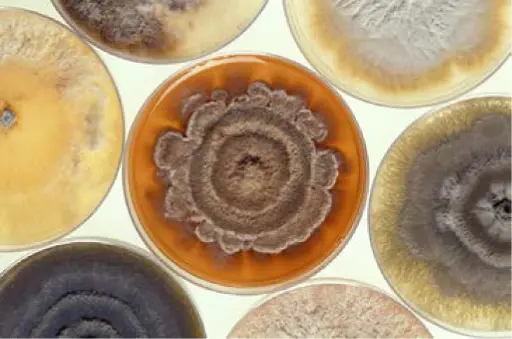
Alternaria toxins represent a possible health-endangering group of mycotoxins produced mainly by the Alternaria species. These are a widespread group of fungi contaminating mainly fruits and vegetables, but also other crop plants, during growth as well as storage. The most important mycotoxin-producing species is Alternaria alternata which occurs mainly on cereals and seeds [1].
Introduction
Even though Alternaria toxins are normally associated with fruits and vegetables that are visibly infected by Alternaria species, they have also been found in cereals, such as wheat, rye, sorghum, rice, and even tobacco. Alternaria toxins have been shown to exhibit both acute and chronic effects and therefore represent a threat to animal and human health. The most studied mycotoxin in the group of toxins produced by the species Alternaria is tenuazonic acid. Its main function is the inhibition of protein synthesis and results in antitumor, antiviral and antibacterial activity. Most of the other Alternaria toxins show cytotoxic activity in mammals, some of them are mutagenic like the altertoxins, while others are toxic to the unborn [1]. This application focusses on the determination of alternariol (AOH), alternariol monomethyl ether (AME), altenuene (ALT) and tenuazonic acid (TeA).
Results
All samples and standards were provided from the Leibniz-Zentrum für Agrarlandschaftsforschung (ZALF) e.V. [2]. First a calibration was made using the standard ZALF 5 with five different injection volumes. AOH was calibrated in a range from 0.5 ng up to 5.0 ng (absolute), ALT and AME from 1 ng up to 10 ng (absolute) and TeA from 2ng up to 20 ng (absolute). AOH, ALT and AME were detected with a fluorescence detector. TeA was determined using a UV detector. Tab 1 gives a short summary of the retention times of the substances and achieved correlation coefficients of calibration. As sample an extracted nutrient solution of an Alternaria strain was used. The extract was divided into two fractions. One for the TeA determination (ZALF 7, dilution 1:20) and one for the other metabolites (ZALF 6, without dilution). Fig 1 shows an overlay of the fluorescence traces of the standard ZALF 5 and sample ZALF 6. For ALT, a concentration of 1.18 ng/µL was calculated, for AOH 2.74 ng/µL and 0.36 ng/µL for AME. Fig 2 Shows the UV traces of standard ZALF 5 and sample ZALF 7 for determination of TeA. In the second fraction, a value of 3.44 ng/µl TeA was calculated.
Tab. 1 Retention times and correlation coefficients of altenuene, alternariol, alternariol monomethyl ether and tenuazonic acid calibration
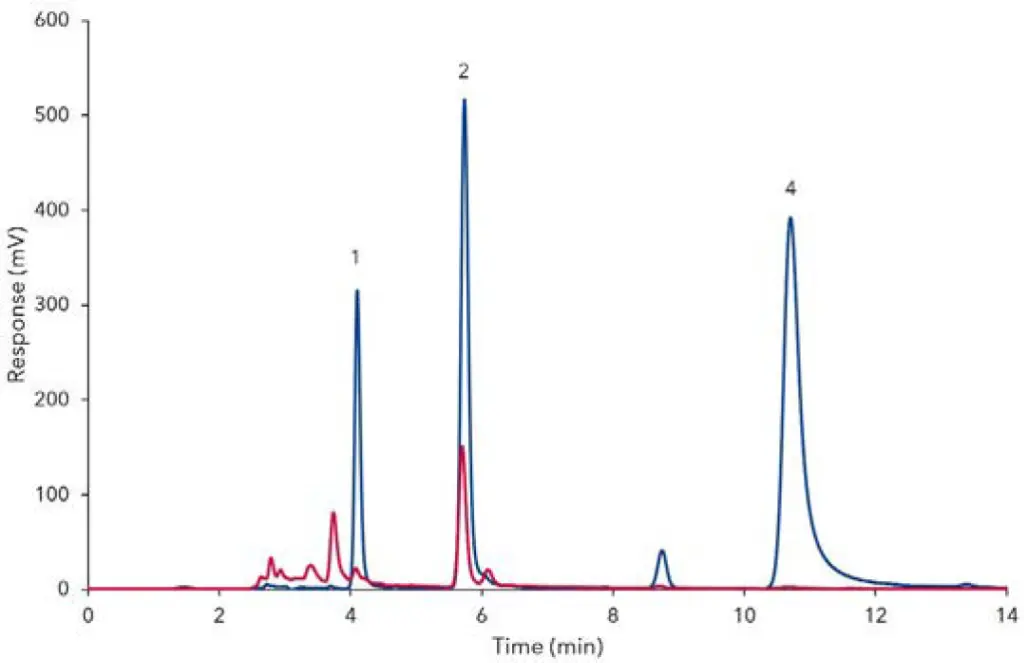
Fig. 1 Overlay of standard ZALF 5 (blue) and sample ZALF 6 (red), fluorescence detection, 1) ALT, 2) AOH, 3) TeA, 4) AME
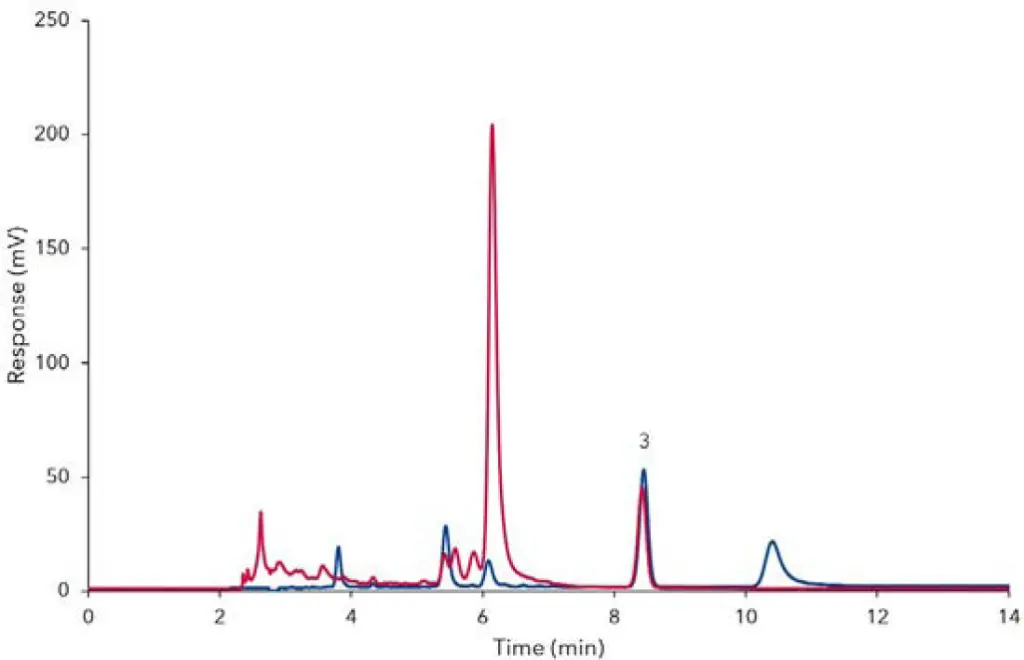
Fig. 2 Overlay of standard ZALF 5 (blue) and sample ZALF 7 (red), UV-detection, 3) TeA
Materials and Methods
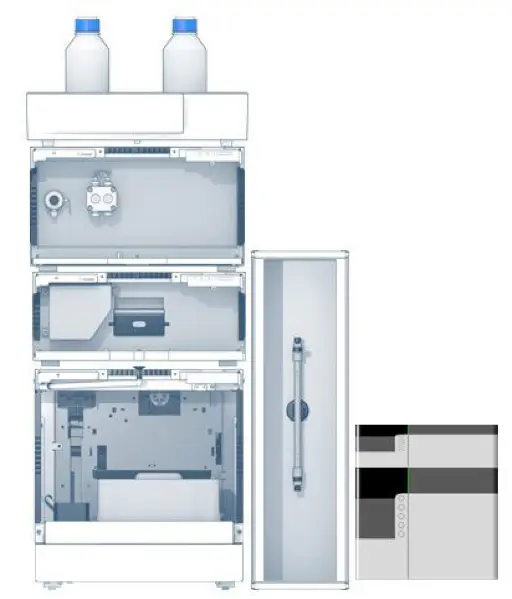
An AZURA® Analytical HPLC Plus system was used for this application. The system consisted of an isocratic AZURA P 6.1L pump, an AZURA AS 6.1L autosampler, an AZURA DAD 6.1L, an AZURA CT 2.1 column thermostat and a RF 20 Axs fluorescence detector in combination with CBM 20 A under the Chromeleon™ software. The isocratic method [2] was applied for 30 minutes at a flow rate of 1 mL/min with a mixture of methanol and water in a ratio 70:30 (v/v). Furthermore 300 mg/mL zinc sulfate were added to the mobile phase. The column temperature was set to 30 °C. The substances were measured with an excitation at 253 nm and emission at 415 nm. The UV detector was set 280 nm. The used column, in a dimension 250 x 4.6 mm ID with precolumn, was filled with Prontosil Hypersorb 120-5 ODS silica.
Conclusion
It was possible to identify and quantify all Alternaria alternata metabolites with the described isocratic method. Using a fluorescence detector for enhanced sensitivity allows measurements of small amounts of mycotoxins even in a complex sample matrix. There are currently no statutory or guideline limits set for Alternaria mycotoxins because surveys to date have shown that their natural occurrence in foods is low and the possibility for human exposure is limited. The need for regulation is kept under review as new information becomes available [3].
Additional Materials and Methods
Tab. A1 Method parameters
Tab. A2 System configuration
References
[1] https://www.romerlabs.com/en/knowledge-center/ knowledge-library/articles/news/alternaria-toxins/
[2] Dr. Marina Müller, Leibniz-Zentrum für Agrarlandschaftsforschung (ZALF) e.V.
[3] http://www.micotoxinas.com.br/altertoxins.htm
Related KNAUER Applications
VFD0158 – Zearalenone and its major metabolites – a simple isocratic method
VFD0152 – Determination of Aflatoxin in milk
Application details