
Science with Passion

Application No.: VFD0157 Version 1 07/2017
Simulated Moving Bed (SMB) – a powerful tool for continuous purification of xylitol
Y. Krauke, C. Benkhäuser, M. Lübbert, K. Monks; applications@knauer.net
KNAUER Wissenschaftliche Geräte GmbH, Hegauer Weg 38, 14163 Berlin
Summary
Simulated moving bed chromatography (SMBC) was applied for the purification of xylitol from fermentation mash of a fed batch culture. This process enabled to purify xylitol with nearly 100 % purity and recovery. Thus, allowing large scale purification of xylitol from biological xylose-xylitol conversion process.
Introduction
Within the European Valor Plus research project an alternative, biological way of xylose conversion was investigated. By using a Candida yeast strain, xylose from a hemicellulose hydrolysate was converted to xylitol. HPLC analysis of the fermentation mash revealed that the xylose to xylitol conversion was successful. Previous batch HPLC experiments (App. note VFD0155) indicated the potential to apply SMBC for this purification task. The separation was performed in isocratic mode on polymer based Eurokat columns and the target substance xylitol eluted at the end of the chromatogram, all factors enabling a SMB process. SMB chromatography is a continuous chromatography technique that separates binary or pseudo-binary mixtures into pure substances or fractions. Compared to traditional batch chromatography this process leads to higher yields of purified substances while consuming less eluent and packing material.
Results
For the set-up of a SMB process several parameters of the separation process had to be determined. First, separation at three different temperatures (40°C, 50°C, 60°C) was tested. Separation at 50°C gave the favourable results and was therefore chosen for the purification. Overload studies with a 1:2 dilution of the fermentation mash revealed a nearly baseline separation of xylitol and mannitol. The chromatogram was divided in the raffinate fraction (all but xylitol) and the extract fraction (xylitol) (Fig 1). A substance eluting with the dead time of the system was determined and therefore an open-loop set-up was chosen with a waste outlet. The retention times of the substances and column porosity were determined and used for the process set-up. Using these values and the PurityChrom® MCC software the flow rates of the pumps and different zones in the process were o btained (Fig 2). After six cycles, samples from the extract, raffinate and waste were collected and analyzed. A fast analytical method (add. results Fig A1) enabled a rapid evaluation of the process. A more detailed analysis revealed pure xyli tol in the extract without any no xylitol was in the raffinate or waste (Fig 3 blue/green lines). With this SMB process 1.8 g/h xylitol were purified with 100 % purity and recovery. The yield of the SMB process is greater by the factor of seven than that of the batch process.
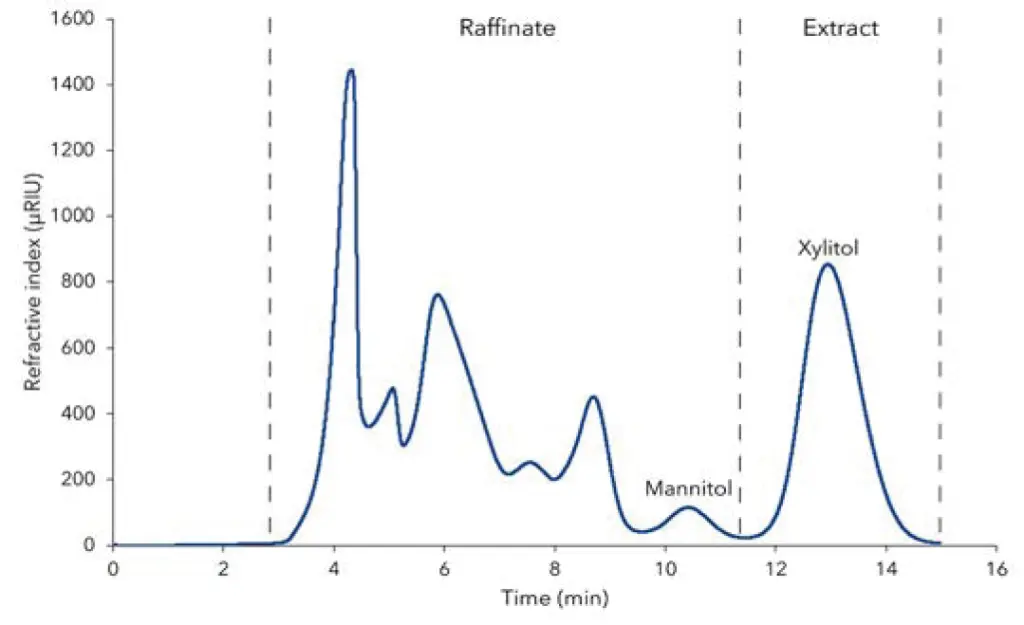
Fig. 1 Design of SMB process on chromatogram of fermentation mash with indication of the two fractions “raffinate“ and “extract“; 1 mL injection; Eurokat Ca 150 x 20 mm, 25 -56 µm particles; 4 mL/min; 50°C
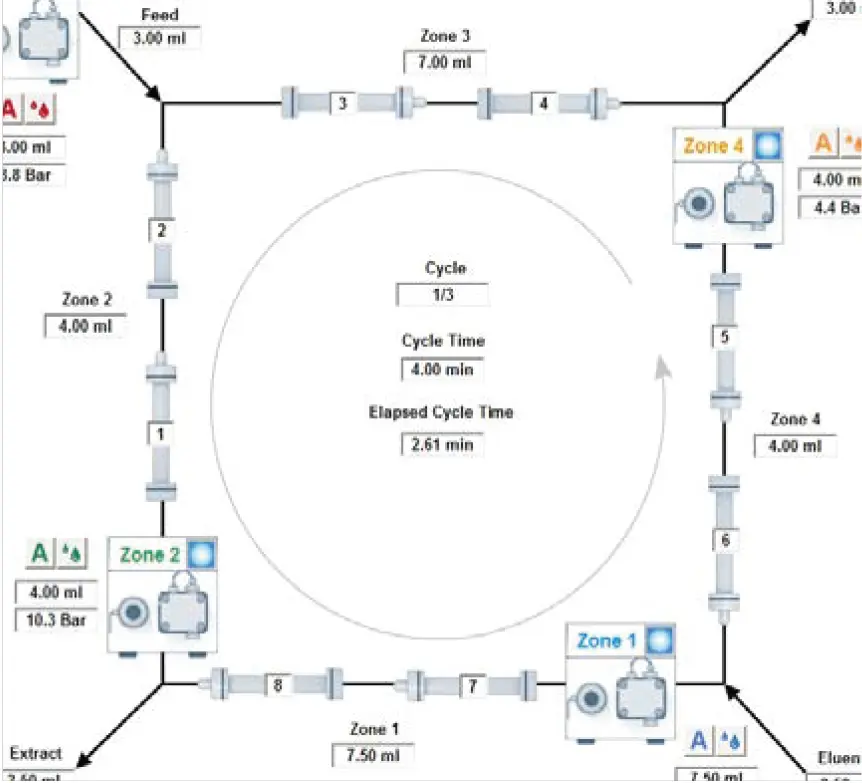
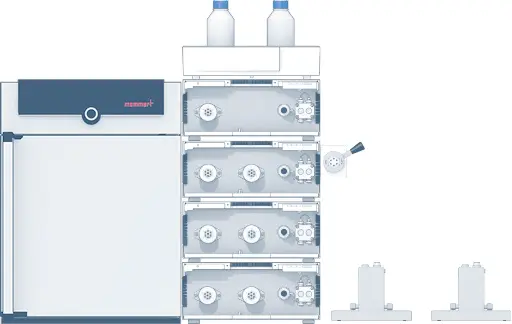
Fig. 2 Example scheme of the SMB process set-up with the four pumps, the out – and inlets, the 8 columns, four zones, indication of flow rates, pressure and cycle time; PurityChrom MCC software
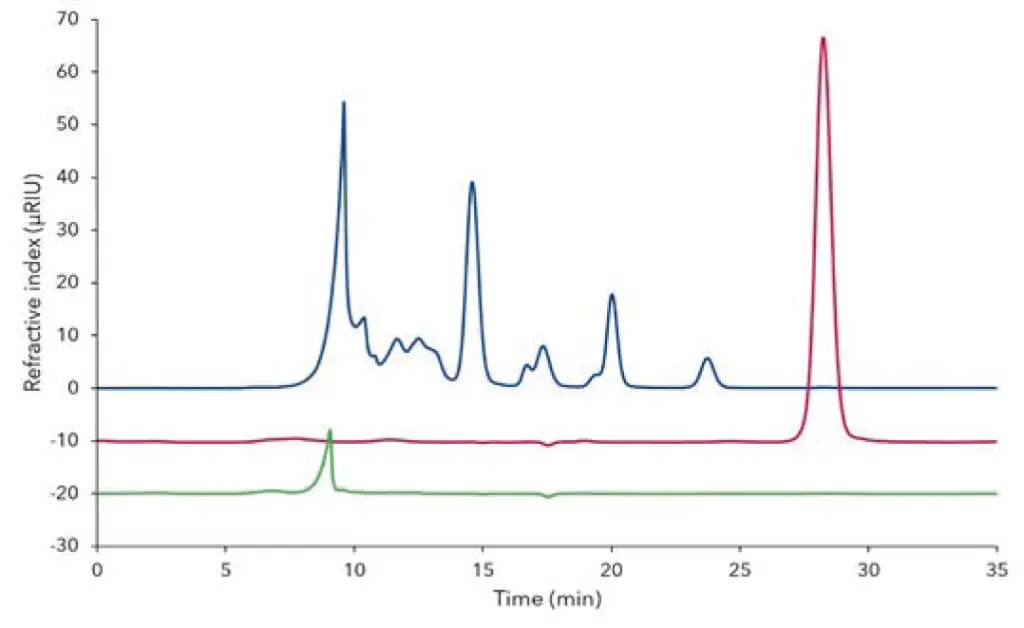
Fig. 3 Overlay of analytical chromatograms of raffinate/all but xylitol (blue), extract/xylitol (red) and waste (green) from the SMB pro-cess at the 6th cycle; 20 µL injection; Eu rokat Ca 300 x 8 mm + pre-column; 10 µm particles, 0.5 mL/min; 75°C
Materials and Method
The SMB standard configuration consists of four AZURA® Assistans ASM 2.1L with seven multiposition valves and four P 4.1S Pumps (10/50 mL/min). Flow was controlled with two CORI-Flow M13 flow meters and temperature with the SMB oven. Eight identical Eurokat Ca 150 x 20 mm columns (sulfonated cross-linked styrene-divinylbenzene copolymer) with 25-56µm particles were used for purification. Analysis was performed with Eurokat Ca columns 300 x 8 mm, 10 µm particles and dedicated analytical sugar system (VFD0151).
Conclusion
Xylitol was purified with high purity and yield from fermentation mash using the AZURA® SMB system. This purification process allows a significant higher throughput and thus yield of xylitol as classical batch chromatography. The actual throughput is limited by the concentration of xylitol in the original mash. The developed method is very robust and separation of two to four times more cencentrated mash should give same separation results.
Acknowledgement: This project has received funding from the European Union‘s Seventh Framework Program for research, technological development and demonstration under grant agreement no FP7-KBBE-2013-7-613802.


Additional Results
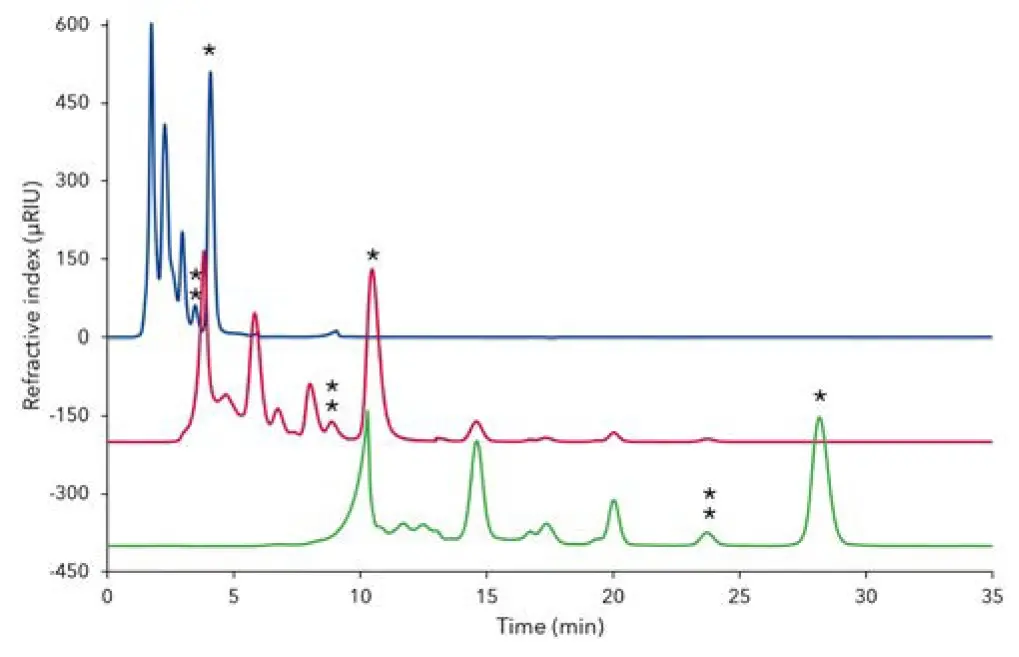
Fig. A1 Comparison of separation profiles of fermentation mash using Eurokat Ca columns with different length for a fast, analytical method; blue – 2 x 30 x 8 mm (0.7 mL/min), red (offset=-200) -120 x 8 mm (0.7 mL/min), green (offset=-400) – 300 x 8 mm (0.5 mL/min); 20 µL injection; 75°C; * – xylitol, ** – mannitol
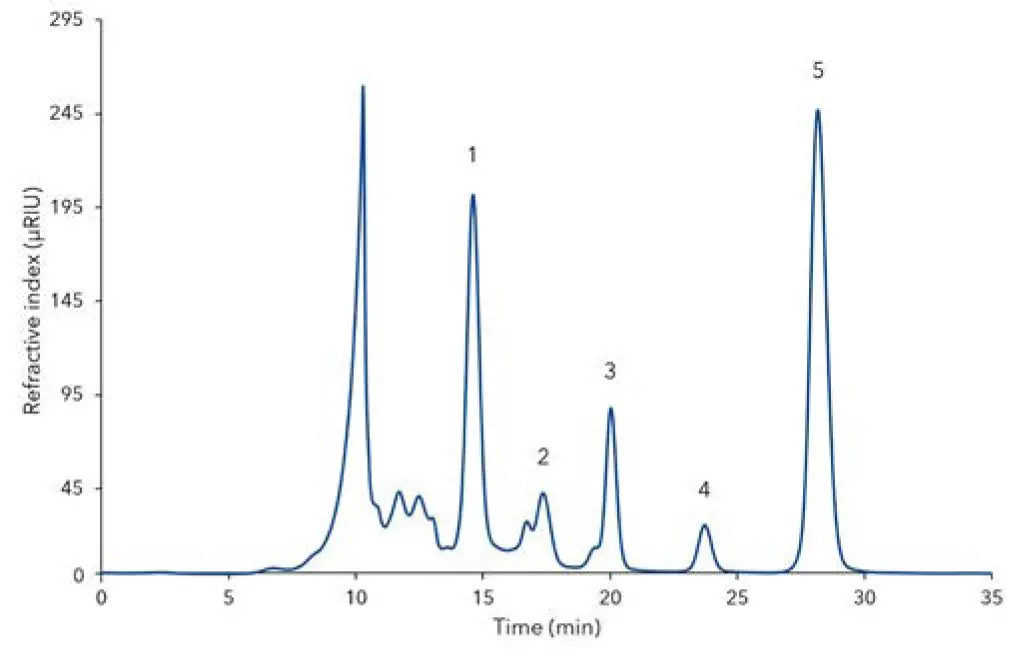
Fig. A2 Analytical chromatogram of fermentation mash showing five identified substances; 20 µL injection; Eurokat Ca 300 x 8 mm; 10 µm particles; 0.5 mL/min; 75°C; 1) xylose, 2) arabinose, 3) glycerol, 4) mannitol, 5) xylitol
Tab. A1 Results of data feed analysis presented as mean of four replicates with standard deviations indicated
Additional Materials and Methods
Tab. A2 Method parameters (SMB process)
Tab. A3 System configuration (for Analytical system, see VDF0155)
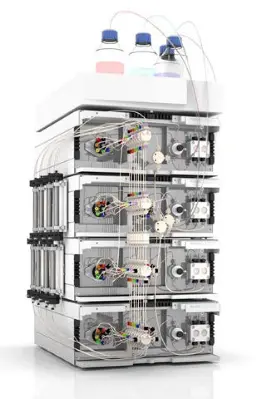
AZURA® Lab SMB System
Related KNAUER Applications
VFD0160 – Determination of sugars and natural sugar substitutes in different matrices
VFD0155 – Semi preparative xylitol purification with dedicated sugar purification system
VFD0150 – Alternative xylitol extraction via hplc purification from fermented biomass
VSP0013 – Simplified scale up for sugars with the AZURA RID 2.1L extended dynamic range option
Application details