
Science with Passion

Application No.: VFD0150 Version 1 09/2016
Alternative xylitol extraction via hplc purification from fermented biomass
Yannick Krauke, Hagen Schlicke, Matthias Luebbert, Kate Monks; applications@knauer.net
KNAUER Wissenschaftliche Geräte GmbH, Hegauer Weg 38, 14163 Berlin
Summary
A latest approach in bioethanol generation is the usage of yeast and bacteria that uses C5 sugars for fermentation and the valorization of bio refinery by products. Here it is shown that a hemicellulose-like fermentation mash has a high content of the artificial sweetener xylitol and that its purification by HPLC can be accomplished using polymer based Eurokat columns. The product is soluble in water and can easily be used for further applications.
Introduction
The second generation of bio refinery uses biomass with lower contents of C6 glucose and higher contents of C5 sugars. Besides ethanol generation its goal is the full usage of biomass by valorizing by products. Fermentation of C5 sugars with microorganisms result in mash that could be used for further applications.
Polymer based Eurokat columns were tested for their ability to separate fermentation mash and among them the Eurokat Ca column had the best separation profile. Analysis of the mash revealed high contents of xylitol. Purification of highly pure xylitol was established.
Results
The fermentation mash was analyzed on different columns (Eurokat Na, H, and Ca) to determine the optimal stationary phase. The Eurokat Ca column showed the best separation profile for xylitol Fig. 1 even though it has the longest run with about 28 min compared to Eurokat Na with 18 min and Eurokat H with 12 min (not shown). A more detailed analysis of the fermentation mash identified five components: xylose, arabinose, glycerol, mannitol and xylitol Fig. 1. Xylitol had the highest concentration with 80 mg/mL in the sample, followed by glycerol with 20 mg/mL.
The other three components had concentrations of 7–8 mg/mL Fig. 1. The baseline separation of xylitol indicated promising batch purification. Overload studies with a semi-preparative Eurokat Ca column were performed . This column has a three times higher volume (50 mL) than the analytical column (15 mL) and larger particle size (25–56 μm) enabling higher sample loading and faster flow rates with lower back pressure. The collected fraction of xylitol Fig. 2 had a purity of 99 %, measured with RI Fig. 3.
Sample analysis
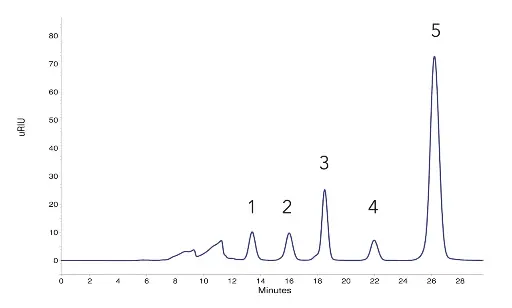
Fig. 1 Chromatogram of 1:10 dilution of fermentation mash 10 µL injection on Eurokat Ca; 1) xylose (8.2 mg/mL), 2) arabinose (8.3 mg/mL), 3) glycerol (21.0 mg/mL), 4) mannitol (7.0 mg/mL), 5) xylitol (80.6 mg/mL)
Batch purification
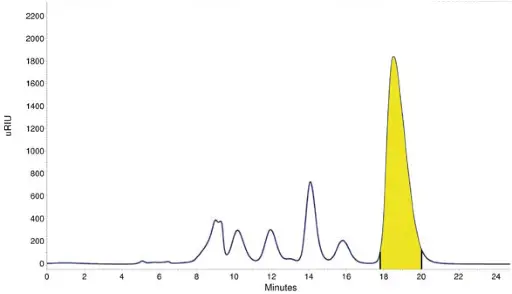
Fig. 2 Fractionation of xylitol from 1000 μL injection; yellow fraction area (9.5 mL)
Fraction analysis
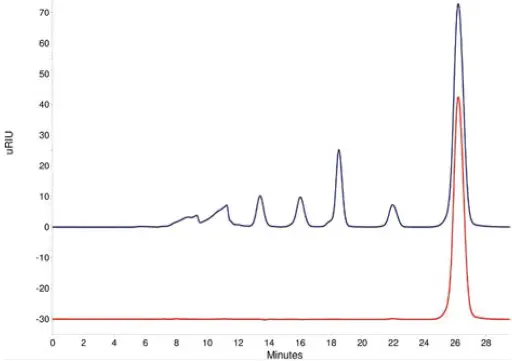
Fig. 3 Comparison of sample and fraction chromatograms; blue – sample, red – fraction from batch purification
Acknowledgement: This project has received funding from the European Union‘s Seventh Framework Program for research, technological development and demonstration under grant agreement no FP7-KBBE-2013-7-613802.

Materials and Method
Vogelbusch Biocommodities GmbH provided the fermentation mash that resulted from fermentation with yeasts of hemicellulose-like hydrolysate with high xylose content. The sample was filtered through 0.45 μm filter after centrifugation. A 1:10 dilution was prepared and analyzed. For calibration a mixture of xylose, arabinose, glycerol, mannitol and xylitol was prepared and six dilution steps from 15 mg/mL to 0.3 mg/mL prepared.zAnalytical runs were performed with KNAUER analytical Eurokat columns (300 × 8 mm) with integrated pre-columns (30 × 8 mm) with 10 µm particles at 75 °C running at flow rates of 0.5 mL/min using H2Odd as eluent. The KNAUER AZURA analytical HPLC system comprising of the AZURA P 6.1L HPG 10 mL pump, 3950 autosampler, AZURA DAD 2.1L diode array detector with high sensitivity KNAUER LightGuide cartridge flow cell, AZURA RID 2.1L refractive index detector, AZURA CT 2.1 column thermostat controlled by the OpenLAB® EZChrom Edition software was used. The puritifcation of xylitol was performed with KNAUER Eurokat Ca columns (250 × 16 mm) with 25–56 µm µm particles at 75 °C running at flow rates of 2.5mL/min using H2Odd as eluent. The KNAUER AZURA Preparative HPLC system comprising of the AZURA P 6.1L HPG 50 mL pump, 3950 autosampler (preparative version), AZURA RID 2.1L refractive index detector, AZURA CT 2.1 column thermostat controlled by the OpenLAB® EZChrom Edition software was used. The refractive index detector‘s Extended Dynamic Range (EDR) feature was used for preparative experiments.
Conclusion
The Eurokat Ca column was found to be the best column for analysis of fermentation mash among tested Eurokat columns. The used fermentation mash has a high content of xylitol (80 mg/mL). A semi-preparative batch purification of the xylitol resulted in high recovery (95 %) of xylitol with a purity of 99 %. Upscaling of the batch process or application of SMB (simulated moving bed) chromatography would be promising for xylitol production from fermentation mash.
Additional Results
The fermentation mash was separated on Eurokat Na and Eurokat H columns Fig A1. On the Eurokat Na column only three peaks were detected. The the Eurokat H column xylitol was also not baseline separated from the other substances. For the overload studies 50 µL to 1500 µL of the 1:10 dilution of the fermentation mash were separated on the Eurokat Ca column. Overlays of all the chromatograms show a shift in the early eluting phase (10–14 min) due to volume overload but less for xylitol Fig A2.
Column screening
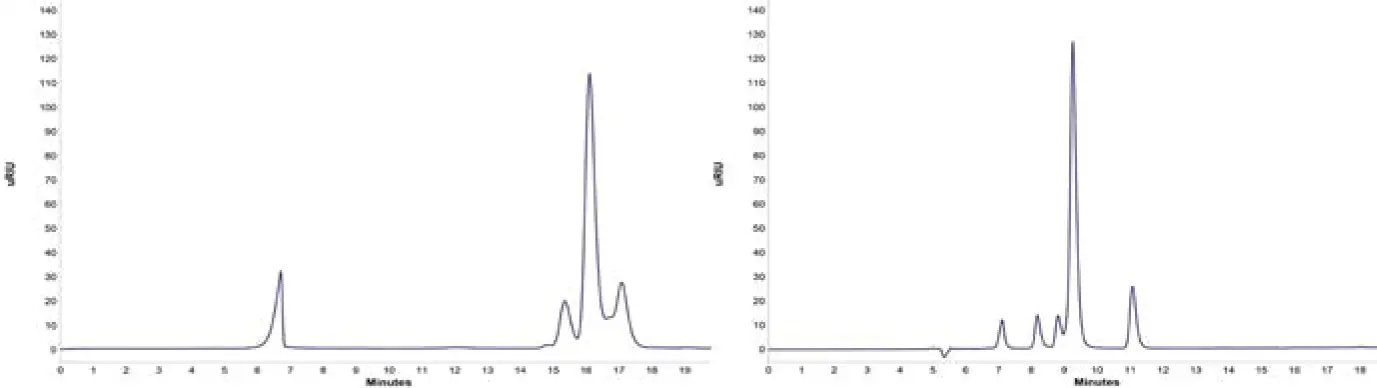
Fig. A1 Chromatograms of 1:10 dilution of fermentation mash; left Eurokat Na; right Eurokat H; 1 xylitol; 10 μL injection
Overload experiments
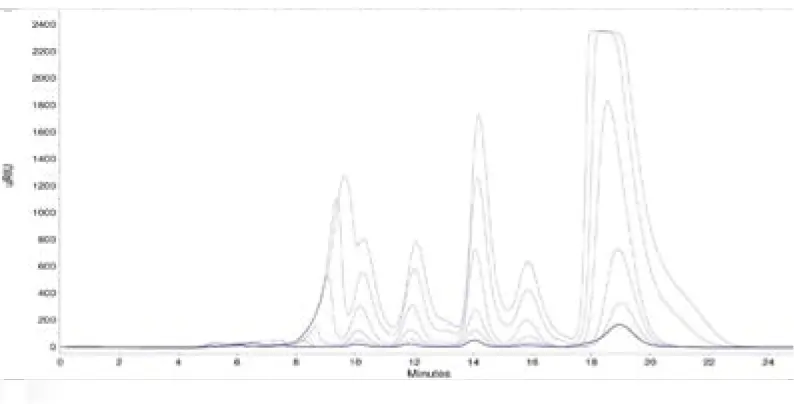
Fig. A2 Overload studies with semi-preparative Eurokat Ca and fermentation mash; 50 μL, 100 μL, 200 μL, 500 μL, 1000 μL, 1500 μL injection
Additional Materials and Methods
Tab. A1 Comparison of properties and method parameters of applied Eurokat columns
Tab. A2 System configuration
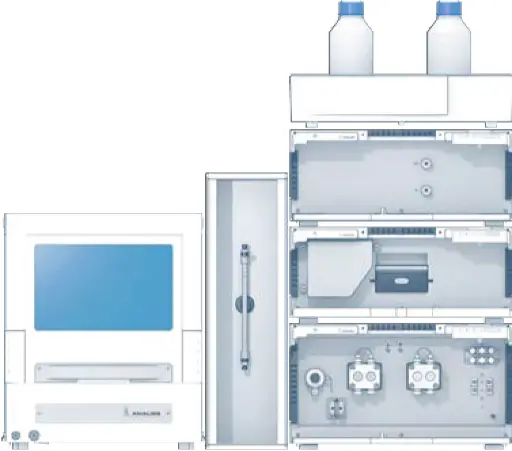
AZURA® Analytical system
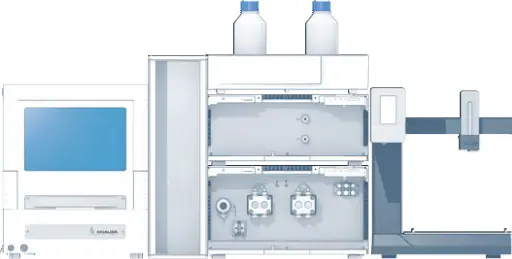
AZURA® Preparative system
Related KNAUER Applications
VFD0160 – Determination of sugars and natural sugar substitutes in different matrices
VFD0161 – Determination of sugars in honey using HILIC separation and RI detection
VFD0155 – Semi preparative xylitol purification with dedicated sugar purification system
VSP0013 – Simplified scale up for sugars with the AZURA RID 2.1L extended dynamic range option
Application details