
Science with Passion

Application No.: VPH0069 Version 1 02/2020
Analyzing cannabis flowers according to the German Pharmacopeia –monograph 2017
Lisa Loxterkamp, Kate Monks; applications@knauer.net
KNAUER Wissenschaftliche Geräte GmbH, Hegauer Weg 38, 14163 Berlin
Summary
Since the change in German law in 2017 (§1 Abs. 1, BtMG) [1] the need for reliable and robust HPLC methods for quality control has drastically increased. Six common cannabinoids of high medicinal interest cannabidiol (CBD), cannabidiolic acid (CBDA), cannabinol (CBN), Δ8-tetrahydrocannabinol (Δ8-THC), Δ9-tetrahydrocannabinol (Δ9-THC), and Δ9-tetrahydrocannabinolic acid (Δ9-THCA) were quantified using the AZURA® HPLC plus system according to the monography of German Pharmacopeia [2]. Three different reversed phase columns were screened for robustness for the method verified in the subsequent step. Method verification took place using authorized medicinal cannabis flower samples available on the market. The substances were analysed with the help of chemical reference standards.
Introduction
Cannabis sativa L. is one of the oldest agricultures and medicinal plant which produces a variety of compounds such as terpenoids, flavonoids and cannabinoids [3]. The interaction of cannabinoids with the body’s own cannabinoid receptors, which occur in a variety of brain cells for coordination, memory processing and spatial orientation, opens up new pharmacological and psychological treatment options [4]. Probably the most psychoactive cannabinoid of the four different isomers of Δ9-THC is the (-)-Δ9-trans-tetrahydrocannabinol, also known as dronabinol. In Germany, due to its psychoactive properties, Δ9-THC is controlled by the narcotics law (from the German Betäubungsmittelschutzgesetz (BtMG)). In March 2017, the regulations changed by the amendment of article 1 BtMG. The amendment of annexes II and III of the BtMG now allows cannabis such as marijuana plants and plant parts to be marketed and prescribed and are therefore authorised for medical purposes as ready-to-use medicinal products [1]. As cannabis is an approved medicine, production must be conducted and monitored in accordance with Good Manufacturing Practice (GMP) guidelines. In order to confirm this quality and to guarantee accurate labelling of medicinal products, food and cosmetics, the demand for standardized methods for the quantitative and qualitative determination of the ingredients especially the cannabinoids is increasing [6]. The quality assurance of the plants may be ensured by employing the German Pharmacopiea method DAB [1,5]. In this work, the HPLC method for cannabis flowers according to the DAB monography including robustness evaluation was carried out with the AZURA HPLC plus system.
Results
A combined mobile and stationary phase design of experiment (DoE) approach with the aid of the HPLC modelling software DryLab (Molnár-Institute, Berlin, Germany) was imployed. Investigated parameters were gradient time (tG), temperature (T), pH and the stationary phase of the column, producing the three dimensional spaces shown in Fig 1. The red areas in Fig 1 display the robust space of each column (critical resolution > 1.6), from which it is easily seen that the largest area is represented by the column C18P on the right. Due to the completely filled pH dimension, within a given temperature and gradient time, the column C18P shows a nearly unaffected pH stability for this method. Therefore, the column C18P was determined to be most robust and was therefore used for the further measurements. For the assignment of the analytes the resulting chromatogram of a standard mix from the six different cannabinoids with the concentration of 10 µg/mL is shown in Fig 2. The measurement of the cannabis flower bediol (Bedrocan, Veendam, Netherlands) with a dilution of 1 to 10 with ethanol is shown in Fig 3.
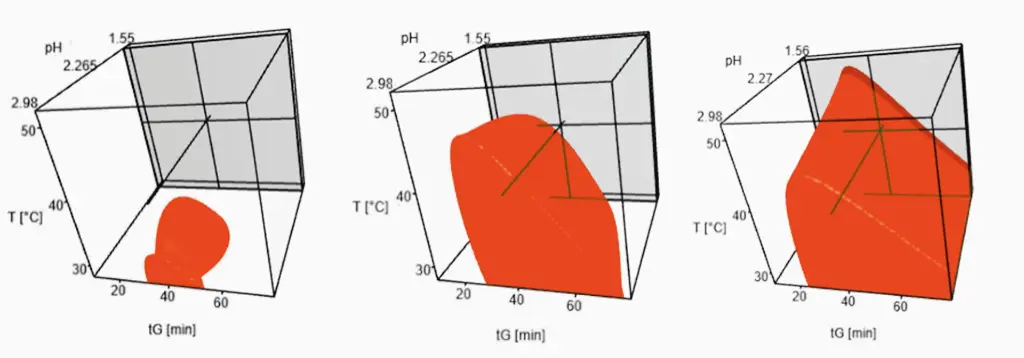
Fig. 1 Representation of the robust space using the tG-T-pH (30/90 min, 30/50°C, pH 1.6/2.2/2.8) with the columns C18 (left), C18H (center) and C18P (right), adjusted robust space level 1.6
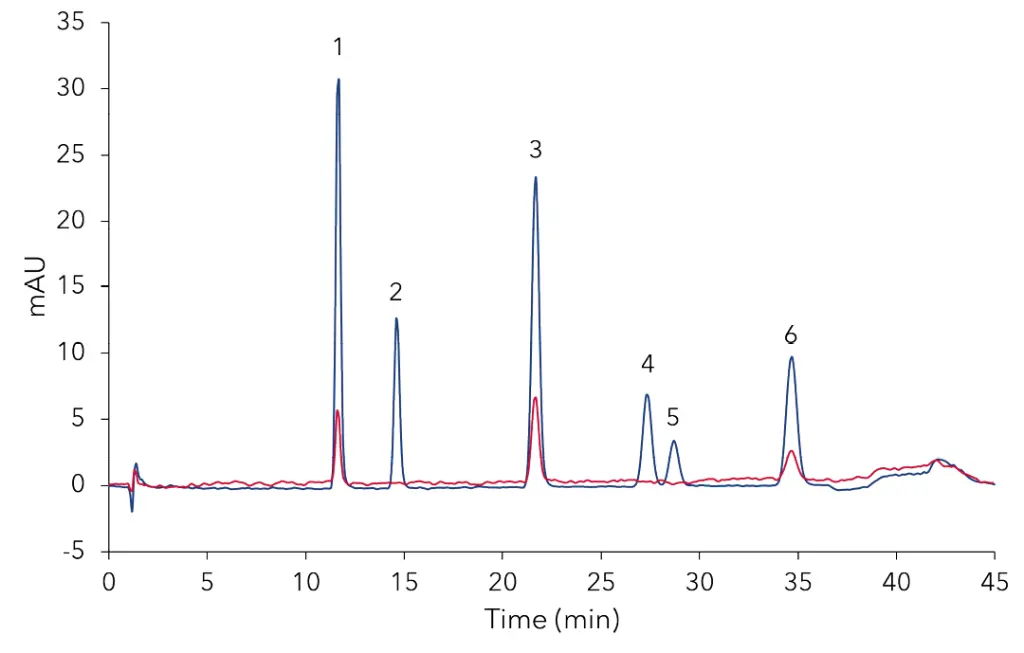
Fig. 2 Chromatogram of standard mix 10 µg/mL, R=1.5 between Δ8-THC and Δ9-THC; blue - 225 nm, red - 306 nm, 1 - CBDA, 2 - CBD, 3 - CBN, 4 - Δ9-THC, 5 - Δ8-THC, 6 - Δ9-THCA
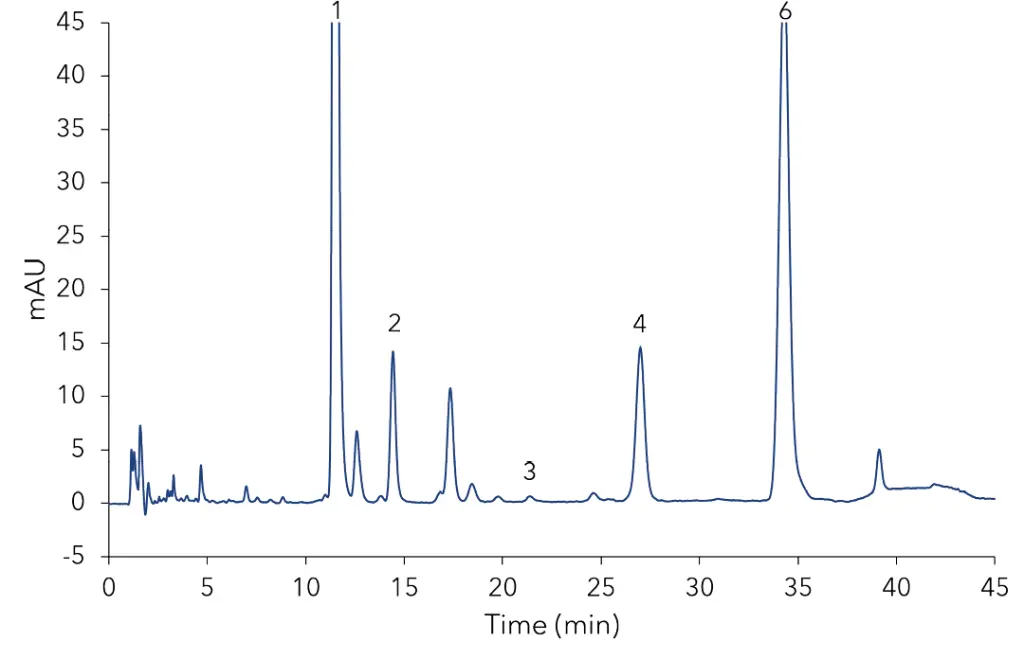
Fig. 3 Chromatogram of bediol sample 1 mg/mL in ethanol; 1 - CBDA, 2 - CBD, 3 - CBN, 4 - Δ9-THC, 5 - Δ9-THCA
Sample Preparation
The whole 5 g portion of bediol was grinded with a flower grinder. The difference between grinded and original bediol is shown in Figure 5. The sample preparation was performed according to DAB, where 500 mg substance was extracted three times with 15 mL ethanol on a laboratory shaker for 15 min with a following centrifugation at 5000 rpm for one minute. Mixing all the extracts within 50 mL measuring flask, a 1:10 dilution was carried out and measured with the HPLC system after filtrating over a 0.45 µm RC filter.
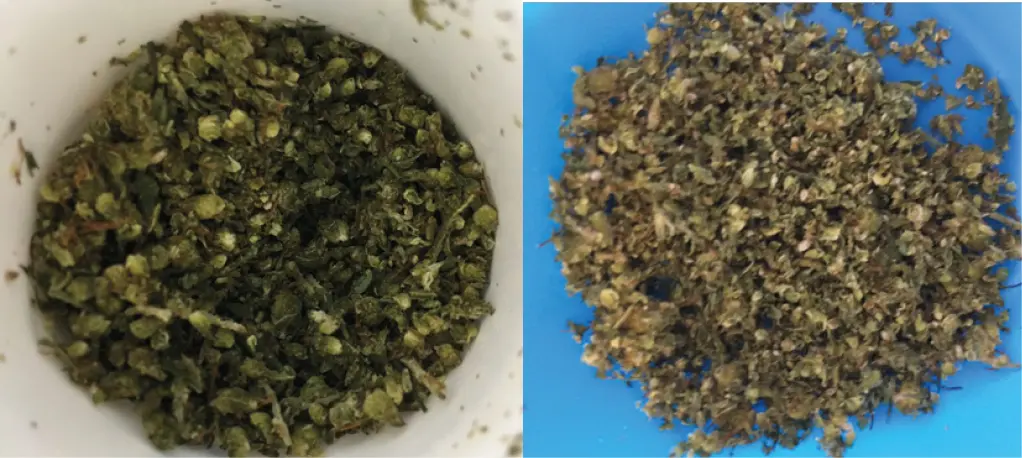
Fig. 4 Bediol sample (left original, right grinded)
Conclusion
A design of experiment combined with a column screening can be a helpful tool to determine the robustness of a method. With the help of the HPLC Modelling Software Drylab this could be tested within the three different columns with convincing results. The measured chromatograms show a sufficient separation of the six given cannabinoids according to DAB method. The specification of the DAB with a critical resolution of R>1.2 for the critical analyte pair Δ8-THC and Δ9-THC is confirmed with R=1.5 within the measurements. The sample measurement of bediol shows a sufficient assignment of the signals whereas the not identified signals can be assumed as matrix or not categorized cannabinoids. Additionally, the use of two different wavelengths shows a differentiation between the acid and neutral forms of the given cannabinoids. CBN also shows an absorption towards 306 nm due to the increased amount of conjugated systems compared to Δ8-THC and Δ9-THC.
References
[1] Gesetz über den Verkehr mit Betäubungsmitteln „Betäubungsmittelgesetz in der Fassung der Bekanntmachung vom 1.März 1994 (BGBI. I S.358), das zuletzt durch Artikel 1 der Verordnung vom 2. Juli 2018 (BGBI. I S.1078) geändert worden ist“. BtMG 1981
[2] Avoxa - Mediengruppe Deutscher Apotheker. Deutsches Arzneibuch 2017. Allgemeiner Teil, Monographien A-Z, Sachregister; Deutscher Apotheker Verlag, 2018
[3] Hoch, E.; Friemel, C.M.; Schneider, M. Cannabis. Eine Wissenschaftliche Bestandsaufnahme; Springer: Berlin, Heidelberg, 2018
[4] Grotenhermen, F. Endogene Cannabinoide und das Endocannabinoidsystem. In Handbuch Psychoaktive Substanzen; Heyden, M. von Jungaberle, H., Majic, T., Eds.; Springer Berlin, Heidelberg: Berlin, Heidelberg, 2018; pp. 411-420
[5] Guidline on Good Agricultural and Collection Practice (GACP) for starting Materials of Herbal Origin. EMEA/HMPFC/2468167/2005, 2006
[6] B.C. Smith. Inter-Lab Variation in the Cannabis Industry, Part I: Problem and Causes. Cannabis Science and Technology 2019, Vol 2 No 2
Material and Methods
Tab. 1 Standard solutions, structures and samples
Analyte | CAS | Purity/ | Manufacturer |
Cannabidiol (CBD) | 13956-29-1 | 1.0 mg/mL in MeOH | Cerilliant |
Cannabidiolic acid (CBDA) | 1244-58-2 | 99.1% (HPLC) | Sigma- Aldrich |
Cannabinol (CBN) | 521-35-7 | 1.0 mg/mL in MeOH | Cerilliant |
Δ8-Tetrahydro-cannabinol (Δ8-THC) | 5957-75-5 | 1.0 mg/mL in MeOH | Cerilliant |
Δ9-Tetrahydro-cannabinol (Δ9-THC) | 1972-08-3 | 1.001 mg/mL in MeOH | Cerilliant |
Δ9-Tetrahydro-cannabinolic acid (Δ9-THCA) | 23978-85-0 | 98.8% (HPLC) | Sigma- Aldrich |
Acetonitril | 75-05-8 | Gradient grade | Merck Millipore |
Ethanol | 64-17-5 | Gradient grade | Merck Millipore |
H3PO4 | 7664-38-2 | AnalaR 85 % | VWR Chemicals |
Tab. 2 Method parameters
Column temperature | 40°C |
Injection volumen | 10 µL |
Injection mode | Full loop |
Detection | UV 225 nm /306 nm |
Data rate | 10 Hz |
Tab. 3 Pump parameters
Eluent A | Water, HPLC grade (H3PO4 85% 8.64 g/L) | ||
Eluent B | Acetonitrile, gradient grade | ||
Flow rate | 1.0 mL/min | ||
Pump program | Time (min) | % A | % B |
0 | 35 | 65 | |
35 | 30 | 70 | |
37 | 20 | 80 | |
40 | 20 | 80 | |
42 | 35 | 65 | |
45 | 35 | 65 |
Tab. 4 System configuration
Instrument | Description | Article No. |
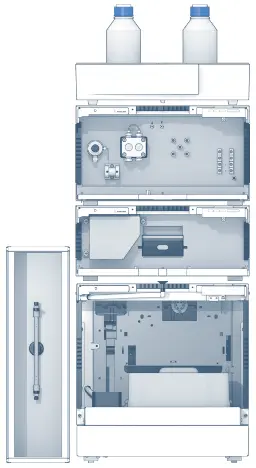
Pump | AZURA P 6.1L, LPG | |
Detector | AZURA MWD 2.1L | |
Flow Cell | 10 mm, 10 µL, Pressure Proof | |
Autosampler | AZURA AS 6.1L | |
Column thermostat | CT 2.1 | |
Column | Eurospher II 100-3 C18 P, Säule 150 x 4.6 mm Eurospher II 100-3 C18 H, Säule 150 x 4.6 mm Eurospher II 100-3 C18, Säule 150 x 4.6 mm | |
Software | Clarity Chrom 8.1 | |
HPLC modelling software | DryLab 4.3.4.2 | - |
Application details
Method | HPLC |
Mode | RP |
Substances | CBD, CBDA, CBN, Δ9-THC, Δ8-THC, Δ9THCA |
CAS number | 13956-29-1, 1244-58-2, 521-35-7, 5957-75-5, 1972-08-3, 23978-85-0 |
Version | Application No.: VPH0069 Version 1 02/2020 | ©KNAUER Wissenschaftliche Geräte GmbH |