
Science with Passion

Application No.: VBS0074
Version 1 02/2019
Comparison of ion exchange columns
Ulrike Krop, Kate Monks; applications@knauer.net
KNAUER Wissenschaftliche Geräte GmbH, Hegauer Weg 38, 14163 Berlin
Summary
Ion exchangers are used in a variety of protein purification protocols. This application compares equivalent columns, a weak and a strong anion exchanger as well as a weak and a strong cation exchanger from two different vendors. The columns were comparable in all assessed cases.
Introduction
Ion exchange chromatography is a powerful technique to separate proteins and is therefore used in numerous purification protocols. The column resins are modified by covalently bound functional groups. The choice of column modification influences the selectivity of the column. According to the charge of the protein cation or anion exchange chromatography is the best method. In this application equivalent columns with different modifications from two vendors were compared.
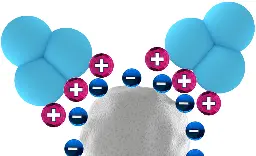
Principle of cation exchange chromatography
Results
Cytochrome C (pI 10.3), Lysozyme (pI 11.35) and Ribonuclease A (pI 9.6) are proteins with relatively high pI values, which make them ideal candidates for cation exchange chromatography (Fig 1 & 2) while for anion exchange chromatography Conalbumin (pI 6.8), α-Lactalbumin (pI 5.8) and soy bean Trypsin inhibitor Cytochrome C (pI 4.5) were used (Fig 3 & 4). All sample mixes bound under low salt conditions to the resin and eluted under increasing salt concentrations. Identical protein mixes and method parameters were used for the comparison of the two vendors of weak and strong anion and cation exchangers. The peaks for the protein separation are comparable in all evaluated cases.
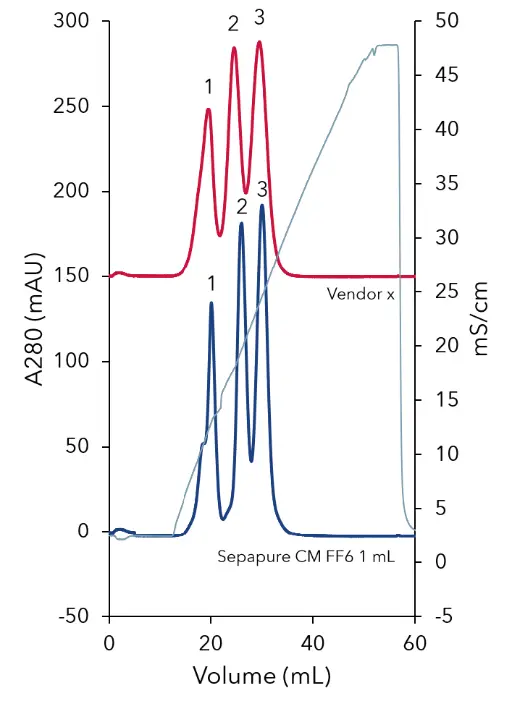
Fig. 1 Chromatograms of the separation of Ribonuclease A (1), Cytochrome C (2), and Lysozyme (3) with weak cation exchange chromatography columns, blue line: Sepapure CM FF6 1 mL, red line: comparable column from vendor x, grey line: conductivity signal
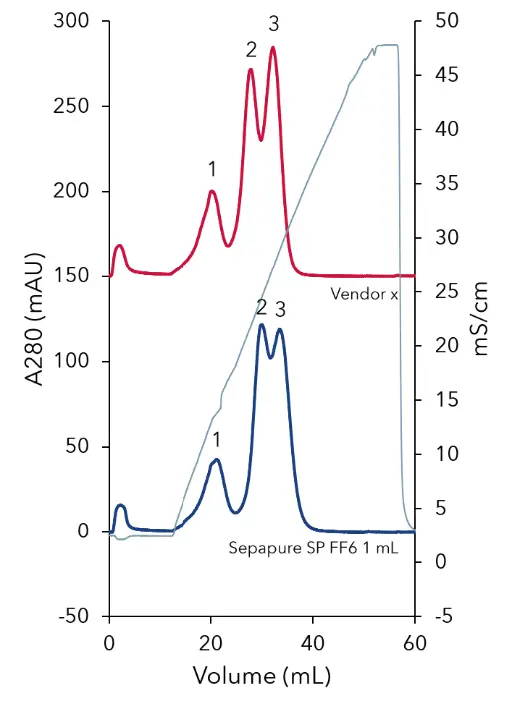
Fig. 2 Chromatograms of the separation of Ribonuclease A (1), Cytochrome C (2), and Lysozyme (3) with strong cation exchange chromatography columns, blue line: Sepapure SP FF6 1 mL, red line: comparable column from vendor x , grey line: conductivity signal
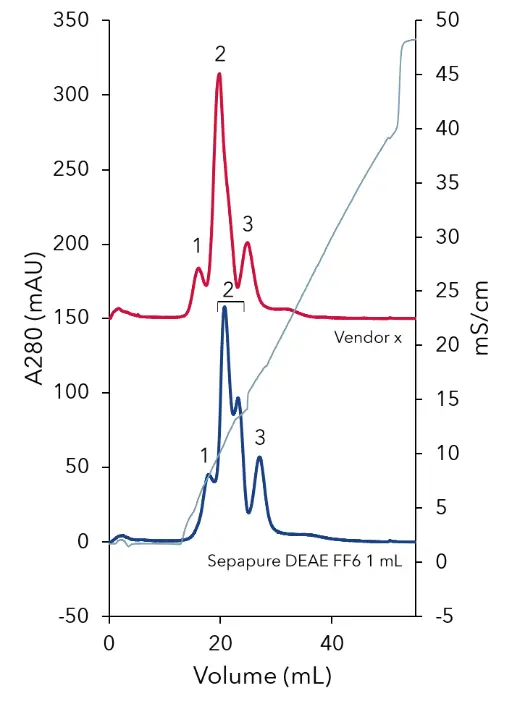
Fig. 3 Chromatograms of the separation of Conalbumin (1), α-Lactoalbumin (2), and soy bean Trypsin inhibitor (3) with weak anion exchange chromatography columns, blue line: Sepapure DEAE FF6 1 mL, red line: comparable column from vendor x, grey line: conductivity signal
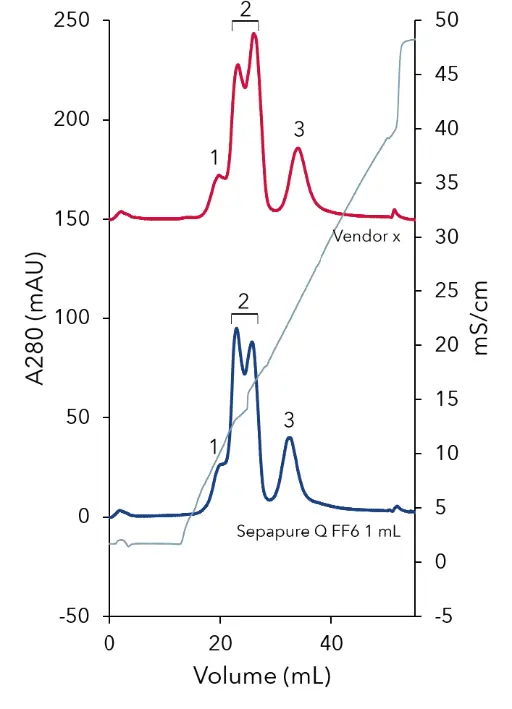
Fig. 4 Chromatograms of the separation of Conalbumin (1), α-Lactoalbumin (2) and soy bean Trypsin inhibitor (3) with strong anion exchange chromatography columns, blue line: Sepapure Q FF6 1 mL, red line: comparable column from vendor x, grey line: conductivity signal
Materials and Methods
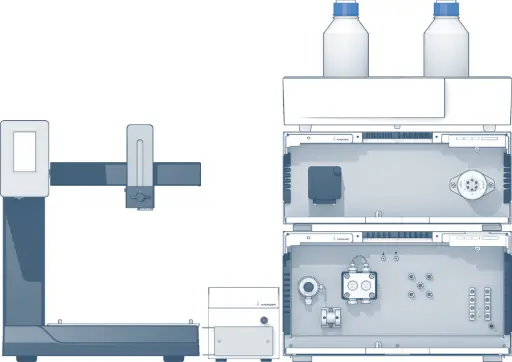
In this application, an AZURA Bio purification system consisting of AZURA P 6.1L LPG metal-free pump with 10 mL pump head; AZURA ASM 2.1L assistant module with an injection valve and a single wavelength UV detector UVD 2.1S; AZURA CM 2.1S conductivity monitor and Foxy R1 fraction collector was used. For cation exchangers a mix of Cytochrome C (0.4 mg/mL), Lysozyme (0.4 mg/mL), and Ribonuclease A (1 mg/mL) was used. For anion exchangers a mix of Conalbumin (0.2 mg/mL), α-Lactalbumin (0.4 mg/mL), and soy bean Trypsin inhibitor (0.6 mg/mL) was used. Prior to the run the 1 mL columns (Sepapure SP, CM, Q, DEAE and the equivalent columns from vendor x) were equilibrated in buffer A (for cation exchangers: 20 mM Sodium phosphate buffer pH 6.8; for anion exchangers: 20 mM Tris/HCl pH 7.4). 2 mL of the sample was injected with a flowrate of 1 mL/min. The columns were washed with 10 column volume (CV) of buffer A to remove all unbound protein. The proteins were eluted with a linear gradient over 40 CV up to 50 % buffer B (20 mM Sodium phosphate buffer pH 6.8, 1 M NaCl) for the cation exchangers or up to 40 % buffer B (20 mM Tris/HCl pH 7.4, 1 M NaCl) for the anion exchangers. The proteins were detected at 280 nm and conductivity signal was recorded to monitor the salt gradient.
Conclusion
Four different ion exchange columns types (SP, CM, Q, DEAE) from two vendors were compared. The equivalent columns were evaluated under identical conditions. The chromatograms of the protein separation are comparable in all assessed cases. The alternative columns can be considered as a replacement.
Additional Materials and Methods
Tab. A1 Method parameters for cation exchange chromatography runs
Tab. A2 Method parameters for anion exchange chromatography runs
Tab. A3 System configuration
Related KNAUER Applications
VBS0070 – Ion Exchange Chromatography with AZURA® Bio purification system
VBS0071 – Comparison of two column sets for antibody purification in an automated two step purification process
VBS0072 – Separation of proteins with cation exchange chromatography on Sepapure SP and CM
VBS0073 – Separation of proteins with anion exchange chromatography on Sepapure Q and DEAE
Anwendungsdetails